Posts by Dr. Boli
FROM THE ILLUSTRATED EDITION.

UNRAVELING A MYSTERY OF PEDANTRY.
Are you ready for the introduction? Here it comes.
The computer keyboards we all use—whether on phones, on tablets, on laptops, or on desktop computers—are priceless historical documents. They preserve layers of history going back a century and a half to the Sholes and Glidden typewriter, which introduced the QWERTY keyboard. The staggered arrangement of keys, which line up in rows but not in columns, comes from the mechanical necessity of running a type lever from the key to the typebar.
Each subsequent advance has left its mark on our keyboards. The Remington 2 gave us the shift key, so we could have lower-case letters. Backspace keys came later, along with tabulators for typing in columns. The more expensive electric typewriters introduced a carriage-return key, which returned the carriage to the beginning of the next line.
Computers added characters useful in various computer activities—backslashes, brackets, backticks, tildes, and sundry alternate, option, command, function, and control keys. The Macintosh keyboard was the last important development of the computer keyboard, which means that our keyboard layouts were frozen in the 1980s. Touch-screen keyboards are a step backwards in many ways, often making use of the double shift that was popular on portable typewriters a hundred years ago but mostly extinct by the 1930s.
You will notice that at no point in this development from typewriter through computer did the keyboard go through a typesetting stage. This is an important observation: our keyboards were never meant for setting finished text. Typesetting was a separate discipline from writing. In fact there were separate lines of development in keyboards for typesetting, as for example the Linotype and Monotype keyboards. Like Homo neanderthalis, they were stockier, perhaps a little clumsier, and excellently adapted for their task; and like that unfortunate side branch of the human family, they were displaced by their more generalized cousins. We might say that the Macintosh keyboard, with its awkward but serviceable key combinations for proper typographic characters, retains a small percentage of Neanderthal DNA; but on the whole the typesetting keyboard is an extinct dead-end in keyboard evolution.
Thus we have been stuck with a series of clumsy compromises, which have led to a series of clumsy adaptations. For quotation marks and apostrophes, it saved a key—and all the mechanics that went with it—to invent a character that would sort of do, if you weren’t too fussy, for both opening and closing single quotes and apostrophes. Likewise with double quotes. Two hyphens would have to do for an em dash. We have kept those clumsy compromises on our computer keyboards of today.
But typeset text looks amateurishly awful with typewriter quotation marks and apostrophes and double hyphens for em dashes. So our software tries to guess which of the various possibilities we really mean when we press that apostrophe key. Is it really an apostrophe? If it’s at the beginning of a word, we’d better make it an opening quotation mark. That’ll make ‘em happy. This algorithmic substitution is usually called “smart quotes” or some similarly silly name.
And now, finally, we come to the little mystery of pedantry we mentioned at the beginning of the article.
For many years, LibreOffice Writer—the word processor on which Dr. Boli depends when he needs a full-scale word processor—installed by default with a curious inconsistency. It would correct typewriter quotation marks to proper printed quotation marks—but it would leave typewriter apostrophes alone. (This default was finally changed a couple of years ago.) Of course you could change this behavior in the preferences, but why was it ever set that way in the first place? Dr. Boli had always assumed it was an unaccountable oversight.
But the truth seems to be otherwise. It appears that, among the sort of people who write code for that kind of software, there is some kind of urban legend that a proper apostrophe is the typewriter apostrophe. The printed apostrophe is a closing single quotation mark. This is just the sort of pedantic distinction that easily gains traction among people whose livelihoods depend on pedantic distinctions—after all, using exactly the right character makes the difference between your program compiling and your compiler blowing a raspberry at you. The mere fact that it happens to be completely wrong does not prevent the pedantic distinction from taking firm root in the minds of the susceptible.
The subject came up when Dr. Boli was reading the reference manual for an academic writing tool called Madoko, which was written by a Microsoft engineer and is still kindly maintained on line by Microsoft, probably in a fit of forgetfulness, since it has not been seriously updated for five years. In the section on smart quotes, our engineer points out how much care he has taken to get the apostrophes right:
Madoko will only smart quote single quotes if the last quote is not directly followed by a letter. This often prevents wrong quotation with words like “can't”:

   ‘really, I can't do this’, he said. I can't and mustn't do this.
Yes—if he had not put that extra work into the processing of the single quotes, those apostrophes might have come out looking the same as a closing quotation mark.
Dr. Boli himself has long since given up on the idea of allowing software to decide how to distribute apostophes, quotation marks, dashes, and so on. He uses a keyboard layout with key combinations for all those characters, and after nearly thirty years of using the same layout, his fingers naturally find their way to those combinations.
But it pleases him to discover this strange little urban legend circulating through the coding community. He feels like an entomologist who has discovered a new species of small black insect. To him it is an object of delight and fascination, even if the rest of the world thinks it’s just a bug.
IN BUSINESS NEWS.
TONIGHT ON DUMONT.
Vice-President Harris talks about that time somebody recognized her on the street.
Rollo, the Calculating Poodle, prepares Alan’s quarterly estimated tax payment.
Bozar the Clown, appearing on Zoom from an undisclosed location, makes popovers in the shape of the Temple of Vesta.
Teenie Sparkle, host of the popular children’s program Sparkle Park, tells Alan what she really thinks of those sniveling brats.
Enoch Witherburton and His Not Labeled for Individual Sale Orchestra play the Century III Chevrolet jingle.
Tune in tonight: 8 p.m., or 9:26 p.m. Central, because deliveries are slow these days.
From DR. BOLI’S ENCYCLOPEDIA OF MISINFORMATION,
Third Series.

Virginia.—Technically, the original charter of Virginia has never been abrogated, which makes Pennsylvania, Ohio, North Carolina, Michigan, British Columbia, Alaska, and Russia, as well as a number of other jurisdictions, provinces of the Commonwealth of Virginia. The incoming Virginian administration is already making plans to appeal to the United Nations for a return of the occupied territories.
LETTER TO THE EDITOR.
Sir: Isn’t it about time something was done about evil in the world? When we elected a new mayor, I fully expected that evil would be eliminated from the city at least, although an energetic mayor should be able to use his influence as the elected head of the largest municipality in the tri-state area to suppress evil in the suburbs as well. Yet just this morning I had to wait more than twenty seconds to get around a car that was double-parked on Smithfield Street in front of that café at the end of the bridge. If double-parking is not evil, then I do not recognize evil when I see it.
The mere fact that he has not technically taken office yet should not have been enough to discourage our mayor from tackling the evil problem. Again, a truly energetic mayor-elect should have been able to take the reins and rule by decree without waiting for a mere ceremony. If our new mayor were truly dedicated to the suppression of evil, there would be concentration camps for double-parkers by this point. People with loud stereos would be drawn and quartered, and the heads of speeders in school zones would be displayed on pikes in front of the Department of Public Education as a valuable lesson to young drivers. This is what a world without evil would look like to me.
Since, however, the mayor sees fit to sit on his hands and do nothing, at least until his so-called “inauguration,” my only option is to take active steps myself. I have accordingly decided to move to another city where the problem of evil is addressed with more resolution. I understand that Pyongyang takes a very proactive approach in preventing evil, and as an added incentive its metro system is famously well decorated. I shall be moving to Pyongyang, and if things go well there you will never hear from me again.
Sincerely,
Corwald A. Blotch,
President,
The Goodness League of Western Pennsylvania.
Advertisement.

PLEASE LISTEN CAREFULLY.
If you know your party’s extension, you should have dialed it directly and you are a very bad person.
To insult us in Spanish, oprime el ocho.
To complain about overly complex and confusing menu systems, press 1, followed by the pound sign. Do not press the pound sign for any other purpose.
To complain about ignorant or untrained telephone representatives, press 2.
To complain about know-it-all telephone representatives who think they’re so smart, press 3.
To complain about on-hold music that is too loud, too repetitive, or too abrasive, press 4.
To complain about on-hold music that is beautifully and expressively played being interrupted by our telephone representative, press 5.
To complain about telephone representatives with foreign accents, press 6 and let’s see how well you can speak their language.
To complain about the fact that our menu options change every four days, press 7.
To complain about the weather, hang up and dial the National Weather Service.
To call our ancestry or familial relationships into question, press 8. This will get you the Spanish operator, but we suspect that it will not make much difference to you at this point.
To repeat this message, write it down on a piece of paper, and then recite it in your best imitation of our robotic tone of voice.
ASK DR. BOLI.
Dear Dr. Boli: What’s up with this “critical race theory” I keep hearing people yammering about? —Sincerely, Jim France, Chairman and CEO, NASCAR.
Dear Sir: When Dr. Boli first heard the term “critical race theory,” he had a strong negative reaction. The phrase contained three words each of which separately makes him feel physically ill; together, they must add up to something dire.
However, once he had looked into this notion, he discovered that most of its proponents seemed to believe that the United States was founded by racists whose main concern was to institutionalize the subjection of the African. This is certainly true, and if children are not being taught such obvious truths in school then there is something seriously wrong with our schools.
They should also be taught that this country was founded by abolitionists who thought that slavery was a sin that cried to God for justice and would bring divine wrath on the nation if we did not eliminate it forthwith.
And they should be taught that this country was founded by moderates who thought that slavery was, in the abstract, sort of a bad thing, but what can you do?
The fact is that our Founding Fathers could hardly agree on anything, There is no such thing as an idea that was common to all our Founding Fathers, except the notion that, at all costs, we must keep the government out of the hands of those other Founding Fathers, whose ludicrously dangerous and fantastical philosophy would drive us straight to perdition. Thus our government was instituted as a series of absurd compromises, like the Electoral College and the “three-fifths” rule, that would have made Solon and Lycurgus collapse in fits of giggles.
Dr. Boli calls this view of American history “Slippery Mess Theory,” and he believes that every American child ought to learn it from a very young age. You, Mr. France, as an influencer in certain circles, could do much to bring about that desirable outcome. Simply persuade the persuasible that they must gather outside state capitols, county courthouses, truck stops, and other centers of culture, holding signs and shouting slogans against Slippery Mess Theory. By the fundamental laws of human psychology, this will cause every American child to want to learn all there is to know about Slippery Mess Theory, and the goal will be accomplished without any special effort on the part of teachers, who have had a rough year.
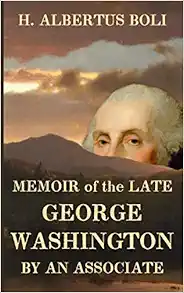
The inside story of the birth of our country can be found in the only reliable biography of George Washington: Memoir of the Late George Washington by an Associate, available now wherever obscure paperback books and ebooks are sold.
MEMORANDUM.
To: All Employees
From: The President
Re: Thank You to Essential Workers
All of us here at the Schenectady Small Arms & Biscuit Co. are aware of how deeply the pandemic has affected our lives. Sales of our cookies and artificially cheez-flavored crackers rose to unprecedented levels, as Americans sought comfort and consolation in packaged snack foods. Our stock value rose by 152%, making my own stock options, which were fortunately backdated to 1843, extraordinarily valuable. Your executives and board members have prospered as never before, and of course we have done our duty as Americans by pouring that money back into the economy, causing a significant uptick in orders for the gilded-lawn-statuary industry.
All this is possible through the heroic efforts of our valuable essential workers. Even in the worst of the pandemic, you kept at your jobs, or were brought back to them by the local police under certain emergency powers which my wife’s nephew the sheriff assures me were totally constitutional. Many of you paid a high price for your loyalty. At one point in the middle of last year, our factory boasted the highest infection rate in North America, an accomplishment we bested only a month later when we beat out our own Brazilian division for the highest infection rate in the Western Hemisphere. It must be candidly admitted that our workplace-safety team dropped the ball here, owing to a trivial misreading of CDC guidelines on workstation separation. Who knew that a single tick mark could make the difference between feet and inches?
Yet in spite of the high infection rate, you all worked long hours, loyally remaining at your stations, and once again I should like to thank my wife’s nephew Bud for that.
Now that we have come through the worst of it, the economy is booming, and our market position is more secure than ever. It seems to me, therefore, that it is high time we rewarded the essential workers whose labor made all this prosperity possible. Accordingly, you will be happy to know that I have directed our graphic-design department to produce a 16-by-20-inch poster with the slogan “HEROES WORK HERE” in Helvetica Light type on a white background. (We chose Helvetica Light because it makes a more efficient use of limited ink resources.) A copy of this poster will be displayed on the wall opposite every single production line to show our brave essential workers how much their contributions are valued. After all your hard work and dedication, it’s the least your management team can do.
With warmest regards,
J. Rutherford Pinckney,
President