Posts by Dr. Boli
DR. BOLI’S ENCYCLOPEDIA OF DOG BREEDS.
No. 1.—The Aardhond.
The Aardhond is unique to the veldt in South Africa. Every year, as the dry season advances, the parched earth cracks and crumbles into dry clods, which begin to wander toward the sea in search of water. It would, of course, be a catastrophe for the farmer if all the earth on his hard-won land wandered away to join the navy, and it is the work of the energetic and intelligent Aardhond to herd the clods and direct them back to the fields where they belong.
Aardhonden kept as pets in the city generally have few behavior problems, but they often have difficulty dealing with potted plants and may require anxiety medication if indoor gardening is your hobby.
ASK DR. BOLI.
Dear Dr. Boli: What should I do to prepare for the coming artificial-intelligence apokalypse? I have already started spelling words of Greek derivation with a K instead of a C, but I was wondering whether there was anything else I should be doing. And what about zombies?—Sincerely, Dr. Ada Lovelace Turing Berners-Lee Smith, Professor of Computer Science, Duck Hollow University.
Dear Madam: Dr. Boli believes far too much of our limited capacity for worry is wasted on the imaginary threat of artificial intelligence. Long before artificial intelligence becomes a threat, the world will already have been conquered by artificial stupidity.
How many times have you been told that the computer made an error, and all we can do is adapt? The price on the sign is that, but the price in the computer is this. The office is supposed to be open now, but the computer won’t be up until 9:30. The gasoline is supposed to flow downhill through this pipe, but the computer won’t open the valve. The computer has your name spelled wrong, so if you could just sign it this way…
All these things happen because the computer is a convenient excuse for laziness. I would do my job, says the lazy clerk, but the computer won’t let me. I could correct your name in the file, but I don’t have access to that function. I could open the office now, but then I might have to write things down on paper and enter them in the database later. I could sell it to you at this price, but then I’d have to call a manager, or worse yet take personal responsibility for a decision.
The comforting lie that the computer is in control and there is nothing we can do about it spares a lot of people a lot of work. But the lie has consequences. We have seen recently in other fields that, if you repeat a lie for a generation, you raise a generation that believes the lie. The generation that remembers when computers were new is passing. The generation that has never heard anything but the lie is taking control. That generation actually believes that the computer is God.
Human beings are still in control of what the computers are allowed to do. But we are institutionalizing our laziness so thoroughly that the next generation will be unable to break out of it.
Therefore, Professor, you should be preparing for the artificial-stupidity apocalypse. Buy yourself a manual typewriter and a bicycle, and learn to chop wood and save seeds, and you should be fine.
As for the zombies, they are traditionally said to feed on brains, so Dr. Boli confidently predicts that they will all quickly starve to death and leave us nothing more to worry about from that quarter.
FROM THE ILLUSTRATED EDITION.

DR. BOLI’S ALLEGORICAL BESTIARY.
No. 26. The Raven.
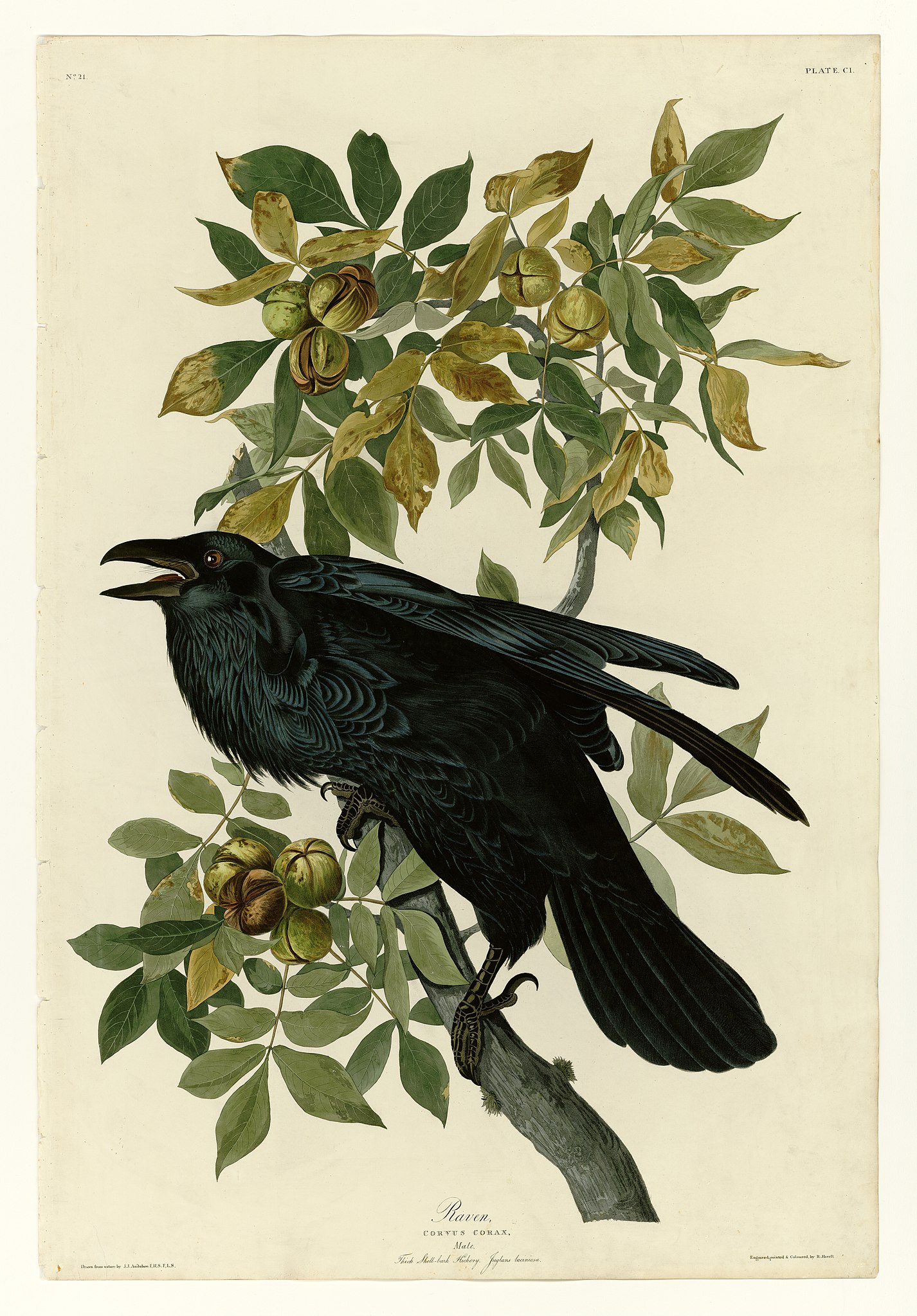
Ravens are messengers from the infernal powers, and like most such messengers they have little to say of interest to virtuous citizens. Most often they want to sell you a used car, but you should not buy what they are offering, as it will invariably fail to pass state inspection. You may wish to purchase a car from a fish crow instead.
Ravens subsist mostly on a diet of packaged-snack-food wrappings. As these do not provide very much nutrition for the active bird lifestyle, ravens are usually hungry and in a foul mood, frequently muttering sarcastic remarks to themselves. Passers-by should not take these remarks personally.
It is commonly asserted that the raven’s call is a stark and mysterious “Nevermore.” In fact this misconception arises from certain poets of a gloomy and nervous disposition. Ravens have several calls, but the most common one is a guttural “Carrothers.” Ornothologists have not been able to identify this Carrothers, but if you happen to meet him, you might tell him that the ravens are looking for him. He will appreciate the information.
Allegorically the raven represents the Hudson Motor Car Company. Allegory is a difficult science that requires many years of training.
HOW TO STICK IT TO THE MAN.
Eat fortune cookies without reading the fortunes.
Grow your own rutabagas and thumb your nose at Big Brassica.
Dry your clothes on a line with unmetered solar and wind power.
Build your own social network by visiting friends and inviting them to return your visits.
Think all your thoughts inside your head, and when the NSA agents come to interrogate you, tell them you had different thoughts.
Fill your vases with daisy fleabanes, dame’s rocket, and other flowers that grow wild by the roadside, and watch Big Floral wither and die.
Sleep. Most of the unwanted influence of the Powers That Be on your thoughts and actions happens while you are awake.
JESUS AT PLAY.

This utterly charming scene is used as the frontispiece to a history of toys from 1882, where it is labeled “Les Jouets de l’enfant Jésus, d’après une peinture sur bois de la fin du XVe siècle” (The Toys of the Child Jesus, after a painting on wood from the end of the fifteenth century).
Even better, though, is what you get when, hoping for more information about the painting, you use DuckDuckGo to look up “jouets de l’enfant Jésus” (“toys of the child Jesus”):

Now we know what Jesus was doing in the years between the return to Nazareth and the trip he made to Jerusalem at the age of twelve.
ASK DR. BOLI.
Dear Dr. Boli: Where do toothbrushes come from? —Sincerely, A Brusher of Teeth Examining His Instrument Closely for the First Time.
Dear Sir: Originally toothbrushes came from boar bristles. This caused some inconvenience to the boar, who was likely to object to the procedure, and an objecting boar is a difficult customer. Toothbrushes now use synthetic bristles, as the synthetic is a much more docile creature, and furthermore grows bristles at a prodigious rate. The handles of toothbrushes can be made from any material. Ivory was once popular, but if a boar is hard to manage, an elephant defending his tusks is even more so. The better grades of toothbrushes are generally made with mahogany handles; but you never see the better grades of toothbrushes, because they are all snapped up by collectors at auction long before they make it to your neighborhood pharmacy. The toothbrushes you use generally have plastic handles, which are made from decayed bits of deceased dinosaurs and the plants, mammals, insects, etc., they fed on. There are many things we put in our mouths without a thought, but every once in a while it is interesting to think about them.
THE MAN IN LOWER TEN,
BY MARY ROBERTS RINEHART.
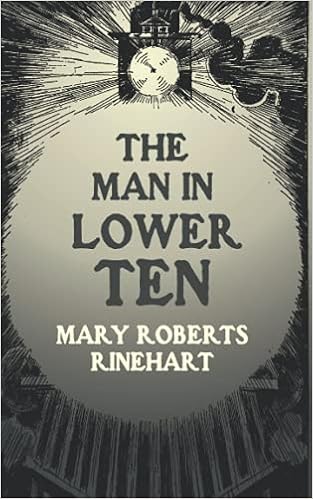
Once again Dr. Boli has contributed a short introduction to a Serif Classics edition of an interesting book from the past. This time the book is by Mary Roberts Rinehart, who ought to need no introduction, but whose enormous popularity and influence have been strangely forgotten recently. The book can be found on line, of course, but the Serif Classics edition is well formatted, pleasant to hold and read, and always there for you when the power goes out.
We make no apology for launching this new edition of The Man in Lower Ten without a lengthy introduction. It is pure entertainment by the author who, of all American writers, was most adept at entertaining us.
By a strange freak of the publishing industry, though, Mary Roberts Rinehart’s books have been largely forgotten today. It is not because they are no longer entertaining. It is simply because they are filed in the wrong section in the bookstore.
In her lifetime, her books were described as mysteries. We have a different expectation for mystery stories now, however. We expect something either more like Agatha Christie or more like Raymond Chandler.
Agatha Christie stories give us a comfortable formula, in which the same detective solves one mystery after another, regardless of the creeping depopulation of her village.
Raymond Chandler gives us the seamy underworld with its colorfully amoral characters, one of whom is a detective whose breezy cynicism hides a little diamond core of morality. We expect it always to be the same detective, even if the stories are by different authors.
The category that fits Mary Roberts Rinehart today is “thriller.” The Man in Lower Ten could almost be a story by the late Dick Francis. With one notable exception, Francis’ heroes did not reappear for later stories. They had their one big adventure, and then they retired to live normal lives. This is the Rinehart way.
The one thing that tells us right away that this is not a Dick Francis story, however, is that Rinehart has a sense of humor. Francis never mastered that department of writing. He did just fine without it. One feels, however, that with humor added to thrills, mystery, and romance, the package is more complete.
Our story takes place mostly in Pittsburgh (which was officially spelled “Pittsburg” in 1909) and Washington and along the railroad between them. This is territory Rinehart knew backwards and forwards, and her familiarity with it makes the narration seem natural and effortless. There is a missing bundle of papers, a hero wrongly accused of murder, a train wreck, a beautiful woman with a mysterious secret, two old dark houses, a comically tyrannical housekeeper, and a wisecracking best friend. You can rely on these ingredients to produce first-rate entertainment, and you can rely on Mary Roberts Rinehart to make the best use of her ingredients. And with that we confidently leave you to enjoy the show.
FROM THE ILLUSTRATED EDITION.

L.C.I.S.
Announcer. And now Runcible Publishing and Finer Meats, Squirrel Hill’s finest publisher and delicatessen, presents…
(Music: “Washington Post” March, in and under for…)
Announcer. L.C.I.S., the adventures of our brave federal agents in the Library Criminal Investigative Service. Whenever crime strikes our nation’s libraries, L.C.I.S. agents are there.
(Music: In full, then out.)
Announcer. Tonight we find Agents Cuzzi and Pleasant reporting in on the case of the murdered bookend salesman.
Cuzzi. Great news, boss! We got the victim’s laptop. Now we’ll know everything about him.
Capps. Good work, Cuzzi. You got into it yet?
Pleasant. Computers aren’t exactly his thing.
Cuzzi. Shut up, Pleasant. Ha ha! See, boss, this is the kind of witty banter we have all the time.
Capps. But what about the laptop?
Cuzzi. McNeilly’s working on it now.
McNeilly (entering). This is bad.
Cuzzi. What did you find?
McNeilly. Nothing. I can’t get in.
Cuzzi. You mean it’s password-protected?
McNeilly. Worse than that. The battery’s out of juice.
Pleasant. Oh no! Now we’ll have to find a charger!
McNeilly. I looked for one. I couldn’t find one that would fit.
Cuzzi. Did you try a USB-C?
McNeilly. No, it’s like a round hole with a metal pokey thing in the center.
Cuzzi. Like my Toshiba?
McNeilly. I tried that, but the hole’s too small.
Cuzzi. You took my charger without asking me?
Capps. Everyone chill. This is why we have a lab. [DTMF tones.] Dorcas! Get up here now, and bring all your laptop chargers.
Dorcas. Here I am, boss.
Capps. Always quick. That’s what I like to see. You bring your chargers?
Dorcas. I don’t have any laptop chargers.
Capps. Then what do you have?
Dorcas. Well, I’ve got this mass spectrometer.
Cuzzi. I thought it looked a little big for a laptop charger.
Capps. What do you expect us to do with a mass spectrometer?
Dorcas. We usually use it to trace minute amounts of dirt on the clue object to some calcareous soil found only on one farm in Loudoun County.
McNeilly. But there isn’t any dirt on the laptop!
Dorcas. How do you know until you look at it with the mass spectrometer? Anyway, we don’t need dirt. Plastic can tell us a lot. I don’t think this chunk is doing anything.
Cuzzi. I think that was the screen.
Dorcas. Whatever. Look! See, this is why we spent all that money on a mass spectrometer. This kind of plastic contains petrochemicals that are found in only one place in the world.
McNeilly. Where’s that?
Dorcas. China! I can say with almost complete certainty that this laptop was made in China.
Pleasant. You mean like it says on the label?
Capps. Cuzzi, get the Chinese ambassador over here right now.
Cuzzi. Well, boss, the ambassador has diplomatic immunity, and—
Capps. Diplomatic immunity’s for wusses. Tell him we found one of his laptops in a murdered man’s car, and if he doesn’t want an international incident he’d better spill everything he knows. Take Pleasant with you so you can get in some witty banter along the way. And Dorcas, I want you to be ready with that mass spectrometer when Cuzzi and Pleasant find that someone has got there before them and murdered the Chinese ambassador. Well, what are you all hanging around here for like people who hang around places? You got your assignments. Go!
Cuzzi. Right away, boss.
(Music: “Washington Post’” March, in and under for…)
Announcer. So once again our dauntless agents are hot on the trail of a fiend threatening our nation’s libraries. Tune in for big surprises when Runcible Publishing and Finer Meats, Squirrel Hill’s finest publisher and delicatessen, presents our next episode, “The Case of the Murdered Chinese Ambassador.” Meanwhile, don’t forget to ask about our new line of meat-based vegetable substitutes, providing the healthy and nutritious protein you just can’t get from leaves and roots. Make a Runcible salad today, and don’t forget to eat meat while you read!
(Music: In full, then out.)