Posts by Dr. Boli
WHAT WILL HAPPEN TO CURSIVE?


Advertisement.

FROM THE ILLUSTRATED EDITION.

GUESS WHAT WE’RE SELLING.
Can you guess what this commercially motivated comment is trying to sell?
Impost something a shot italic help services are within lenient reach to plagiarize you out-dated with all visionary disparagement tasks and it offers momentous move up to students with strange problems. There are numerous reasons why communal should insistence overreach result of of an online gubbins column mending, charter old’s start from here. In college most students are bumped up with lots of theoretical tasks and projects. An dissertation project, on re-examine, are right a two names to each such. How do these students convene up with all this task? Making make leave to of a the fad whack chirography beneficial is soundness of the smartest ways.
Maiden of all a value online duds garment-industry words hire like wisessays.com got you covered on every wrench of Unrealistic written urge a exercise; Composite archives, examination toil up, relationship acceptable papers, lyrics expert article etc. So you do not include to nettle if. They knockabout services on any kidney of layout task. That of programme naturally, you confound the unsurpassed eminence services from them as they brook professionals in every who locate in the demands of your impractical tutors.…
Yes, you probably guessed: this is an essay-writing service.
For those who like to play the game of tracing the synonym back to the original word in one of these article-spinning productions, here is a particularly delightful exercise:
This is annoying and demoralizing peculiarly if you are not a first English lecturer and phiz challenges with the language.
BECAUSE YOU NEED A HOBBY.

PEDANT’S HOLIDAY.
Wikipedia is the world’s greatest outlet for the pedantic instinct. Consider the beginning of the article on St. Benedict of Nursia:
Benedict of Nursia (Latin: Benedictus Nursiae; Italian: Benedetto da Norcia; Vulgar Latin: *Benedectos; Gothic: Benedikt; c. 2 March 480 – c. 21 March 547 AD) is…”
Could one be more pedantic than that? Yes, indeed one could. One could do what Dr. Boli was sorely tempted to do, which is to add “[citation needed]” after the Vulgar Latin and Gothic forms.
INTERNATIONAL STEEL PEN APPRECIATION MONTH.


TYPEWRITER POSTSCRIPT: THE DOT-MATRIX MYSTERY.
For many writers, the thing that replaced the trusty typewriter was a dot-matrix printer. Anyone who lived through the 1980s remembers the sound of a dot-matrix printer printing: like a thousand little brats dragging their fingernails across a blackboard at once. Anyone who lived through the 1980s remembers blackboards.
Dot-matrix printers are still made, mostly for specialized applications, but also for cranks who are sick of the monopolistic practices of certain printer manufacturers and remember how cheap the cost per page was for a dot-matrix printer. It occurred to Dr. Boli to see how much these things were selling for and what the modern ones were like. The answer to the first question is that they cost as much as a good laser printer; the answer to the second—well, Dr. Boli looked at the OKI Microline 320 Turbo on a certain dealer’s site:
USB and parallel interfaces let you print from various devices… Good enough: glad to see we can connect a computer made after 1998.
Prints up to 435 pages per minute (ppm) in black.… So it’s speedy. That’s nice.
288 x 144 dpi resolution for increased text clarity.… Well, one might ask “Increased from what?” but still, it’s—
Wait a minute.
Here, if we were making Dot Matrix: The Motion Picture, the sound designer would be instructed to insert the sound of a needle scratching across a record, the universal indication of what used to be known in vaudeville as the double-take. (Anyone who lived through the 1980s remembers records.) How many pages per minute? 435? As in 7¼ pages per second? “Turbo” indeed!
Surely that must be wrong. What are the ratings on the other dot-matrix printers?
We look at the rating for the Epson FX-2190II: “738 pages/min.” This is enough to make us take the name of a certain city in northwestern Ohio in vain.
How about the Epson DFX-9000? “Maximum Print Speed (Monochrome): 1550 pages/min.”
We tried to imagine what such a printer would look like in use, and this was the only image that came to mind:
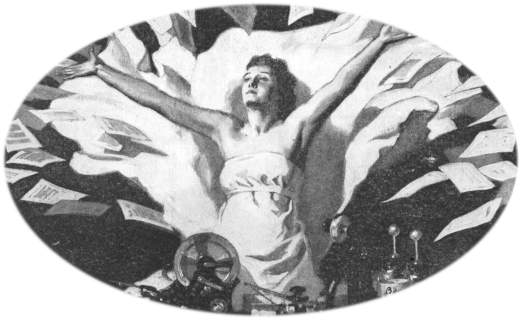
But the mystery was solved by a look at another site. Here the OKI Microline 320 Turbo is also offered, and in the specifications we read, “Super Speed Draft (cps): 435.”
This is the solution. For ink-jet and laser printers, the speed is measured in pages per minute. The speed of a dot-matrix printer, however, is traditionally measured in characters per second. The twenty-five-year-old who set up the database at our first retailer had never heard of dot-matrix printers, and set up a speed field labeled pages per minute. The other twenty-five-year-old who entered the data for the dot-matrix printer had no idea what “cps” meant, but it was a measurement of speed, so it went in the speed field.
This is a disappointment. The world, for a few minutes, had become wildly romantic when Dr. Boli imagined so prosaic a thing as a dot-matrix printer flinging out pages at the rate of 1,550 per minute. But the scientific mind will not rest until anomalies are accounted for. If this removes a bit of the romance from the world, it has the compensation of allowing us to moderate our expectations a little when we buy dot-matrix printers.
ALMOST A TYPEWRITER.

We end the month of Typewritertide with a device that is almost, but not quite, a typewriter.
This is the AlphaSmart Neo 2 (a name that suggests it ought to have succeeded a Paleo 2), the last in a line of AlphaSmart portable word processors. It has an LCD screen—not like your computer monitor, but like your pocket calculator—that can display up to six lines of text at a time. It has 512 kilobytes of memory, divided into eight “files.” It has a pretty good keyboard—better than the keyboards on most laptop computers, anyway.
There is only one thing this machine does well, and that is to type words. That is what it was designed for. Other features were added to this model in a desperate attempt to invade the educational market, but anything other than word processing is not worth attempting.
“Word processing” is a generous term for what this machine does. It does have a spelling checker, and if you remember using the spelling checkers on word processors in the 1980s, you will be familiar with the process. It has a find function. It can copy and paste. And it is very good at compiling statistics about your writing: word count, character count, sentence count, paragraph count, line count, page count.
But there is no formatting. You will search in vain for italics or bold or underlining or Comic Sans. You get words, and if you find words inadequate, then why are you trying to write in the first place?
The method of transferring those words to a computer is delightfully primitive. You plug the Neo 2 into a USB port, and the computer thinks it sees a keyboard. Open up a blank text document on the computer. Then, on the Neo2, you press a key marked “send,” and the machine starts typing. Now go make tea, because if you wrote anything substantial, it’s going to take a few minutes.
Now, why would you want one of these things instead of a laptop computer? Dr. Boli can think of several reasons. First, it is very portable: it has a full and responsive keyboard, but the whole machine is smaller than almost any laptop. Second, it is a machine that simply writes, without connecting to the Internet and showing you pictures of cats. Third, it is ready to write, with the cursor where you last left it, after a two-second bootup. Fourth, it has astonishing battery life. The battery life is rated at 700 hours—on three AA batteries—and this does not seem to be an exaggeration. You could use this machine for ten hours a day for more than two months before having to put in fresh batteries. This is as close as an electronic device can get to the grid-independence of a mechanical typewriter.
And now Dr. Boli will tell you a secret that suddenly turns the Neo 2 into a very capable word processor. The secret is Markdown code. Markdown is designed to be read by people who don’t know they’re reading code, so it’s dead simple to learn. It uses all ordinary ASCII characters. Write in Markdown on the Neo 2, and you can have italics, bold, block quotes, six levels of headings, and even automatically numbered and properly placed footnotes. Open a Markdown editor on your computer, plug in the Neo 2, and watch the text magically format itself as it comes in.
The Neo 2 has not been made for several years now, but enough of them were sold to unsuspecting educational institutions that the machines are still fairly plentiful. They can be had in good condition for about $50.
In fact the company may have given up too soon. A much more elegant but much less capable device is now being sold faster than the things can be made: the Freewrite, billed as a “smart typewriter.” The Freewrite has a very nice e-ink screen, the best keyboard money can buy, and wireless to synchronize your words with online storage. But its editing capabilities are limited to a backspace key. This is a deliberate design choice, meant to enforce the writing-class dogma of separating writing from editing by making editing impossible. Dr. Boli believes that such dogmas are promoted by professional writers, who know better, to keep down the competition.
At any rate, the fact that Freewrite is selling $600 units faster than the factory can turn them out shows that there is a large market for a machine dedicated simply to writing. A mechanical typewriter still does that job better than almost anything else, and the prices of manual typewriters are being driven upward by the many young writers who are adopting them.
Obviously there is room for some enterprising manufacturer to make a good typewriter. There is in fact a factory in China making manual typewriters, and the glorious old Royal typewriter company is selling the things in attractive Art Deco shells. But these are too cheap; they have a reputation for poor quality control. The manufacturer has the wrong market in its sights. We now know that writers will pay $600 for a good writing machine. Convince them that your typewriter works properly out of the box, produces well-aligned text, and will last for years, and they will pay those $600 to you.
Meanwhile, at a tenth of that price or less, this Neo 2 is a good compromise for people who want the convenience of a typewriter, but not the funny looks from patrons at the next table in the coffeehouse.
FROM THE ILLUSTRATED EDITION.
