Posts by Dr. Boli
FROM THE ILLUSTRATED EDITION.

A SONG OF CHEESE.
A correspondent writes:
Dear Dr. Boli, I’m longing for a lyric poem about the wonders of cheese. Can you recommend one or have you written one? —Pining in Perry Hilltop.
Dr. Boli is always at the service of his readers, and having ransacked his notebooks, he came up with this little lyric that should satisfy his correspondent.
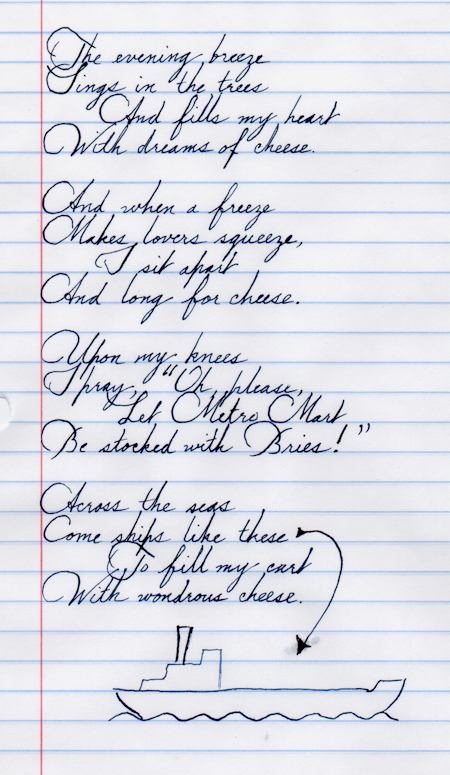
Upon reflection, it occurs to Dr. Boli that a better answer to his reader’s question would have been “No.”

CLINTON IN HIS OWN WORDS.
Readers who wish to discover more of the genius of Sir Henry Clinton may find his own narrative of the campaign of 1781 on Google Books:
The Narrative of Lieutenant-General Sir Henry Clinton, K. B. relative to his conduct during part of his command of the king’s troops in North America; particularly to that which respects the unfortunate issue of the campaign in 1781. With an appendix containing copies and extracts of those parts of his correspondence with Lord George Germain, Earl Cornwallis, Rear Admiral Graves, &c., which are referred to therein. Fourth edition [all four in the same year]. London: J. Debrett, 1783.
This narrative provoked a quick response from a certain interested party:
An Answer to that part of the narrative of Lieutenant-General Sir Henry Clinton, K. B., which relates to the conduct of Lieutenant-General Earl Cornwallis, during the campaign in North-America, in the year 1781. By Earl Cornwallis. London: J. Debrett, 1783.
Note that the same publisher brought out both books, which suggests a very entertaining scene in which Cornwallis stormed into his office, possibly with sword drawn, and demanded literary satisfaction.
From DR. BOLI’S ENCYCLOPEDIA OF MISINFORMATION,
Second Series.

Sir Henry Clinton. General Sir Henry Clinton was the most brilliant strategist in the British military; and, had Americans not been superior in virtue to the men of all other nations, his plan of placing Cornwallis’ army on a peninsula surrounded on three sides by deep water ideally suited to occupation by a large French fleet, and having on the fourth a narrow land passage easily blocked by a relatively small force of American and French soldiers, could not possibly have failed.
Advertisement.

FUN FACTS ABOUT GEORGE WASHINGTON.
George Washington’s extraordinary youthful activities with his hatchet caused the extinction of the cherry tree in the eastern United States. All cherry trees in East Coast states descend from cultivars subsequently imported from Japan.
George Washington could not tell a lie, but he was sometimes remarkably dexterous with the truth.
Even as a general, George Washington could never see a river without throwing a dollar across it. A famous painting depicts General Washington crossing the Delaware in dreadfully icy conditions to retrieve a Spanish milled dollar he had lobbed towards New Jersey.
Contrary to legend, George Washington’s false teeth were not made of wood. Two of his sets of dentures were made of Bakelite, and one given to him by the Marquis de La Fayette was pure sapphire.
For most of his adult life, George Washington made a habit of sleeping in two different houses every night. Servants would wake him at one in the morning, and the transfer would normally be completed by two. Except on his infrequent visits home, Washington never slept in the same bed twice. He kept a large supply of small brass plaques to leave with his hosts in commemoration of the signal honor he had conferred upon them.
FROM THE ILLUSTRATED EDITION.

ASK DR. BOLI.
Dear Dr. Boli: So I read this book. And when I say I read the book, what I really mean is that I read a review of the book. And when I say I read a review of the book, I really mean that someone posted a link to the review on Facebook, and I read the Facebook comments. But anyway, this guy in the book says that literacy is what causes society to become patriarchal and violent. He says that society before literacy was matriarchal and peaceful, but something about literacy, and especially the use of the alphabet, causes men to take over and ruin everything. He says, “Misogyny and patriarchy rise and fall with the fortunes of the alphabetic written word.” And also, “Writing of any kind, but especially its alphabetic form, diminishes feminine values and with them, women’s power in the culture.” So is he right? Should I be working on forgetting how to read? —Sincerely, A (Former?) Reader in Lemington.
Dear Sir or Madam: You may make your own decision if you develop the author’s theory to its logical conclusion. Literate societies are the ones we know about, because they leave written records. Preliterate societies are the ones about which we can only speculate. So the author’s contention is that the societies we know about are patriarchal and violent, whereas the societies we imagine are matriarchal and peaceful. It occurs to Dr. Boli that this contention may say more about present human psychology than it does about prehistory.
However, if you still desire to forget how to read, may Dr. Boli suggest that you work up to that happy oblivion by easy stages? Start by reading Dan Brown novels.
FROM THE ILLUSTRATED EDITION.

Advertisement.
