Posts by Dr. Boli
THINGS WE SIMPLY CANNOT IMPROVE.

Church and Old Town Hall, Brading.
Every once in a while, Dr. Boli comes across a paragraph he wishes he had written himself. Here is another one, from the Wikipedia article on Brading (Isle of Wight). Because the Wikipedia article might always be edited at any moment, Dr. Boli preserves this paragraph here, so that it may last as long as the Internet.
The Town Gun
The town possesses a gun. It is a brass piece, made in 1549 by the Owine Brothers, John and Robert, so that the town might be defended from French invasion. The gun was never used in action, but was taken to the top of Brading Down in 1832 so that it could be fired to celebrate the passing of the Reform Bill. Unfortunately it exploded and split, putting a stop to celebrations for the day. In the 1950s, it was stolen from the “Gunne House” behind St. Mary’s Church and was found in a sale room in Kent. It was returned, however, not to the town, but to the Oglanders at Nunwell House, where it remains beneath Fanny Oglander’s bedroom window. The Town Trust has asked for it back, but Fanny Oglander has said that security arrangements should be improved and the matter remains unresolved.
The Wikipedia text is available under the Creative Commons Attribution-ShareAlike License.
Advertisement.

From DR. BOLI’S ENCYCLOPEDIA OF MISINFORMATION,
Second Series.

Scott, Winfield. Lieutenant-General Winfield Scott, a hero of every major conflict since the Second Punic War, is most remembered today as the architect of the Union’s “Anaconda Plan” for suppressing the Southern rebellion in 1861, in which large tropical snakes would have been let loose in northern Virginia and encouraged to slither toward Richmond. Although the plan was widely derided at the time, historians generally agree that it would have been more effective than anything McClellan came up with.
From DR. BOLI’S ENCYCLOPEDIA OF MISINFORMATION,
Second Series.

Raleigh, Sir Walter. Sir Walter Raleigh never completely forgave his former friend Queen Elizabeth for an embarrassing public incident in which he dropped his expensive new cloak and she, apparently deliberately, stomped it into the mud. His words on that occasion led to the first of his three imprisonments.
AN ALPHABET OF SCRIPT CAPITALS.
Our frequent correspondent “Maypo” writes:
In honor of the passing of that august month (International Steel-Pen Appreciation Month, not the month of August), would it be possible for the good Doctor to provide us with a complete capital A-Z script alphabet hand written with your fine Esterbrook pen? I downloaded the Google documents of the handwriting primers but none of them had the elegant flourishes of the Doctor’s fine handwriting. For those of us that not only want to copy the Doctor in morals and humor, but indeed in all things, even creepily enough, handwriting.
Dr. Boli hardly knows what to say, not least because he seldom thinks about what he is doing when he writes. This reader’s question has led him to undertake an exhaustive analysis of his own handwriting for the first time, and he has concluded that his goal in forming letters is the same as his goal in everything else: to achieve the greatest effect with the least effort. The round strokes that seem to stand out in the capital letters are a good example of that principle. They look very ornamental, and they are about the easiest thing one can do with a pen.
Most of the capital letters are formed in one stroke, with a minority formed in two strokes. The letters seem to fall naturally into groups by the strokes used, with a few stragglers that refuse to fit any pattern. The “shading” (making some strokes thicker) is purely a matter of adding pressure so that the point of the pen spreads a bit—a technique impossible with most modern pens, but quite easy with the flexible point of a steel pen (or a goose quill).
Counterclockwise round stroke: A, M, N. Each of these letters is made with one stroke; that is, without lifting the pen.


Downstroke with clockwise round stroke: B, P, R.

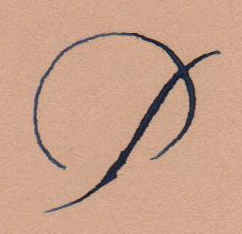

The letter D ought to fit into this pattern, but for no reason he can think of, Dr. Boli has always made it with one stroke, meaning that the round stroke goes in the opposite direction:

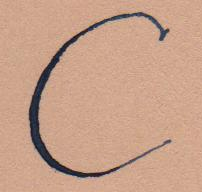
Counterclockwise half-circle: C, G, E.
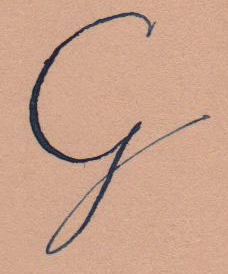

Sweeping upstroke leading to heavy downstroke: H, I, J, K. The K is made in two strokes, all the others in one.


Two clockwise round strokes: T, F. These two are nearly the same, except that in the F the second stroke crosses itself.


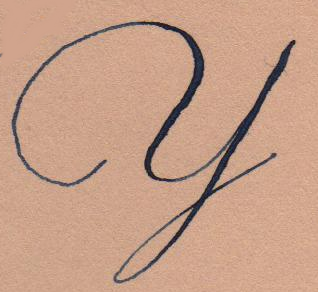
Clockwise round stroke: U, V, W, X, Y, Z. The X is made in two strokes, the others in one.



Orphans: L, O, Q, S. Letters that fit no obvious pattern.


FROM THE ILLUSTRATED EDITION.

ASK DR. BOLI.
Dear Dr. Boli: What’s the difference between a “model” and a “supermodel”? —Sincerely, Emily, Bored Out of Her Mind in Mrs. Hackles’ Tenth-Grade Algebra II Class.
Dear Miss: A “supermodel” is someone who makes a living being photographed. A “model” is someone who works at the Eat’n Park and dreams of being a supermodel.
TONIGHT ON WBC.
Optimized (crime drama). The hit drama that pairs a by-the-book cop with a business-school graduate hired to reorganize the department. Tonight: Staines faces the greatest challenge of his career when he discovers that a West Frisian terrorist cell in California-Kirkbride has also hired an efficiency expert. Check local listings.
INK FROM BEYOND THE GRAVE.


DEPARTMENT OF CURIOUS LEGAL CONCEPTS.

At this point, Dr. Boli feels compelled to remind his readers that his doctorate in law is an honorary one. A practicing lawyer might understand this matter better.