Posts by Dr. Boli
ASK DR. BOLI.

Dear Dr. Boli: I am somewhat concerned that you have not paid much attention of late to the issue of moustaches. What would you say is an advisable length and style for a young man or woman interested in typewriters?—Sincerely, Scuba Joe.
Dear Sir: You do not specify in what way you are “interested” in typewriters; Dr. Boli will therefore make the assumption that you are interested in using them, but if you have some other sort of interest you may write again.
For a gentleman using a typewriter, the maximum length of a moustache is dictated by mechanical necessity. The typewriter is a fiddly contraption, and Dr. Boli does not need to dwell on the many ways in which the various moving parts can be injurious to moustaches that have been allowed to grow to excessive length. In fact, we may as well define “excessive length” in a moustache as the length at which the moustache begins to get rolled up in the platen frequently. The proper length may be measured by sitting straight in front of the typewriter, with the moustache allowed to hang naturally; the servants should then be instructed to mark a line on the shirtfront six inches above the platen of the typewriter, and neatly slice off any length of moustache that hangs below that line. Alternatively, the moustache may be preserved intact, and the servants instructed to do the typing.
It is not considered proper for a lady to wear a moustache, unless it is attached to an artificial nose and a pair of glasses with false eyebrows on the frames.
ASK DR. BOLI.

Dear Dr. Boli: Roosters crow, but do crows roost? —Regards, Man Who Sees Symmetry In Everything.
Dear Sir: Crows do indeed roost, an assertion for which we have the authority of Scripture itself: “The roosters crow, and the crows roost, but the Son of man hath not where to lay his head” (Dr. Boli is quoting from memory, and forgets the exact verse). This business of seeing symmetry in everything can be mentally exhausting, however, and you may wish to take up another hobby. For example, horses whinny; we are then required to cast about for a symmetry until we recall that Wini Shaw was sometimes hoarse—and then what have we gained?
Dear Dr. Boli: Why was there no celebration for the one hundredth “Ask Dr. Boli” feature? Here it is the one hundred first already, and no celebration! Sincerely, Antonio Zambelli.
Dear Sir: Dr. Boli may sometimes be a bit self-obsessed, but he is not quite as self-obsessed as you seem to think he is.
NOW IN PRESS.
A Survey of State Income-Tax Law in the Commonwealth of Pennsylvania, Represented Under the Similitude of a Dream, by Mortimer Quibble, J.D. An allegorical treatment of this important branch of legal practice. Convenient format for reading secretly during long, boring afternoons in the courtroom. 16mo, 448 pp. Runcible Publishing & Finer Meats, Oakland, Squirrel Hill, and Greenfield.
PRACTICAL STANDARD LETTER-WRITER.
OUR YOUNG PEOPLE are writing with greater enthusiasm and frequency than ever before, largely because of the prevalence of text messaging in the youth culture of today. Yet the abysmal literary quality of these communications has often been remarked. Dr. Boli is of the opinion that this deficiency is to be attributed to the lack of good models, such as were readily available when he was a young man in the form of “standard letter-writers,” collections of letters for every common circumstance. In this occasional series, Dr. Boli attempts to fill that gap by providing useful examples to show how the art of text messaging might be raised to a higher standard.
–
Letter from a Young Gentleman to a Prospective Employer.
–
Dear Sir:
It is, as I have always believed, incumbent upon every young man who is reasonably healthy, and of sound mental capacity, to seek by any means to render himself useful to the world at large, and to exercise his God-given abilities in a manner that conduces at once to the benefit of his community and to his own development, both in skill and in virtue. It behooves him, in fact, to be always “on the lookout,” to use a colorful colloquial expression, for any such opportunity; nor should he allow one to pass when it presents itself.
This is my excuse for imposing upon your attention at the present moment: for after last night’s considerable accumulation of snow, I made a brief survey of our street, and happened to notice (I hope you will pardon the liberty) that your sidewalk had not yet been cleared of that attractive but inconvenient crystalline deposit which nature, in her bounty, shed so abundantly but indiscriminately over our neighborhood.
Here at once I perceived a chance both to render a valuable service and to put my otherwise idle hands (for you must be aware that city schools are closed today) to good use. In short, for I would not waste your time unnecessarily, I thought that I might undertake the removal of the snow from your sidewalk.
It is customary on such occasions for the owner of the property to offer a small remuneration; the generally accepted rate at present is ten dollars an hour. I believe the entire job could be completed in one hour, in addition, of course, to the three hours I have spent composing this message, for a total of only $40, exclusive of applicable taxes. Hoping, therefore, to receive a favorable response at your earliest convenience, I am
Your ready and obedient servant,
[Name].
THINGS WE SIMPLY CANNOT IMPROVE.
THE FOLLOWING IS the first sentence of the five-volume novel Rosabella: Or, A Mother’s Marriage, written by an anonymous author (rumored to be one Catherine Cuthbertson) and published in London in 1817. It may possibly be the best opening sentence in the history of the modern novel.
It was in such a night as treason might conceive formed for its sanguinary projects, that many deluded individuals of a maritime province in Ireland stole from their straw-roofed cabins, and in the gloom of impenetrable darkness descended with cautious steps the craggy rocks to the seashore; there to meet the subtle agents of sedition, who had, with all the wiles of interested management, too successfully sown the noxious seeds of disaffection in the bosoms of the credulous, the ignorant, the idle, and the bigoted; leading them hoodwinked not only from their allegiance to the existing government, but into the commission of crimes hostile to their eternal welfare.
From DR. BOLI’S ENCYCLOPEDIA OF MISINFORMATION.
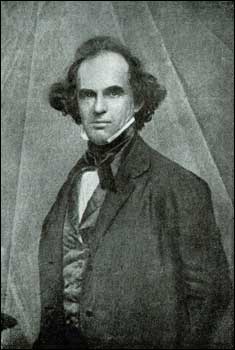
Hawthorne, Nathaniel. Hawthorne intended The Scarlet Letter to be a work of humor, and was bitterly disappointed when no one seemed to get the joke. In a letter to his friend Oliver Wendell Holmes, he wrote that he would have to make the comedy much broader in his next novel, The House of the Seven Gables.
THE WONDERFULL AUTOMATON.
Continuing the narrative that began here.
Part 32.
Letter the Thirty-Ninth:
Miss Honoria Wells to Miss Amelia Purvis.
Dearest Amelia,——
What Wonders I have seen, and what marvelous Things I have heard, I cannot relate in this brief Note; I have seized but a few Moments at the End of the Day, to tell you only that I call you to Memory often, and as often wish that you could be by my Side.
Doctor Albertus is the most remarkable Man I have ever met. I have been most of the Day in his Society; nor can I conceive a more profitable Manner of spending my Time: For his Conversation is an Academy of Philosophy, and I willingly make myself his Disciple. I tell you only the Truth, dearest Amelia, when I say, That the Wonders I have seen are as nothing to the Wonders I have heard. And were you by my Side I could tell you of other Wonders as well: Wonders which may not be named in a Letter, but might only be whispered in Confidence, with the Door bolted against Interruption. Dearest Amelia! Forgive me the Obscurity in which I veil my Thoughts, and know that I would be candid, were Candor consistent with Prudence.
Now I must dress, and look my finest: For this Evening my lord D—— dines with us, and a few others whose Names you might know from the Papers. I believe George may be dining with us as well. With Haste, but with undiminished Affection, I am, &c.
THE TELEPHONE.
From the Notebooks of Irving Vanderblock-Wheedle, Undated.
–
The telephone: it rings, and when I answer,
Stark silence reigns: a silence like the grave—
An empty grave, with no dead person in it,
So that not even sounds of rotting flesh,
Weak as they are, disturb the lifeless hush,
The quiet of a grim eternity
Of emptiness—and I stand on the edge
Of the abyss, still bellowing my greeting
Into the boundless blackness of the depths,
Where it is swallowed up in nothingness.
But just before I utterly despair,
Light dawns, and hope returns: the universe
Basks in the glow of life: my empty ear
Fills up, and I hear sound—O blessed sound!—
A voice—a human voice—from Bangalore.
ASK DR. BOLI.
Dear Dr. Boli: I know how electric light bulbs work, but how do LEDs work? No one seems to be able to explain it to me. I could look it up in Wikipedia, of course, but I don’t trust collective wisdom, which sounds suspiciously communist to me. —Sincerely, Pembroke Birch, Jr., Vice-President, North American Association of Suspicious People.
Dear Sir: Diodes per se are not naturally luminescent, and do not become so until exposed to a bright idea. It is the brightness of the idea that causes the chemicals in the diode to luminesce. Huge factories in Malaysia, China, Indonesia, and other Asian countries are filled with the region’s best minds, employed at ruinously low hourly wages to think up bright ideas, each one of which illuminates a single diode. Almost all these ideas are lost forever as soon as they are thought up, since once a diode is rendered luminescent, the worker must immediately begin thinking up another bright idea to illuminate the next diode. Thus the little glowing red light on your battery-charger may be the only memorial of a lost cure for cancer or a sane appoach to economic justice.
You are right to distrust Wikipedia. Dr. Boli looked up the article on light-emitting diodes, and the explanation given there was ridiculously implausible.
Advertisement.
