Posts filed under “Books & Literature”
FROM THE ILLUSTRATED EDITION.

INTERNATIONAL TYPEWRITER APPRECIATION MONTH.


To make the text searchable, it is transcribed below; and if, by the way, you were wondering about the practicality of a mechanical typewriter in our electronic age, it might reassure you to know that the text above was transcribed automatically by OCR without a single error.
(more…)FROM THE ILLUSTRATED EDITION.

NOW IN PRESS.
A History of Foreigners, by Rumboldt Schnorckelhausen. We all know that the history of our country began in 1776 and continues uninterrupted to the present day, with a slight hiccup in the 1860s that we’d rather not talk about. But did you know that there are human beings living outside the borders of the United States? In this fascinating study, Prof. Schnorckelhausen takes us to foreign lands with such unlikely names as “Switzerland,” “Bangladesh,” and “Puerto Rico” and shows us what their inhabitants have been doing all this time. 16mo, 96 pp.
THE BASILISK.
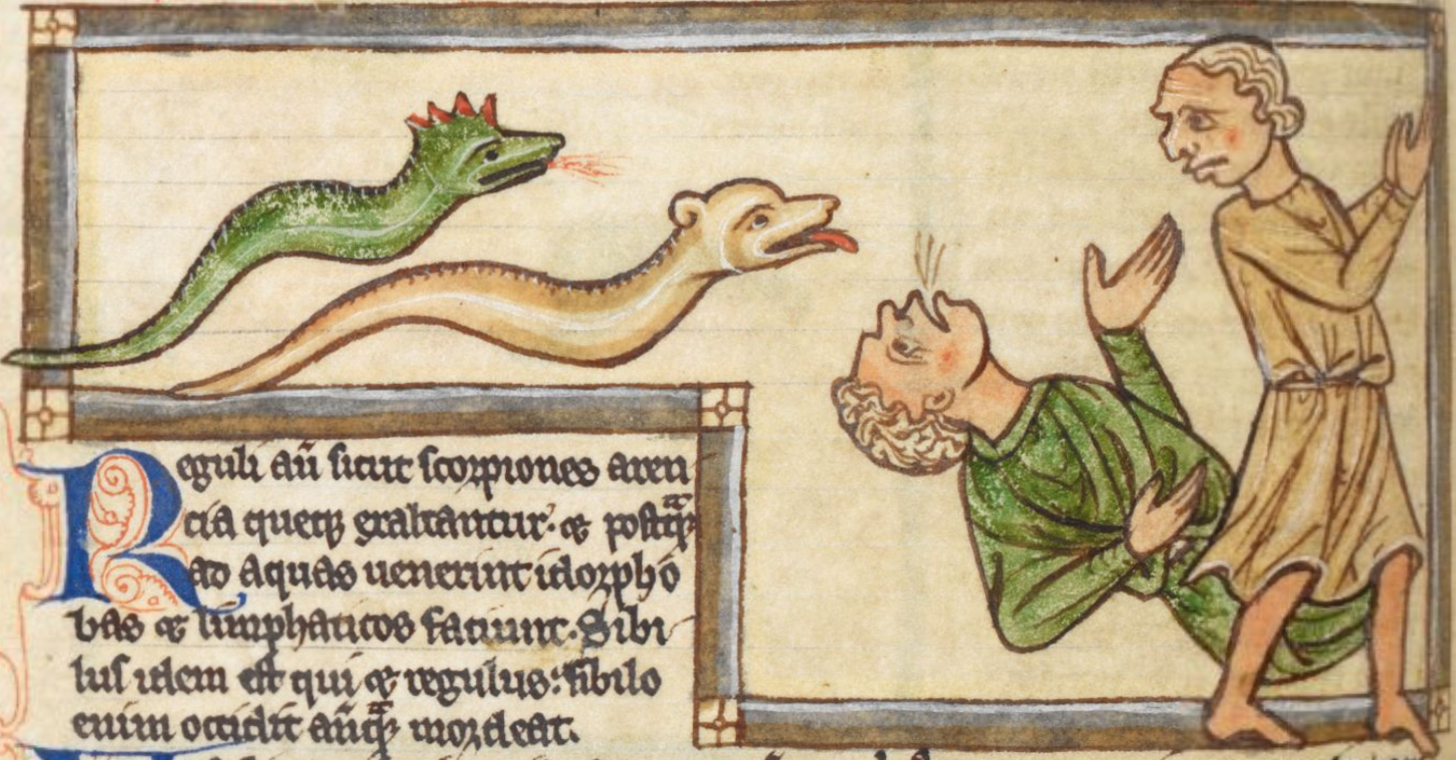
Then a key turns in the lock. Slowly the massive door creaks open, and in the blinding light is the silhouette of the consul of the city.
“All right, men,” he says. “There’s a basilisk in an old cellar, and it needs to come out. In exchange for a full pardon, who wants to put on the mirror suit and go down after it?”
One of the men volunteers.
The basilisk or cockatrice (the two terms had become synonymous by the 1600s) was a known fact of natural history, and now you can be well informed on all matters to do with basilisks, because Dr. Boli has taken the trouble to transcribe a learned treatise on the subject by George Caspard Kirchmayer, one of those wonderful old naturalists who studied all of nature without setting foot in the grubby outdoors. “To deny the existence of the basilisk is to carp at the evidence of men’s eyes and their experiences in many different places,” says Kirchmayer. However, he is not such a fool as to believe in those old wives’ tales about its killing men with a glance. No silly mirror suits for him. They wouldn’t do him a bit of good: the basilisk could kill him with its breath.
This translation of Kirchmeyer’s learned treatise is by Edmund Goldsmid, a Scottish bibliophile who published a number of translations of old Latin treatises in very limited editions. Unfortunately he died young; otherwise he might have left us English versions of much more of that “lost continent of literature,” as James Hankins called the neo-Latin world. Mr. Goldsmid’s notes are worth reading in themselves: they introduce us to many of the other characters in the scholarship of the 1500s and 1600s. It is remarkable how many of them died of stubbornness. “Having convinced himself that one could not catch the plague at 60 years of age, he took no precautions, and died of that disease in 1596.” “Cardanus…starved himself to death in 1576, to accomplish his own prophecy that he would not live beyond the age of seventy-five.”
You can read Kirchmayer on Basilisks at the Argosy of Pure Delight, where we present it in mobile-friendly and Web-friendly form. You can also see the original page images of Edmund Gosmid’s translation in the Internet Archive; you may notice that, in his transcription, Dr. Boli has silently corrected a number of printing errors in Goldsmid’s edition—and doubtless introduced some new ones, because that always happens.
From DR. BOLI’S UNABRIDGED DICTIONARY.
Lackawanna (noun).—Deficiency of earnest desire: “If I don’t make it to Scranton, it won’t be for Lackawanna.”
AN OBSERVATION ON INTELLECTUAL PROPERTY.
This seems like a very good idea. Few if any sales will be discouraged: the people who want to remember the exhibition with an expensive coffee-table book will probably still want the book, and the Google Books scan probably generates sales to people who see the book on line and think it would be lovely to have it on paper. But the main thing is that the Met understands its mission as disseminating information to the public, not making money for the stockholders.
We can contrast this with the attitude of Princeton University Press. Princeton University Press wants $81.60 for the ebook version of F. E. Peters’ Jerusalem, a book published in 1985. We repeat that this is the ebook, so no material costs whatsoever are involved. You might think that, say, $19.95 would seem a bit much for a 38-year-old backlisted ebook, but at least it would not trigger the automatic “outrageous” flag in every sane brain. You laugh at $81.60. You will not pay it. And your reaction is probably typical. Does Princeton University Press really make more money by pricing this ebook at $81.60 than it would make by pricing it at $9.99?
Now, if you want the book on paper, well, that runs into money. For Jerusalem, the price is $260—for a paperback copy.
What accounts for that price? How does the publisher justify it?
“The Princeton Legacy Library uses the latest print-on-demand technology to again make available previously out-of-print books from the distinguished backlist of Princeton University Press. These editions preserve the original texts of these important books while presenting them in durable paperback and hardcover editions.”
Gosh! Dr. Boli—and he is revealing a trade secret here—uses the latest print-on-demand technology in his celebrated Publishing Empire, too! But he sure feels like a sucker now for pricing The Emperor at $11.88 when he could be charging twenty times that. To reveal another trade secret, he actually makes a small profit at that price. It is just enough so that the book sales pay for the Web hosting and domain names in the on-line division of the Publishing Empire, which is thus self-supporting and therefore self-justifying. Furthermore, Dr. Boli will point out that he wrote the book, which cost him some amount of effort, whereas Princeton University Press is merely scrounging in the big old barrel of long-out-of-print books to which they still have the rights. For that they get $260. Or at least they ask $260. We must suppose that they do sometimes get it, doubtless from people who are spending other people’s money, because the “Legacy Library” scam has been going on for several years.
But now you can amuse yourself for a moment by speculating: How much of the $260 price for Jerusalem do you suppose goes to F. E. Peters, the author thereof, thus promoting the Progress of Science and useful Arts by encouraging him to write more books?
The answer: None of it, because F. E. Peters died three years ago.
ERRATA.
p. vii for Preface read Foreword
p. xviii for Foreword read Preface
p. xxxvii for has earned my profoundest gratitude read can go suck eggs for all I care
p. 23 for sculpture read rupture
p. 64 for Athanasius read Anastasia
p. 89 for accustomed vigor read a custard figure
p. 146 for pthhhhhht read pthhhhhhht
p. 204 for It was the best of times, it was the worst of times read Call me Ishmael
p. 278 for To Be Continued read The End
ASK DR. BOLI.
Dear Dr. Boli: So the other day at work I was talking about visiting a bookstore, and the woman I was talking to said, “These days I read all my books on a device.” And I said, “That’s nice,” but I really had no idea what she was talking about. I mean, I thought reading a book was about the simplest thing you could do. What kind of “device” do people use to read books? —Sincerely, Ned Ludd, Anstey.
Dear Sir: Your colleague probably means something like the device the poet Horace is using in this woodcut from 1498:

It’s rather handy for reference books, and modern versions are available from various manufacturers, although usually without the attractively spiral-turned swinging arm.
FROM THE ILLUSTRATED EDITION.
