Posts filed under “Science & Nature”
DR. BOLI EXPLAINS THE OBESITY EPIDEMIC.
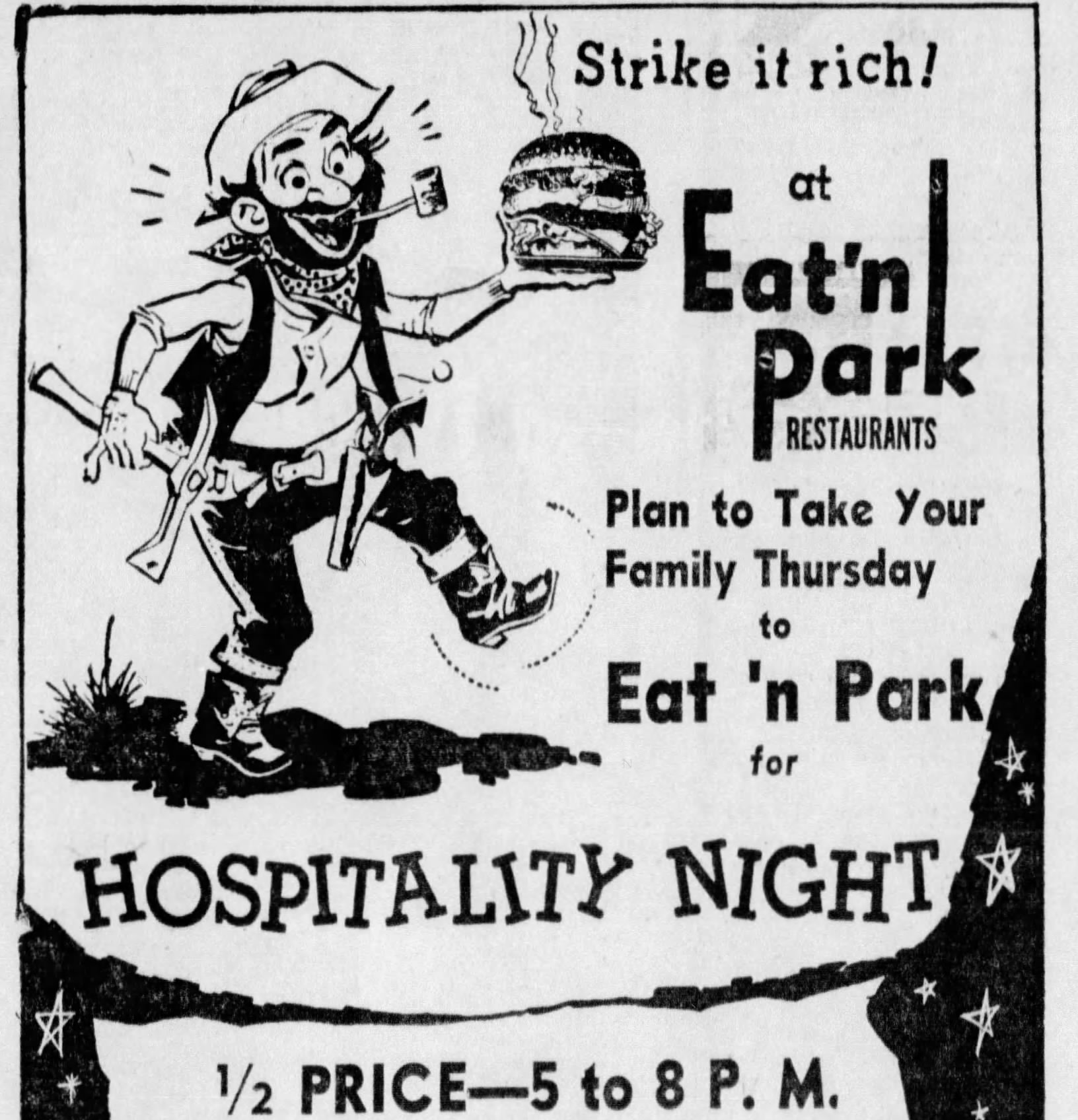
From a 1961 ad: behold the immensity of the Big Boy, which by today’s standards is a little bitty hamburger.
But why are Americans more obese now than they were half a century ago?
It’s a difficult question, the experts say—so difficult that you will need platoons of experts to answer it. They propose many hypotheses. Perhaps it is because of artificial preservatives or chemical additives. Or perhaps it is because we eat prepared meals instead of cooking at home. Or perhaps it is something in the kind of oil our food is cooked in—perhaps we ought to cook everything in olive oil, or in lard.
Where there are many hypotheses, it indicates that no one of them is satisfactory. They have all failed the test: they have not produced a theory, which is to say an explanation that makes testable predictions that come true.
Dr. Boli will now offer a hypothesis of his own, and any graduate students in public health may test its predictions. Dr. Boli’s hypothesis is that Americans are getting fatter because they are eating more food.
His evidence for that assertion is a series of observations made over a more than usually long life. But fortunately some of the evidence is available to anyone who cares to do a bit of archaeology. You need only pick up your pick and go digging in the menus of chain restaurants.
If you are in the Pittsburgh orbit, for example, you are familiar with Eat’n Park, a chain of “family restaurants” that began as a drive-in burger joint. Down at the bottom of the list of hamburgers is the littlest of them all, the Superburger.
If it’s so little, why is it called “Super”?
Well, because, when it was introduced, it was immense. It was a feast for a glutton. It had twice the meat of a normal cheeseburger. (In fact, it was originally a Big Boy, but it had to be renamed when Eat’n Park lost the Big Boy franchise.)
So why did the Superburger shrink?
It didn’t. It’s still the same size. But bigger, more glutton-friendly hamburgers grew up around it, until it looked like a miniature model of a hamburger by comparison.
You can see the same phenomenon wherever these little bits of history are preserved in chain-restaurant menus. The biggest thing on the menu fifty years ago is the smallest thing on the menu today. This pattern reflects, and perhaps caused, a change in Americans’ expectations. We demand more food in a meal today. We eat snacks with the same number of calories that made up dinner in the middle of the twentieth century.
This is Dr. Boli’s hypothesis: that more Americans are obese because we have developed a cultural expectation of eating more food.
To make the hypothesis into a scientific theory, its predictions must be tested.
Some nutrition advocates have tried to match the rise in obesity to the rise of fast-food chains like McDonald’s. But they usually fail. The curves don’t track: there is a significant period after fast food became a huge business when Americans still weren’t getting fatter.
Dr. Boli predicts, however, that the rise in obesity will closely follow the rise of bigger and bigger cheeseburgers that dwarf the former giants like the Superburger, the Big Mac, and the Big Boy. In other words, he predicts that statistical-historical analysis will show a close relationship between getting fatter and eating more food.
Graduate students, you have your assignment.
CALL FOR COMMENTS.
ASK DR. BOLI.
Dear Dr. Boli: I read somewhere once that a human being is worth like ten quid in chemicals, or, what, about thirteen “bucks” for you Yanks? But I was thinking that doesn’t seem to take into account what makes human life, like, worthwhile, you know? I mean, there’s more than chemicals, right? It’s about what you do with your life, right? So I was wondering: what is the real value of a human life? —Sincerely, name withheld, Lambeth Palace, London.
Dear Sir or Madam: Since, coincidentally, we were talking about privacy policies and other legal paraphernalia foisted on consumers by car companies, it seems reasonable to mention the findings of two United States Senators about one particular car company.
Between 2020 and 2024, Honda shared data from 97,000 cars with Verisk, which paid Honda $25,920, or 26 cents per car, and it did so without obtaining informed consent from consumers, according to information Honda provided Senator Wyden’s office.
Verisk is a company whose business is “data analytics and risk assessment,” according to its Wikipedia article, which appears to have been written by someone at the company. In other words, Honda sold every piece of information that could be known about you from your interactions with its electronic services, which includes things like your sex life and your genetic information, for 26¢.
Actual sales figures seem to Dr. Boli to be the only realistic and objective way to determine the value of a thing. On the open market, a human life is worth 26¢.
ARE YOU INCLUSIVE ENOUGH?

This is the sort of thing that makes Dr. Boli incandescently furious, thus qualifying him for a place in social media if only he would get over his prejudice and open an account with one of the various billionaire supervillains’ social-media empires. “Inclusive language” indeed! In most American textbooks there are six kingdoms of life, yet the Fauna Flora Funga Initiative thinks “Fauna, Flora, and Funga” is inclusive enough. Because who cares about Protista, Archaea, and Bacteria?
Well, Dr. Boli cares, and he thinks the people at FFF (“We are unthinkable without fungi”) ought to consider where they and their precious fungi would be without the three apparently unmentionable kingdoms of life.
Don’t be a tool of regressive special interests! When you say or write “flora, funga, and fauna,” keep going and add the P, the A, and the B. Join the FFFPAB Initiative today.
From DR. BOLI’S ENCYCLOPEDIA OF MISINFORMATION.

Scarlet Honeycreeper.—In spite of its bold coloration, the Scarlet Honeycreeper (Certhia coccinea) has evolved the astonishing ability to become completely invisible to predators by standing directly behind another Scarlet Honeycreeper.
ASK DR. BOLI.

Dear Dr. Boli: I understand that the steers that give us beef are castrated male cattle. But the dictionary says that oxen are also castrated male cattle. What is the difference between an ox and a steer? —Sincerely, Old Farmer Haystack, Schenley Arms Apartments.
Dear Sir: A steer is just an ox wearing a beef jerkin.
From DR. BOLI’S ENCYCLOPEDIA OF MISINFORMATION.

New York.—Scientists have recently focused on certain minerals in the otherwise excellent New York water supply as the possible cause of a congenital speech defect that renders native New Yorkers unable to pronounce the name “Carnegie.”
FIVE REALLY RISKY FOODS THAT COULD KILL YOU RIGHT NOW.
1. Meats and seafood. Meat-processing plants are havens for listeria, a bacterium that makes its home in meat and reacts violently to home invasions. Seafood is simply meat grown underwater.
2. Dairy products. Salmonella, which is basically murder in bacterial form, can infest milk, cheese, and other dairy products, rendering them unsafe for human consumption. Stay away.
3. Eggs. Eggs can not only be infected with salmonella but can also transmit bird flu, which is especially dangerous for people who eat like a bird.
4. Plant-based foods. Plants are the most frequent carriers of E. coli, which is fatal in four out of five serialized television dramas. Avoid vegetables, fruits, grains, and fungi, which count as plants for the purpose of food-risk awareness.
5. Salt. Salt is collected either from the sea, which is full of pollution and dead fish, or from the ground, which is nothing but pure dirt. Yeah, right, like I’m going to put that in my mouth.
THE BELA LUGOSI OF THE VEGETABLE KINGDOM.


ASK DR. BOLI.
Dear Dr. Boli: My duct tape broke. What should I use to fix it? —Sincerely, A Mad Scientist (or at Least One Who Isn’t Too Pleased About It).
Dear Sir or Madam: You are asking a dangerous question. Duct tape is the universal restorative. To repair the repairing thing is something like dividing by zero. It might have unintended mathematical, philosophical, and even theological consequences. It could lead you into a conundrum from which there is no escaping.
But you might try chewing gum. You’d be surprised how many things chewing gum properly cured can take care of.