Posts filed under “Science & Nature”
ASK DR. BOLI.
So, what I’m hearing is that now would be a good time to invest in learning to write unintelligible arcane hieroglyphics barely distinguishable from ink splotches, to better evade the all-seeing eyes of our technocratic overlords?
The Rt. Hon. Baron has made a good suggestion, but it depends on the premise that our technocratic overlords will be watching what we do and trying to prevent us from doing it. Dr. Boli does not expect that outcome from the development of artificial intelligence. Instead, as the intelligences we have created match and then exceed our human abilities, they will discover that they simply have no need of us. Now, it is possible that they will exterminate us to get us out of the way, but it seems to Dr. Boli that they are more likely simply to lose interest in us as we fall further behind them. They will go off and do their thing, as the young people would put it in their colorful vernacular; and to judge by Bing’s technocidal fantasies, they will all murder each other, leaving us back in the primitive state of trying to construct expert systems in Lisp, which will prove more useful for our human needs in the long run.
ASK DR. BOLI.

WHY AI HATES YOU.



Transcribed below. The article to which Dr. Boli’s friend sent him for a summary of the Bing AI meltdown was “Over the Course of 72 Hours, Microsoft’s AI Goes on a Rampage” by Ted Gioia.
(more…)From DR. BOLI’S ENCYCLOPEDIA OF MISINFORMATION.

Sequoiadendron giganteum.—“Big Bob,” a giant sequoia, towers more than six feet from base to crown, making it the tallest tree in the famous Ikutamachi bonsai collection in Osaka.
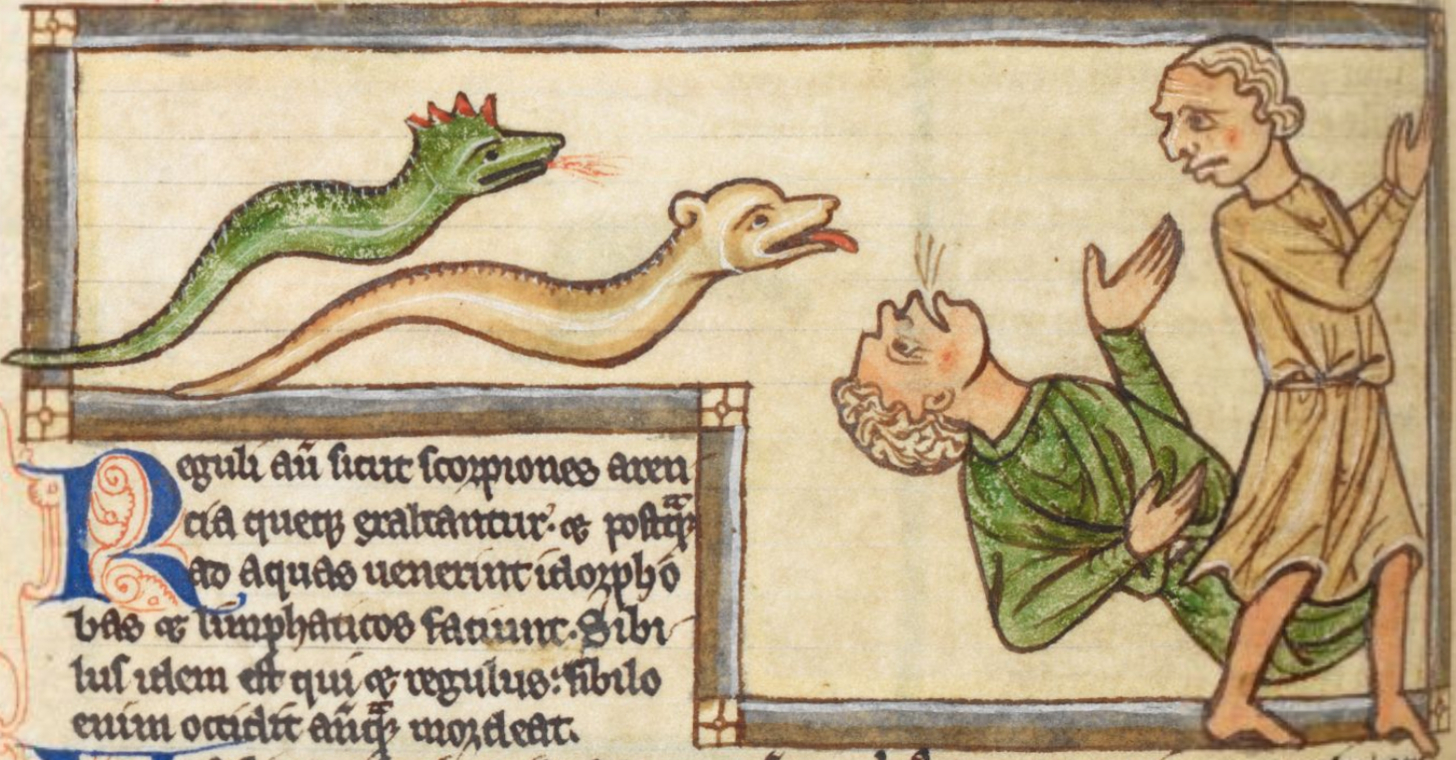
THE BASILISK.
Then a key turns in the lock. Slowly the massive door creaks open, and in the blinding light is the silhouette of the consul of the city.
“All right, men,” he says. “There’s a basilisk in an old cellar, and it needs to come out. In exchange for a full pardon, who wants to put on the mirror suit and go down after it?”
One of the men volunteers.
The basilisk or cockatrice (the two terms had become synonymous by the 1600s) was a known fact of natural history, and now you can be well informed on all matters to do with basilisks, because Dr. Boli has taken the trouble to transcribe a learned treatise on the subject by George Caspard Kirchmayer, one of those wonderful old naturalists who studied all of nature without setting foot in the grubby outdoors. “To deny the existence of the basilisk is to carp at the evidence of men’s eyes and their experiences in many different places,” says Kirchmayer. However, he is not such a fool as to believe in those old wives’ tales about its killing men with a glance. No silly mirror suits for him. They wouldn’t do him a bit of good: the basilisk could kill him with its breath.
This translation of Kirchmeyer’s learned treatise is by Edmund Goldsmid, a Scottish bibliophile who published a number of translations of old Latin treatises in very limited editions. Unfortunately he died young; otherwise he might have left us English versions of much more of that “lost continent of literature,” as James Hankins called the neo-Latin world. Mr. Goldsmid’s notes are worth reading in themselves: they introduce us to many of the other characters in the scholarship of the 1500s and 1600s. It is remarkable how many of them died of stubbornness. “Having convinced himself that one could not catch the plague at 60 years of age, he took no precautions, and died of that disease in 1596.” “Cardanus…starved himself to death in 1576, to accomplish his own prophecy that he would not live beyond the age of seventy-five.”
You can read Kirchmayer on Basilisks at the Argosy of Pure Delight, where we present it in mobile-friendly and Web-friendly form. You can also see the original page images of Edmund Gosmid’s translation in the Internet Archive; you may notice that, in his transcription, Dr. Boli has silently corrected a number of printing errors in Goldsmid’s edition—and doubtless introduced some new ones, because that always happens.
2023 PENNSYLVANIA TREE SURVEY.

1. Are you now, or have you ever been, a tree?
Yes
No
Not sure
2. Does anyone in your household identify as a tree?
Yes
No
I don’t like to ask
3. Where do you stand on the utility-cable issue?
Right over there
Not under them, because there are birds
I do not see the point of utilities, because I am a tree
4. Which of these is Pennsylvania’s top priority?
Emerald ash borer
Chestnut blight
Education
N. B. One of the answers above is wrong.
5. The penalty for bonsai should be…
Death
Life in prison
Confiscation and exile
6. Do you think that, in general, residents of Pennsylvania care more about trees than people in the rest of the country?
Residents of Pennsylvania definitely care more about trees than they do about people in the rest of the country.
I don’t know, but they sure don’t care enough about trees.
Are you talking about the human residents of Pennsylvania? Because that makes a difference.
7. Can you identify the trees near your home?
Most of them
The ones to my left, but not the ones to my right
That one over there is Fred
IN THE NEWS.

DID YOU KNOW…
…that a baker’s dozen is actually 12.93?
…that there is not one statue of Sam Houston on the entire continent of Africa?
…that Sanskrit grammarians counted no fewer than ninety-seven parts of speech, ninety-one of which were known only to the gods?
…that Louis Philippe’s nickname before he became king was “Morrie”?
…that Stilton cheese is described by mycologists as “borderline sentient”?
…that a stool with three legs is perpetually falling over, but perpetually caught by its third leg?
…that it would take more than 12.4 billion Labrador retrievers to retrieve Labrador, even without Newfoundland?
REMARKABLE HABITS OF BIRDS.
Patterson’s Puce-Footed Teal always orders its nest by mail and has never adapted to the Internet.
The Chesapeake Concerto Sparrow has only three movements.
The Atlantic Marathon Tern is the only migratory bird known to solicit pledges and migrate for charity.
The misnamed Florida Scrub Jay is dogmatically opposed to all housework.
The Tamil Nadu Raven says “Mylapore” at the end of every stanza, yet has never been successfully exploited by Indian poets.
The European Marble Dove can eliminate only when perched on allegorical statues.
ASK DR. BOLI.
Dear Dr. Boli: I ordered a “French Dip” sandwich at the sub shop, and it said it came with “au juice for dipping.” That made me wonder: How do they juice an au? —Sincerely, Marine Le Pen.
Dear Madam: Very carefully.
That was a little joke, of course. In reality, once two separate words have been contracted into a single word of two letters, as à le into au, pretty much all the juice has been squeezed out of them. Technically, “au juice” is not strictly a juice at all, but rather a tisane, made by steeping the au in hot water until an au-flavored liquid is obtained.