Posts filed under “Science & Nature”
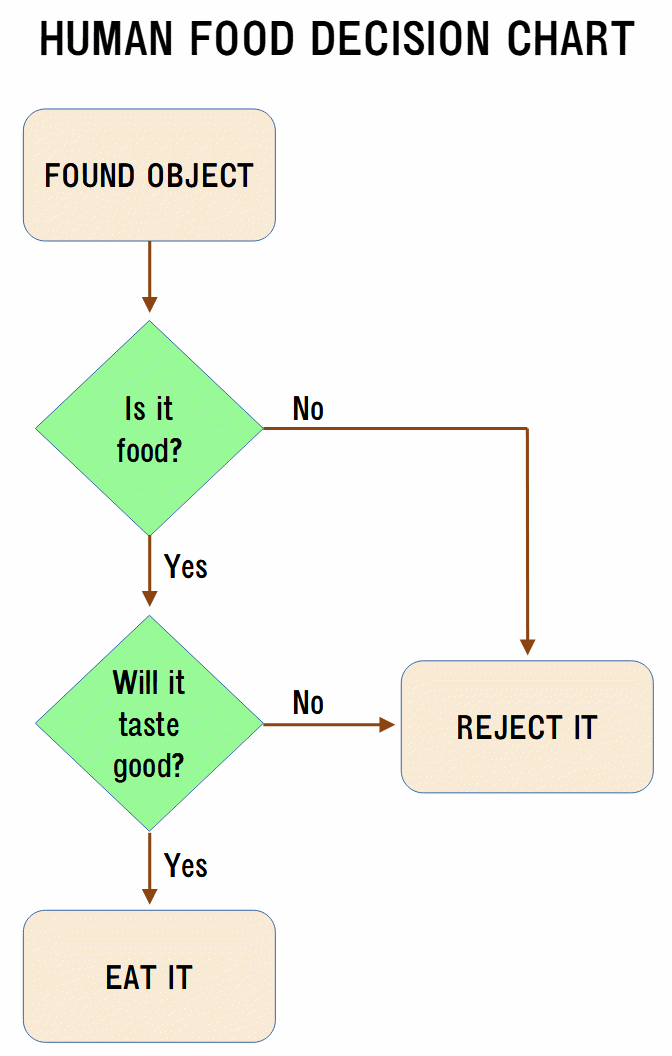
TWO APPROACHES TO THE FOOD QUESTION.

ASK DR. BOLI.
Dear Dr. Boli: I am a member of the managerial class, a small, marginalized, and often despised minority. How should I deal with microaggressions at work? —Sincerely, Ethelbert Norville, M.B.A.
Dear Sir: You should be microannoyed.
Dear Dr. Boli: If I run memory foam through the washing machine, will it come out with post-traumatic stress disorder? —Sincerely, Paula T. Sorbet-Dribble.
Dear Madam: Yes.
THINGS TO KNOW;


Now you know that your metaphorical crops are in abundance. Now you know that people born under a waxing gibbous moon are compassionate and motivated and fickle and indecisive. Now you know that themes of enthusiasm are strong.
Now you know less than before you asked Google, because these things are all negative knowledge. They subtract from the sum of true information in your brain. This is how the Internet makes suckers of us all.
ASK DR. BOLI.
Dear Dr. Boli: How can you tell an “authentic French beignet” from a jelly doughnut? —Sincerely, A man standing at the bakery counter at Whole Foods.
Dear sir: Look at the price tag. “Beignet” means a number of things in France, but in the United States, according to FDA labeling standards, an authentic French beignet is a jelly doughnut with a price multiplier of 5.
ASK YOUR DOG.
Scientifically speaking, this is balderdash. Our current styles of acting are stale and ritualized, almost liturgically artificial. The only reason we insist that acting in our current movies and television entertainment is “natural” is because we have agreed to consider certain clichés as standing in for nature.
We say scientifically speaking because Dr. Boli has proved his assertion by a scientific experiment that does not depend on the reaction of a human audience. He asked the dog. If you have a good watchdog at home, you can try the same experiment yourself.
First, you can play a movie or television show on your computer so that the dog can hear it. Result: Dog does nothing. Dog knows that dog is not hearing real people talking: it is ritualized performance recorded somewhere else, at some other time, and is of no concern to dog.
Now make a video call to some friend from the same computer, so that the sound comes out of the loudspeaker at the same volume. Result: Dog leaps into a barking frenzy to warn you of a perimeter breach. Dog can hear that this is a real person talking. It is not ritualized performance at all.
Nothing has changed in the quality or source of the sound. The only thing that has changed is the rhythm and expression of the person talking. Dog ignores the fictional character because dog has learned that fictional characters are not real people and do not invade the house.
The same, incidentally, is true of news and information programs. Reporters have their own ritualized expression, which is completely uninteresting to dogs. Dogs understand the difference between television personalities and real people—a lesson we humans would do well to learn.
So the next time you hear someone praise the utterly natural performance of a certain actor, ignore the critic. Ask your dog instead. Your dog is a better judge.
DID YOU KNOW…
…that five successive Byzantine emperors were misplaced somewhere in the Blachernae and are presumed to have been built over?
…that there are still three garage bands in Indianapolis that do not have their own Wikipedia articles?
…that scientists are unable to explain how cats sleep for 117% of their lives?
…that so-called “popular” music only appears to be popular because so many people listen to it?
…that Charles Dickens, for all his success as a novelist, never sold a single screenplay?
ASK DR. BOLI.
Dear Dr. Boli: Why are there mosquitoes? I mean really. —Sincerely, A girl who’s trying to enjoy her last few days before seventh grade but is getting, like, totally eaten up out here.
Dear Miss: The scientific answer to your question is very simple: there was a female mosquito, and there was a male mosquito, and they fell in love, &c., &c., and soon there were baby mosquitoes all over the place. But Dr. Boli presumes you already have a thorough understanding of these elementary scientific facts. (If not, then seventh-grade biology will come as a revelation, and you might wish to pay close attention.) The question you ask, then, is of a more philosophical than scientific nature.
It may surprise you to learn that causation is itself a complex question. Aristotle identified causes of four different sorts, and the answer to any question of “why” cannot be given until we have determined which of the four sorts of “why” we are really asking.
In the case of mosquitoes, the material cause of the mosquito is the blood it uses to form bug parts.
The formal cause is the genetic code that causes those bug parts to form in the pattern of a mosquito, rather than, for example, a bloodsucking hippopotamus. Dr. Boli would advise you not to think too much about bloodsucking hippopotamuses, even merely hypothetical ones. It is important to get several nights of good rest before you begin the adventure of seventh grade.
The efficient cause of any given mosquito is that falling in love, and more properly that &c., that its parents did.
Then we come to the final cause, which Dr. Boli suspects is what you have been looking for all along. Why are there mosquitoes when the alternative of not-mosquitoes seems so much more attractive to a rational mind?
Theologians would argue that mosquitoes are a consequence of the first human disobedience, which forever damaged humanity and the world we live in. Prelapsarian mosquitoes had no need for animal food and subsisted entirely on a diet of the juice of blood oranges, which Adam plucked and set out for them every day.
In our fallen world, it is necessary for us to be subjected to a string of small annoyances every day, so that we never forget how far we have fallen and how great is our need to be picked up again. Mosquitoes were by far the most efficient means of delivering minor annoyance until the advent of YouTube.
So the next time you hear the whine of a mosquito in your ear, you should remember that this is all part of the wonderful plan of redemption. You should remember that each individual mosquito is also an essential part of the biological cycle of life. Then you should smack that mosquito quickly and decisively, because nobody likes mosquitoes.
REMARKABLE ANIMALS.
The Patagonian Wild Poodle uses the sharp stones that abound in its native habitat to trim its fur into serviceable pompoms.
McGillick’s Lesser Swamp Gerbil can, when cornered, sing all the songs of Dan Schutte, which discourages some predators and brings out the sentimental sap in others; in either event the gerbil is likely to be spared.
The Brunot’s Island Weasel, having depopulated its habitat of suitable prey long ago, has learned to order from Grubhub.
The Madagascar Flying Lemur can soar through the air for considerable distances, but only when thrown by another Madagascar Flying Lemur.
ASK DR. BOLI.
Dear Dr. Boli: Why are space aliens not visiting us? With all the stars in the galaxy and all the planets spinning around them, there have to be intelligent beings who have overcome the trivial difficulties of faster-than-light travel. Yet they never visit. They never even text me. Are they snobs or what? —Sincerely, Neil deGrasse Tyson.
Dear Sir: It is true that the abundance of worlds in our galaxy makes it improbable that there are no other forms of life out there. They might consider it unwise, however, to get themselves mixed up with unpredictably primitive civilizations. It is likely, therefore, that something about our civilization strikes them as primitive. If we look at our planet from an outsider’s point of view, with an unbiased eye, what we notice immediately is that we still have weather. An extraterrestrial species evaluating our world for potential cultural exchange or commercial exploitation would seize on that detail as indicative of the state of our civilization as a whole. “They still have weather,” the scouts’ report would say. “Until they can get their act together and cooperate enough to implement some rudimentary meteorological planning, it is safe to assume that their planet is unprofitably and even dangerously disorganized; their culture has nothing to teach us, and a risk/benefit analysis of the commercial possibilities does not persuade us that this species could be profitably exploited.”
You should consider the possibility, however, that certain advanced extraterrestrial beings would be willing to meet suitably forward-thinking members of the human species on a private basis, subject of course to sensible non-disclosure agreements. Once you have considered that possibility thoroughly, you should show up at the Grandview Park bandstand at half past eleven tonight and bring a good Riesling. For some reason they are particularly fond of Riesling.
DID YOU KNOW…
…that a rose by any other name would have a far lower Google ranking?
…that the first stationary bicycle was an embarrassing manufacturing error?
…that the Jerusalem artichoke is neither from Jerusalem, nor a choke, nor arty in the least degree?
…that the American Robin (Turdus migratorius) can sing all the songs of Isham Jones except “It Had to Be You”?
…that, in defiance of Darwinian orthodoxy, sponges evolved hundreds of millions of years before the first kitchen sink?
…that Pharaoh’s command to make bricks without straw was a process innovation universally endorsed by today’s brick manufacturers?
…that cumulus clouds are entirely imaginary?