Posts by Dr. Boli
POST THIS NOTICE.

CONOR’S CRITICAL REVIEWS.
Hi, so this is, like, Conor, with Conor’s Critical, uh, well, I wanted to call this channel something alliterative, but the only thing I could come up with was “Crap,” and I promised my mom I wouldn’t use bad language. So Conor’s Critical Reviews. How’s that?
Today we’re going to be looking at one of my favorite cult movies of the past few years: God Versus the Zombies. Spoiler alert: the zombies are, like, totally outclassed. But you don’t watch one of these classics for the plot, right? I mean, you watch it for the atmosphere. So this movie is like totally soaked with atmosphere. I mean it’s got clouds and everything.
So it starts out and there are these zombies, and they’re like attacking New York, which is actually Uniontown, Pennsylvania, cause you can tell by the skyline, but anyway these zombies are attacking, and all the people are running away from them, and then God shows up and smites them, and all the zombies fall down.
So you think, Well, that’s the end of the movie. Cause, you know, when God kills you, you stay dead, right? But the problem with zombies is they’re already, like, dead. And God doesn’t know what to do with them, cause the point of smiting is that you like die when it happens, and these zombies are already dead. So God is like, what’s up with that? And the zombies are like, gluh gluh brains gluh, and God is like, I’ll smite them again, but they just get up again and they’re all like gluh gluh brains again. So then they—what? Mom, I told you, I’m doing a— But mom, it can wait till I— but— Heck. Guys, I have to take out the trash, so I’m like gonna post this now, and then I’ll do a God Versus the Zombies Part II. See you next time on Conor’s Critical Crap. Oh, heck. I mean Reviews.
MANY THANKS TO READERS…
…for the helpful suggestions they provided. If the literary world does not want literature that is “like Hazelnut Torte crossed with Nissin Cup Noodles,” in the words of “Daniel,” then the literary world is a very dull place.
YOU DO DR. BOLI’S WORK FOR HIM…
…And Get Nothing in Return!
Yes, readers ought to have a union to prevent this kind of exploitation. But here is the interesting game we are playing:
A publishing acquaintance suggested that the way one promotes a book in today’s market is by comparing the author to two other known authors. She says that Dr. Boli ought to be promoting a new book this way. “Tell them it’s like John Green crossed with G. K. Chesterton,” she said.
Dr. Boli objected that the work in question was more like Henry James crossed with Edmund Spenser.
“But you want people to care,” said the publishing acquaintance. “John Green sells books. G. K. Chesterton still sells books, even though I think he might be dead. You have to pay people and give them tenure to make them read Spenser.”
Here Dr. Boli tried to engage her in a conversation about the delights of Spenser, but she put her earbuds back in her ears.
Thus the reader challenge. You have read Dr. Boli’s writing. To what does it compare? “Dr. Boli is like A crossed with B.” That is what the literary world wants to hear. Furthermore, the literary world wants to hear that both A and B are selling a lot of books right now.
HAPPY JUNETEENTH.
This is a day of freedom for all Americans; slavery makes slaves of us all, and one who believes that our life on earth is only a prologue to eternity may be forgiven for supposing that the slaveowner spends a longer time in more discomfort. In honor of the new federal holiday, here are some articles that have appeared in the Historical Spectator on the subject of slavery:
The Real Motives of the American Colonization Society
A Frenchman Looks at American Race Relations
Now, here is an interesting exercise in historical research. How and when did the name “Juneteenth” come into use? It is quite possible that one of our readers knows, but Dr. Boli does not, and his sources of information have failed him. Wikipedia does not mention the question, let alone answer it. You can ask the Internet “Where did the name ‘Juneteenth’ come from?” and the Internet will helpfully tell you that it is a contraction of “June” and “nineteenth.” Yes, you guessed that, but where did that contraction come from? When was it first used? You will see people asking that in forums, and being told that it comes from “June” and “nineteenth.” When they politely remark that they knew that, but it wasn’t the question they were asking, they may be told the same thing in capital letters: IT COMES FROM “JUNE” AND “NINETEENTH.” There are articles with headlines that purport to explain the origin of the name, and they tell you that it comes from “June” and “nineteenth.”
But it is a distinctive contraction, isn’t it? It is not obvious that “June” and “nineteenth” should produce “Juneteenth.” We do not celebrate the Declaration of Independence on Julourth. It seems to Dr. Boli that some graduate student has a thesis topic here that would lead to some fascinating and fruitful byways of history. When was the name first used, and by whom? Dr. Boli will mention that the earliest use he could find was in 1890, but it seemed to refer to a celebration already well known by the name Juneteenth. Can anyone do better?
REFEREE’S SIGNALS IN AMERICAN FOOTBALL.

If my head were a football, it would be right between the goalposts.

I am a pretty, pretty butterfly.
You must be this tall to sack the quarterback.

Insufficient muscular development. 10 yards.

Well, really.

Ev’rybody do that Footloose Strut.

Illegal ambivalence. 25 yards.

Applause, please.
NEW BOOKS FROM RUNCIBLE THIS WEEK.
Tractatus de Filibustro; or, The Art of Saying Nothing at Great Length and with Appropriate Conviction. By State Senator Henrietta Maria Stuart.
Faith’s Proctoscope: In Which the Recent Reform of the Reformed Church is Carefully Examined and Thoroughly Vindicated, and the More Recent Claims of the Reformed Reformed Reformers Are Utterly Demolished. By the Rev. Thaddeus Carton, D.D., D.D.S., M.B.A.
How to Recognize and Avoid Responsibility: An Essential Handbook for the Middle Manager. By the Interim Publications Committee.
The Antisocialite’s Companion: Party Tricks That Will Clear a Room so You Can Drink All the Punch Yourself. By Egbert Pound.
The Noble Gases: Their Pedigrees, Incestuous Marriages, Private Wars, Social Embarrassments, and Oppression of the Common Elements. By Amelia Stokes-Chapell Wallington-Carnaby-Fortescue.
The Collector’s Price Guide to Plastic One-Gallon Fruit-Punch Jugs. By Al from Herb’s Cooking for One.
The Voice of the Voiceless: How to Be an Advocate for the Consonants No One Wants to Talk About. By Prof. Hetta Picketts.
All from Runcible Books and Finer Meats, Squirrel Hill
Don’t Forget to Eat Meat While You Read
MORE INITIALS TO INTERPRET.
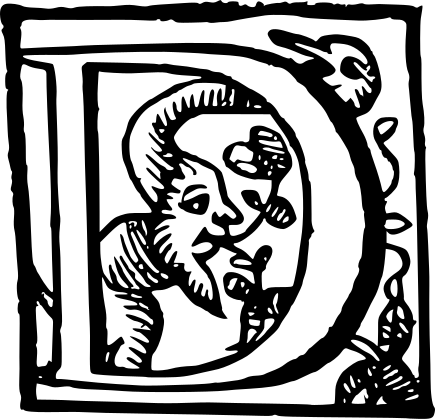
D for the Dermatologist you must see if you have a growth like this on your head.

E for the Ennui suffered by the bagpipe player who must keep up a constant drone for an hour.

L for the Liquor to which this poor man is addicted, causing him to see wild boars that no one else can see.

R for little Roberta playing the starring role in her third-grade play, Our Friend the Roach.

T for Throwing, a monkey’s favorite hobby.

X for Xerxes counting his million-man army and coming up with 999,997.
More fun with initials may be had on our page of initials in the Illustrations collection.
ASK DR. BOLI.
Dear Dr. Boli: So what should we really do about racism in this country? —Sincerely, A Man Who Thought “Racism” Meant NASCAR Until Quite Recently.
Dear Sir: First, we must understand that nothing can be legally done about private racism, which is to say the expression of insulting opinions by private individuals. Private racism is not, and must not be, illegal. In Dr. Boli’s opinion it is wrong, but not everything that is wrong can or ought to be made illegal. Dr. Boli has never come to terms with Calvinism, but it is openly practiced not half a mile from the Boli mansion. Likewise, private racism must be tolerated, and once again Dr. Boli finds it necessary to define tolerance. Tolerance is not approval. It is nearly the opposite of approval. We have no need of tolerance for things of which we all approve. Tolerance is my guarantee of your right to be wrong, in exchange for your guarantee of my right to be wrong. We tolerate racists, meaning that they have the right to rant as much as they like about the inferiority of Danes or Bhutanese or whatever ethnic groups they disapprove of.
We also need to distinguish racism from other things we disagree about. It is not racist to believe that a child born black in this country has the very same opportunities that a child born white has. The term for that is naive or hopelessly optimistic, not racist. It is not racist to believe that people of other cultures should conform to the standards of behavior or belief of one’s own culture: the term for that is narrow-minded or chauvinistic, not racist. Racism is not a question of behaviors: it is the belief that people of a certain ancestry should not have the same privileges as people of some other ancestry. It is aristocracy on a large scale, with all the absurdities of aristocracy—a word that actually means “rule of the best,” which should provoke a hearty laugh in anyone who has mingled with aristocrats.
Legally, what we can do about racism is limited. We can make laws that are blind to race, and demand judges who will enforce them. We can insist on equal treatment in public accommodations, regardless of the private views of the managers of such accommodations. Where we see injustice in government, we can shine a bright light on it, and we can vote for justice. But we cannot use the law to stop racists from being racist. We can only limit the scope of their behavior.
Morally, however, we have a doomsday weapon against racism. We can mock racists. Racism is the most mockable of all vices, because pride is the root of all racism, and pride is also the root of all comedy. When we have seen the proud cavalier displaying his pride in the first reel, we are ready to see him fall off his horse into a mud puddle in the second. The racist who believes he represents a superior race is inviting us to demonstrate exactly how he is wrong about that.
Therefore, dear reader, you know your duty. Go out and do it. No racist should be safe from your sarcasm. All lovers of justice and equality are depending on you.
HIGHLIGHTS OF THE SALON OF 2021.
Eli “Bonkers” Johnson: Diagonal Line #6: Anthraquinone Blue, Upper Left to Lower Right, but Deviating Slightly About Three-Quarters of the Way Along Where a Fly Landed on the Artist’s Elbow. Acrylic on canvas.
Albrecht Kunsthammer: Venus Giving Cupid a Time Out After That Business with the Movie Star and the State Representative. Oil on Wood.
Crandall Pinsk: Untitled No. 2: Revenge of the Untitled. Stuff glued together with a hook in the back for hanging.
Margaret Derby-Wallington-ffitch: Philadelphia Fleabane (Erigeron philadelphicus) Posed as an Allegory of Virtue. Crayon on construction paper.
Boris the Dog: Paw Prints No. 38. Mud on the mistress’ best linen.