Posts by Dr. Boli
NEWS IN BRIEF.
PROTEST RALLY CUT SHORT.
PITTSBURGH (Special to the Dispatch.)—A protest rally held in Oakland this morning by the North American Brotherhood of Clumsy People was cut short after only five minutes of its planned two hours.
The protest, billed as a RAGE, or Rage Against Gravity Event, was one of dozens of similar protests in cities across the nation.
“The Law of Gravity discriminates disproportionately against clumsy people,” declared Miss Ravina Hoop, pacing back and forth on the improvised stage in front of the Carnegie Museum of Natural History. “Clumsy people should have the right to be—”
At this point in her speech, Miss Hoop tripped over her microphone wire and fell headfirst into the crowd. No major injuries were sustained, but the rescue squad, which always appears in force for every NABCP rally, recommended that the rest of the proceedings be postponed.
Advertisement.

ADVICE TO YOUNG WRITERS.
IT SOMETIMES HAPPENS that Dr. Boli is approached by young writers eager to absorb some of his wisdom and experience. What, they ask, does a writer need to succeed in his chosen art?
Invariably Dr. Boli gives them the same answer: good ink. A writer can get by with indifferent paper, provided it does not feather the ink; and the last time Dr. Boli checked (which he admits was some time ago) a gross of steel pens, even of the finest quality, could be had for very little money. But the ink itself must be chosen with great care. Dr. Boli would even go so far as to say that no one can be a good writer without good ink. To a degree seldom sufficiently acknowledged, the flow of ink determines the flow if ideas.
An ink too runny will blot the page; too thick will clog the pen. But ink of exactly the right consistency—that is one of the great pleasures in a writer’s life. Words, sentences, whole paragraphs roll off the tip of the pen without another trip to the inkwell.
Dr. Boli would like to be able to recommend one particular ink and be done with it, but—alas!—the question is not as simple as that. The ink must be matched to the pen.
Dr. Boli himself is partial to the Esterbrook No. 910 Cashier’s Pen, a very fine and somewhat flexible point for which a thin and free-flowing writing fluid is best. The same ink would blot uncontrollably with a broader nib.
Recently Dr. Boli has been informed of certain developments in mechanical science that would supposedly render pen and ink obsolete. He hopes that he may be forgiven a certain degree of skepticism. Until the new mechanical wonders have proved themselves beyond a reasonable doubt, he will continue to advise young writers to devote particular attention to the choice of ink.
From DR. BOLI’S ENCYCLOPEDIA OF MISINFORMATION.

Riga, or possibly Vilnius.
Latvia. The question of whether “Latvia” and “Lithuania” are really two different places was not answered definitively until the early 1990s, when explorers reached Riga and reported that it was not the same as Vilnius.

Vilnius, or possibly Riga.
NOTICE.
A VERY IMPORTANT meeting of the Anarchist Council will be held this evening at 7 p.m. at Mrs. Porter’s house. We will be voting on a proposed amendment that would add the words “or not” to the end of each clause of our Charter.
ASK DR. BOLI.
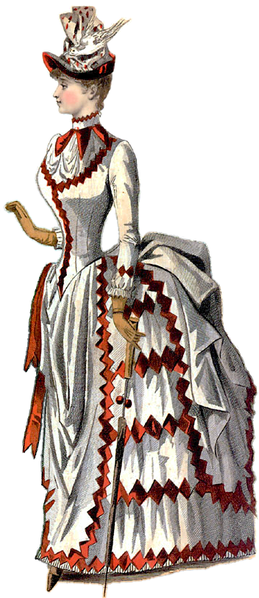 Dear Dr. Boli: While working on costumes for a revival of Cordelia’s Aspirations at the Shiras Theater, I was struck by the question of the bustle, that peculiar mechanical apparatus that gave women’s skirts such a ridiculous bulge in the rear. Why did women affect such a monstrous exaggeration of their own anatomy? —Sincerely, “Raven,” from Claude’s Costumes & Tattoo Parlor.
Dear Madam: Do you mean to tell Dr. Boli that artificial mechanical contrivances were responsible for— that is to say— This is dreadfully unsettling, and Dr. Boli will need some time to recover himself. He had always assumed it had something to do with a change of diet. Mechanical apparatus! Well, this is the frozen limit.
Advertisement.

READERS WRITE.
A NOTE FROM a certain Mr. Smithington, Esq.:
Dear Dr.,
The word “nonplussed” means surprised or confused. An emotional iconograph conveying such an expression would look as such, “:O”. Using the term, “nonplussed” as a neologism referring to one who is unimpressed—as I suppose was the emotion you were attempting to convey with your “emoticon” consisting of merely a colon punctuation mark—is a habit the more vulgar classes are attempting to impose on us and should be discouraged.
With kindest regards,
S
Our correspondent is quite right in condemning the neologism. Dr. Boli was not aware that anyone was using the term that way until this comment sent him out to do some research on the omniscient Internet. He does not condemn all development in language: he would be sorry to see English limited to the vocabulary and style of Alfred the Great, however laudable his works may be in their own right. But the misuse of “nonplussed” threatens to deprive us of a useful expression for which there is no close equivalent.
The root sense of “nonplussed” is “unable to go further.” It is the utterly puzzling sensation of reaching the limit of one’s leash without having previously known that one was collared. It is different from surprise, which is a kind of shock produced by something marvelous or unexpected, and which would fittingly be represented by an expression of open-mouthed wonder. To be nonplussed is to have the sudden realization that one simply doesn’t know what to think or do about something. It is the blank and despairing feeling that what had up to this moment seemed comprehensible really makes no sense at all.
If he were addicted to the use of emoticons, Dr. Boli would prefer to represent the state of being unimpressed thus: : ¹
ASK DR. BOLI.
Dear Dr. Boli: I am about to start a new job at a company whose dress code is described as “business casual.” What does “business casual” mean, and how do I dress that way? —Sincerely, Millicent K. Warble, Soon to Be Vice President in Charge of Drippings, Chunk-O-Beef Restaurants, Inc.
Dear Madam: The mere fact that two words can be printed side by side does not mean that the resulting phrase actually signifies something. As far as Dr. Boli can see, the phrase “business casual” has no more meaning than the phrase “toucan volcano.”
–
Antisocial networking enthusiasts! Did you like this article? Then click on the word Like in this paragraph, and you have Dr. Boli’s word of honor that nothing will happen.
ASK DR. BOLI.
Dear Dr. Boli: Can you explain the significance of the so-called “emoticons” often inserted in various forms of Internet communication? As indicators of human emotion, they confuse me. —Sincerely, Expert System M-331, Carnegie-Mellon University.
Dear, um, Sir or Madam: Emoticons, possibly the greatest innovation in punctuation since the multiple exclamation point, are a carefully worked-out way of encoding facial expressions in written language, so as to give it the immediacy of speech. There are many such expressions, but here is a list of the most common:
:) – I am smiling.
::) – I am smiling while wearing glasses.
:( – I am mildly unhappy about that.
:€ – I am trying unsuccessfully to hold back my tears.
:D – I am smiling in a suspiciously enthusiastic way.
:L – I have a toothpick in my mouth.
:$ – My braces are exceedingly uncomfortable today.
:K – I am a cat.
:K – No matter what they say, I believe that a somewhat droopy mustache adds a quiet dignity to my appearance.
:* – The exploding cigar you gave me just went off in my mouth.
:> – I am feeling insufferably smug.
: – I am nonplussed.