Posts filed under “Books & Literature”
FROM THE ILLUSTRATED EDITION.

THE NINE MUSES.
The arts having progressed considerably since the primitive days of ancient Greece, it is time for a truly up-to-date list of Muses.
Alexis, Muse of Supermarket-Checkout Tabloids.
Madison, Muse of Comic-Book Superhero Franchises.
Olivia, Muse of Telephone Scams.
Kaylee, Muse of First-Person Shooter Games.
Makayla, Muse of Tweets and Facebook Statuses.
Brandy, Muse of 24-Hour News Channels.
Addison, Muse of Acoustic Folk Bands in the Parking Lot of Whole Foods.
Riley, Muse of Installation Art.
Kaitlin, Muse of Texting While Driving.
FROM THE ILLUSTRATED EDITION.

FROM THE ILLUSTRATED EDITION.

FROM THE ILLUSTRATED EDITION.

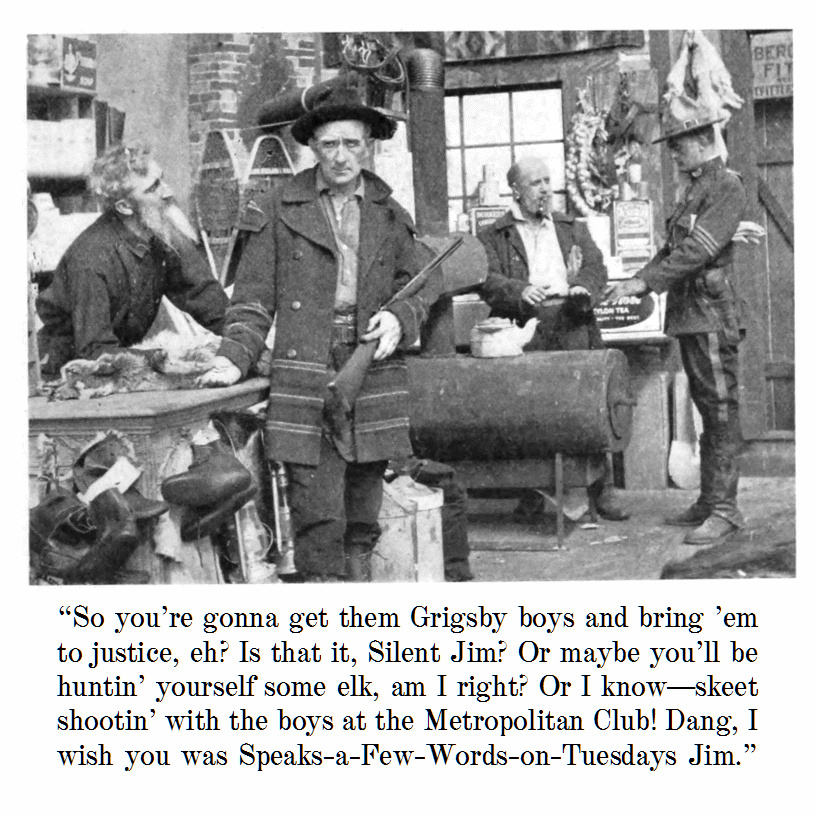
SILENT JIM.
FROM THE ILLUSTRATED EDITION.

FROM THE ILLUSTRATED EDITION.

BOLI’S LAW OF RESEARCH.

It is difficult to find any particular thing if you are looking for it, but you can find the most wonderful and delightful things if you are not looking for anything in particular.
This was a thought that came to Dr. Boli as he was adding a few items to his collection of illustrations.
(The cartoon above was published in 1888.)
ASK DR. BOLI.
Dear Dr. Boli: I keep hearing some cop shows called procedurals, and I was wondering: what’s the difference between a procedural and a detective story? —Sincerely, Prof. Arthur Conan Dinkleberger, Duck Hollow University Department of Popular Entertainment.
Dear Sir: A procedural is a particular kind of detective drama in which dogged work alone leads to the solution of the mystery. In the classic detective story, the detective must make some clever deduction from the facts of the case, which are in themselves apparent to everyone; the solution comes because the detective sees some pattern or indication in those facts that no one else sees. In a procedural, the detectives gather facts until the last fact falls into place, and then the solution to the mystery is obvious to everyone, including the janitor at the precinct house. In other words, a procedural is a story in which the mystery can be solved by Dr. Watson alone, without any assistance from Sherlock Holmes, or by the Parisian police without Auguste Dupin. We might say that the difference is that the classic detective story is interesting, whereas the procedural is a slog. Or to put it another way, a procedural is a detective story for stupid people.
“The Purloined Letter,” by Edgar Allan Poe, is a perfect illustration of the difference between a procedural and a detective story. The Parisian police gather all the evidence it is in their power to gather; they poke and measure and even bring out the microscopes. In a modern “procedural” drama, that would be the story. But they fail, and Dupin, possessing the same evidence, comes to the conclusion that only he can come to.
Here is the original story, as it was first printed in The Gift for 1845.