Posts filed under “Popular Entertainment”
DAILY AFFIRMATIONS FOR SUPERVILLAINS.

What the world needs most today is order.
When I am in charge, I will stop this senseless discrimination against the differently sane.
Though I control a vast nuclear arsenal, I trust in my henchmen’s martial-arts skills to defend me.
What others call my “monstrous egotism” is merely a reasonable and informed self-esteem.
My character judgment is infallible, and my underlings are unswervingly loyal.
Although the United Nations could never agree on a protocol for ordering pizza, they will nevertheless accede to my demands unanimously within twenty-four hours.
A self-destruct countdown that cannot be stopped is a feature, not a bug.
The fact that my extravagantly gorgeous daughter has an eye for square-jawed hero types will in no way impede my ultimate victory.
Anger clarifies my judgment.
Reason alone will persuade the hero’s plucky girlfriend that I am a more suitable mate.
You say “psychotic”; I say “perceptive.”
BUCKETMAN.
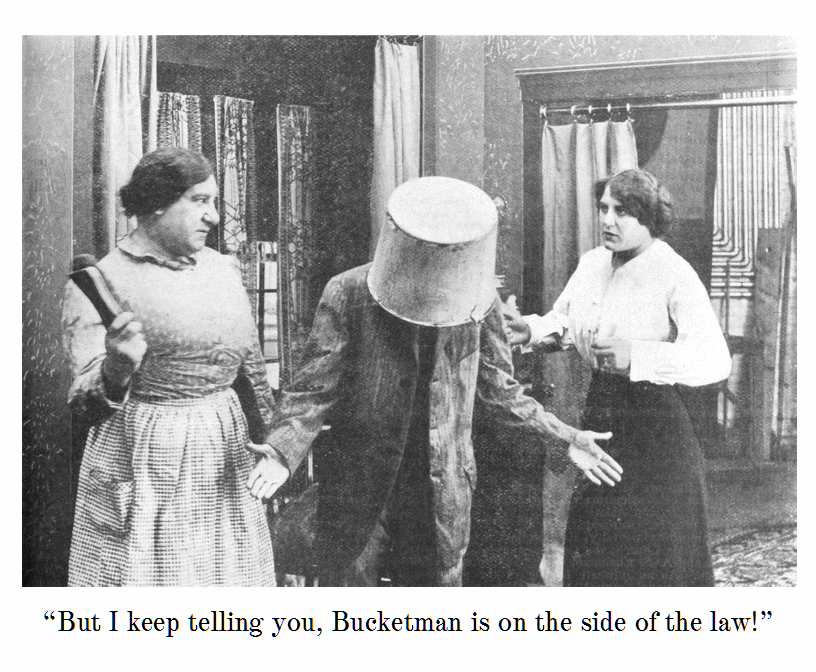
COMING SOON TO A THEATER NEAR YOU.
Two Bedrooms, One Bath. Hilarious door-slamming bedroom farce in which four superheroes forced to share the same apartment get into all manner of comical mixups.
Mystery of the Orchid Chamber. At a weekend party for superheroes, Capybaraman is found murdered in a locked room. Can the other guests figure out which one of them is a supervillain before the killer strikes again?
Hatman. Award-winning documentary follows the Capped Crusader in his epic three-year battle against trademark lawyers from DC Comics.
Twelve Angry Heroes. Riveting courtroom drama in which superheroes summoned for jury duty must decide the fate of a masked vigilante.
The Tights Unit. Gritty procedural follows a day in the life of the “Tights Unit,” a special office of the New York City police department charged with investigating superhero-on-superhero crime.
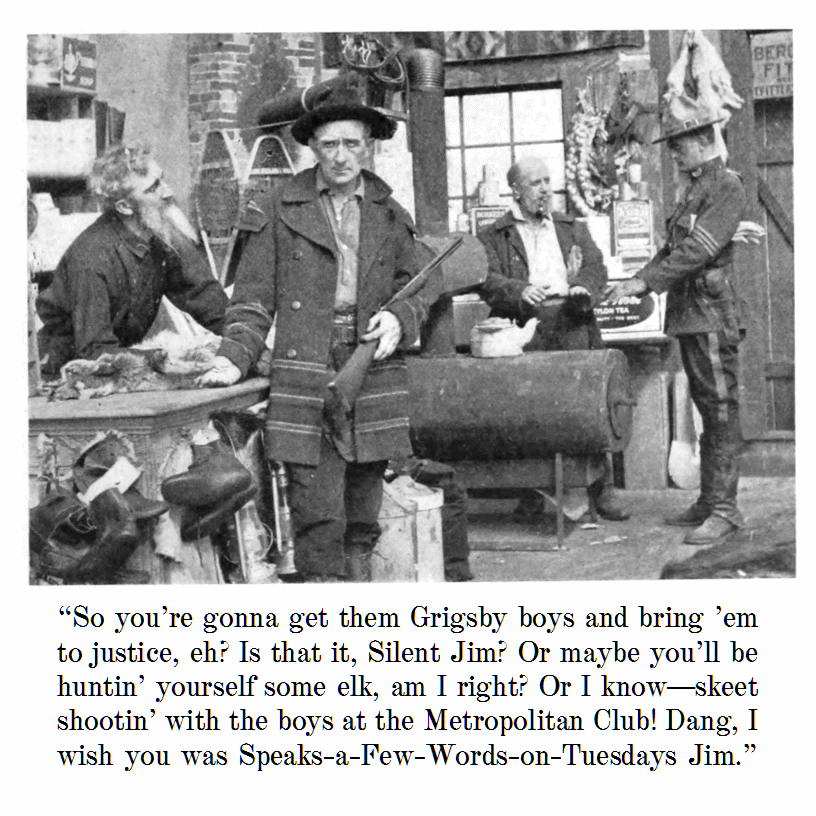
SILENT JIM.
AL’S WILDERNESS SURVIVAL.
Well, here we are with Al’s Wilderness Survival, a brand-new show where we learn how to survive in the great outdoors. I’m Al, and some of you may know me from Herb’s Cooking for One, where I’ve been filling in for Herb while he’s feeling a bit out of sorts, which—well, the doctors are saying we should see an upturn by 2023 or so, so hang in there, Herb.
I’ll still be filling in for Herb, but today I’m doing this new show, because my wife said I had to get a real job. So I thought, What am I really good at? And my wife answered,—cause apparently I talk when I think,—she answered, “Surviving.” And I said, “Why do you say that?” And she said, “Because we’ve been married twelve years and I haven’t killed you yet.” Ha ha! I think that was supposed to be a joke.
So I went to the producer of Herb’s show, and I told him my idea, and he said, “Sure! And let’s make it really real, you know, by sending you way, way out in the woods with no crew or anything—just a camera you can put on a tripod, and there you are.” And here I am. I had to buy the camera myself, but I know the budgets aren’t what they used to be for these shows.
So the first thing you need when you’re stuck out in the woods is shelter. Now, I could sleep in my car, which is parked right over there, but hey, we’re guys, right? What’s the point of surviving in the wilderness if you don’t build your own shelter, just like the pioneers had to do?
So that’s what I’m going to do. I brought my trusty old chainsaw—see how it’s “Pioneer” brand?—and I thought I’d make myself a nice little log cabin. I’ve never made a log cabin before, but I’ve seen pictures of them, and they’re basically just logs in stacks, right? So all we need is some logs. And there are lots of logs in this big old tree right here, if we just get them out of the tree. So we fire up the chainsaw and—
[—————inaudible—————]
Well, that was kind of my fault. One of the things you have to think about when you’re cutting down a tree is which way it’s going to fall, and one of the other things you have to think about is where your car is parked. But that will probably buff out, once I find all the pieces of the roof. But anyway, we have our tree down, so we can start making it into logs. And I think I’ll just stop the camera for a while, cause it’s going to get kind of repetitive. I’m just going to take off the branches, and then saw this trunk into six-foot lengths.
Okay, we’re back with some logs, and we’re ready to start piling them up. Now, I’ve left this big log here, and then I figure I’ll take this other log and—well, gosh, logs are heavy, aren’t they? I don’t think I can move this at all. I mean, how did those stupid pioneers ever get these things built? They must have been crazy. So I think what we need is something else, like maybe a twig cabin. Or a teepee. After all, the Indians knew everything about wilderness survival, didn’t they? What we can do is set up a bunch of these branches—well, the big ones are kind of heavy, too, aren’t they? But I’ll take some of the smaller ones, and we can sort of stand them up in a sort of teepee shape. Well, they fall right over, don’t they? I guess the Indians were idiots, too. I don’t know how they ever got anything put up. Maybe they had, like, more than one guy working on it.
All right, well, it looks like I need help. One of the things you have to learn, guys—and I know it’s hard, because you want to be all macho and independent—but one of the things you have to learn is to know when you need help, and don’t be afraid to ask for it.
That’s why I brought this cell phone, and why I made sure I had the numbers I needed in it if I needed to get help. So I’m dialing one of those now. See, I have it right here in my favorites. It’s ringing, and— Hello? Oh, good, I got you. Listen, this is Al. I’m about three miles off Route 173 on this dirt road called County Route 1283, and what I need is an extra large, with pepperoni and sausage. Oh, and some of that cheese garlic bread, too. Yeah, and a six-pack of Duke. Okay? Forty-five minutes? Great. Thanks. —You see folks, when you’ve got to survive in the wilderness, the essential thing is to be prepared. That’s why I put the Giordano’s Pizza number in my cell phone ahead of time. So this is Al for Al’s Wilderness Survival, saying, Hope you survive till next week’s show. See you then.
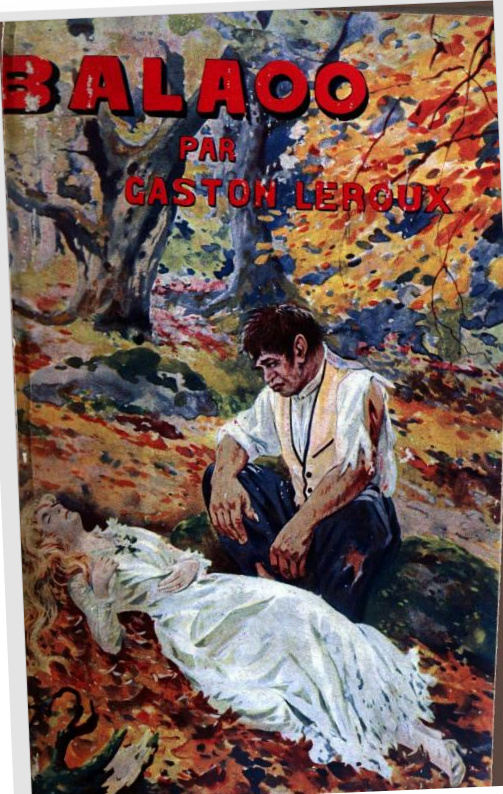
BALAOO, THE DEMON BABOON.

You may tell Dr. Boli that you have no wish to see this movie, but Dr. Boli will know you are lying. Since a reader asked, here is the original source of this cartoon. The picture advertised here was released in 1913, and Dr. Boli is not aware of any surviving prints; but he would be happy if someone could find one. The plot, incidentally, was taken from a novel by Gaston Leroux, author of The Phantom of the Opera. There was an English translation published in 1913—the same year this movie came out, since production cycles were very short in those days—but Dr. Boli has been unable to find it. If you read French, however, you can find the original on Google Books (click on the image below). —UPDATE: A regular reader went to Australia to fetch us back a copy of the English translation (see the comment below).
ASK DR. BOLI.
Dear Dr. Boli: I keep hearing some cop shows called procedurals, and I was wondering: what’s the difference between a procedural and a detective story? —Sincerely, Prof. Arthur Conan Dinkleberger, Duck Hollow University Department of Popular Entertainment.
Dear Sir: A procedural is a particular kind of detective drama in which dogged work alone leads to the solution of the mystery. In the classic detective story, the detective must make some clever deduction from the facts of the case, which are in themselves apparent to everyone; the solution comes because the detective sees some pattern or indication in those facts that no one else sees. In a procedural, the detectives gather facts until the last fact falls into place, and then the solution to the mystery is obvious to everyone, including the janitor at the precinct house. In other words, a procedural is a story in which the mystery can be solved by Dr. Watson alone, without any assistance from Sherlock Holmes, or by the Parisian police without Auguste Dupin. We might say that the difference is that the classic detective story is interesting, whereas the procedural is a slog. Or to put it another way, a procedural is a detective story for stupid people.
“The Purloined Letter,” by Edgar Allan Poe, is a perfect illustration of the difference between a procedural and a detective story. The Parisian police gather all the evidence it is in their power to gather; they poke and measure and even bring out the microscopes. In a modern “procedural” drama, that would be the story. But they fail, and Dupin, possessing the same evidence, comes to the conclusion that only he can come to.
Here is the original story, as it was first printed in The Gift for 1845.
THE HOLLYWOOD PUBLICITY MILL AT WORK.

“The film was also the first to depict Jesus Christ as a character in a motion picture,” says a Wikipedia article about the 1916 movie Civilization, a grand allegorical spectacle that, like Woodrow Wilson, kept us out of war (until, of course, we got into the war).
The Wikipedia article explains that “George Fisher was given the daunting role of playing ‘The Christ’ in Civilization. He was ‘the first cinema actor to portray Christ for the screen’”—a statement quoted from a contemporary article in the Los Angeles Times that rather breathlessly tells us how Mr. Fisher “lived the life of a recluse, spending his time in study and meditation” in preparation for the role. It even quotes him in words so obviously generated by the the Ince studios’ publicity department that the reporter must have blushed purple as he typed them: “I can say in truth that the playing of this part has affected my whole life and the impressions will never leave me. I have tried earnestly and sincerely, with a deep prayer in my heart, to bring a message to the world, one which will reach, perhaps, millions. Now my only wish is that whoever may witness the performances of ‘Civilization’ will realize only the truth and beauty of the message.”
Nothing has changed in ninety-nine years: publicists still ladle out barefaced lies, and reporters eagerly slurp them up because the alternative would be working for a living. Barefaced lies? Yes; you, dear readers, know that the whole story was a lie, because you have seen The Life of Christ, a film that was a great success in 1912, making a profit at least twenty-five times its budget, according to that film’s own Wikipedia article. A film so successful would not have been forgotten in Hollywood circles four years later. But it was useful publicity to suggest that the portrayal of Christ on screen would be something daringly new. So the publicity department simply lied (which is doubtless what Jesus would have done in their place), and a century minus a year later, we still believe the lie. At this point, we must bow in simple admiration of the publicist’s craft.
THE LIFE OF CHRIST,
From the Manger to the Cross.
Here we have an epic photoplay released three years before D. W. Griffith’s Birth of a Nation (a film whose mixture of outstanding virtues and horrible vices always gives Dr. Boli a queasy feeling). This film was eagerly anticipated, and news of each step in its progress was carried back from the Middle East by an efficient publicity machine. When it was released in 1912 (apparently under the title The Life of Christ), it was a huge success; and it was a huge success when it was brought out again in 1919 (as From the Manger to the Cross).
It was an extraordinarily expensive production for the time. Much of the expense of the production came from insisting on using authentic locations all over Palestine. And not just Palestine: when the Holy Family flee to Egypt, they are really in Egypt, with the Sphinx in the background to prove it.
The acting is excellent by early-film standards, and the settings make each scene believable. The domestic scenes of Jesus’ youth are probably the most convincing ever put on film. John the Baptist crying in the wilderness is memorable precisely because the wilderness itself is a character. The adult Jesus is perhaps a little too inhumanly holy, with a bit too much turning of the eyes heavenward; but Robert Henderson-Bland seems to grow into the role, and finds an appropriate wry amusement in the increasingly sputtering Pharisees. His anger in the cleansing of the Temple is palpable; the actor is clearly breathing heavily from the physical exertion of driving out the capitalists. Judas is a bit hammy but appropriately tortured. Pilate is quite believably exasperated, all the more so because the film conveys very well, through images, how annoying it is to have the constant racket of a near-riot outside one’s window. The crowd scenes are extraordinarily well-managed; they always seem to be simply happening, not being coordinated for the camera.
The makers of the film made wise choices in the presentation of it. For example, even though no expense was spared, and even though the technique of producing “spirits” on film by double exposure was well known and commonly used, the film does not show us the angel appearing to Mary or Joseph, but only the effects of the appearance on the human subject. The only trick special effect is Jesus’ walking on the water, and that is brief and well done (by double exposure, of course).
The version of the film above has a good organ score, and is presented with the original tinting, which is tastefully chosen to fit each scene. It ends with the Crucifixion—a fitting choice for Good Friday.
Another version, longer and with an electronic-organ score, is at Archive.org under the title Jesus of Nazareth; but the picture is poorer, there is no tinting, and an “unregistered” blob from the program used to download it from some streaming site hovers in the corner. This one, however, adds the burial, resurrection, and ascension of Christ, including appropriate trick effects. It is hard to tell with the poor picture in this print, but the scenes after the Crucifixion may have been filmed later for a different release. (This article from a 1912 movie magazine tells us that the film as released then ends with the Cruciixion.)
SHE MADE A DIFFERENCE.

She made a difference in the bungalow on the island. Heyst admitted that almost at once.
—
This caption under this picture amused Dr. Boli greatly, for reasons that perhaps his readers can analyze better than he could himself.
Some alert readers may have guessed from the name “Heyst” that this picture comes from a film adaptation of Joseph Conrad’s novel Victory. The players are Jack Holt and Seena Owen.
It is probably not necessary to mention that Conrad did not write the caption: it comes from Faith Service’s “fictionization” of the photoplay of the novel.