Posts filed under “Young Readers”
THE DUCK.
From Dr. Boli’s Fables for Children Who Are Too Old to Believe in Fables.

ONCE TWO SCIENTISTS—it hardly matters what sort—were walking before dinner beside a pleasant pond with their friend, a reporter for the Dispatch, when they happened to notice a bird standing beside the water.
“I am a skeptic,” said the first scientist. “I demand convincing evidence before I make an assertion. But I believe I can identify that bird, beyond all reasonable doubt, as a duck.” The journalist nodded silently at this assertion.
“I also am a skeptic,” said the second, “but evidently of a more refined sort, for I demand a much higher standard of evidence than you do. I see no irrefutable evidence to back up your assertion that this object before us is even a bird, let alone positively identifying it as a duck.” The journalist raised his eyebrow sagely.
“But what of the feathers?” the first scientist demanded. “Surely you must have noticed the feathers, which are the veritable hallmark, so to speak, of a bird.”
“I have seen nearly identical feathers on a feather duster,” the second replied. “At present the evidence is not strong enough to say whether the object before us is a member of the avian genus Anas or a common household implement.” The journalist held his chin and pondered this revelation.
“But this object has two legs, and walks upon the ground,” the first scientist objected.
“So indeed do many members of the genus Homo, including our own species,” the second replied, and the journalist smiled a knowing smile.
“But this creature has webbed feet,” the first scientist pointed out, his voice rising slightly.
“My cousin Albrecht has webbed feet,” the second replied. “You are making my case for me by presenting not one but two compelling pieces of evidence that this object is in fact a member of the genus Homo, and very likely my cousin Albrecht.” The journalist looked up, as though he were carefully weighing the argument.
“But it has a broad and flat bill,” the first scientist said.
“The platypus has a broad and flat bill,” the second pointed out, “and so has a baseball cap. Since we have much evidence that suggests the object is a member of the genus Homo, and some that suggests it belongs to the genus Ornithorhynchus, it seems reasonable to suppose, as a provisional hypothesis, that the object is a mammal, and with somewhat less certainty we may identify it as my cousin Albrecht wearing a baseball cap.” The journalist, unable to suppress his instincts any longer, produced a long, narrow notebook and began to scribble furiously.
“But it has feathers!” the first scientist shouted. “It has feathers, and two legs, and webbed feet, and a broad flat bill, and it says ‘quack,’ and—look—it’s gone into the pond now, and it’s floating on the water. It’s a duck!”
“Each one of those observations is susceptible of a different explanation,” the second scientist responded calmly. “Where is your compelling evidence?”
The first scientist slapped his forehead. Then, calming himself, he turned to his friend the reporter. “Since we seem unable to reach a conclusion,” he said, “would you be kind enough to favor us with your opinion?”
“Reputable scientists disagree,” said the journalist. “There is a debate. The question is far from settled. The truth probably lies between the two extremes of duck and not-duck.”
So the two scientists both stomped away in dudgeon and hostility, and the journalist, unable by himself to decide where to eat dinner, starved to death.
—
Are you well-informed in all matters of ornithology and semantics? A healthy corrective dose of misinformation will help you adjust to the real world.
THE TORTOISE AND THE HAIR.
From Dr. Boli’s Fables for Children Who Are Too Old to Believe in Fables.
ONCE IN THE Catskill Mountains of upstate New York there was a tortoise, and he was really rather speedy as tortoises go. And at the same time there was a hair, growing on the chin of one of those lazy Dutch settlers so abundant in those parts, champion nappers who could snore for decades at a stretch.
“You know,” said the hair, “I’m just about the fastest thing there is. In a year, I’ll grow down to this old Knickerbocker’s kneecap.”
The tortoise was quite surprised to hear an individual hair speaking in reasonably good English, and was even more surprised to discover that he could speak English in reply. Apparently he had never tried it before, and the ability had sat latent in him all the years of his long reptilian life.
“You’re not as fast as all that,” the tortoise answered. “For a hair, you may be speedy, but a zippy tortoise like me could run rings around you and then dash off so fast all you’d see would be smoking tracks.”
“Oh, really?” asked the hair with a sarcastic twirl. “Well, then, let’s just see who’s the fastest. You see that ankle way down yonder, the one you get to if you head straight past the kneecap and keep going on down the shin? I challenge you to a race. The first one to get to old Van der Donck’s left ankle wins.”
“You’re on,” said the tortoise; and at a prearranged signal they both started out, the tortoise stomping along with all his might and the hair growing like a summer weed. For some time the tortoise clearly had the better of it, and indeed he had nearly reached the kneecap while the hair was still struggling to get past the collarbone.
But then, after having slept only a few weeks, the lazy Dutch colonist awoke from his abbreviated nap, picked himself up, and started walking, and never stopped walking until he got to Albany, where he had some business to attend to. The tortoise followed at a mad pace (by tortoise standards), and for all I know he may still be trudging down the road to Albany, racing at top tortoise speed toward the long-vanished ankle. Meanwhile, the Dutch settler, taking to town life, decided to shave his beard, the clean-shaven look having come into fashion. Every morning the hair must begin its own journey afresh, and after many years is still not any closer to the ankle.
Thus there is no way of telling which party will win the race, and the moral of this fable must remain in limbo until the outcome of the race is finally decided.
CAPTAIN PLEONASM AND THE WORLD WITHOUT EVIL.
Although no recordings of the old Captain Pleonasm radio serial have survived, a number of the original scripts were recently unearthed in the archives of the Northern Broadcasting Company.
ANNOUNCER. Malt-O-Cod, the delicious and nutritious malt food drink flavored with real cod-liver oil, presents…
(Music: Theme, up and under for…)
ANNOUNCER. The Thrilling and Exciting Adventures of Captain Pleonasm and His Faithful and Trustworthy Sidekick and Assistant, Interjection Boy!
(Music: In full, then fade for…)
ANNOUNCER. As you recall, in last week’s episode, Captain Pleonasm and Interjection Boy had defeated the combined forces of all the world’s villains, forever ridding the world of evil and putting a stop to all bad things.
INTERJECTION BOY. Babblin’ baboons, Captain Pleonasm! Have you got any threes?
CAPT. PLEONASM. It will be necessary for you to go fish. You will need to draw a card at random from the unsorted pile in the center of the table.
(Music: Stinger.)
INTERJECTION BOY. Golly golliwogs, Captain Pleonasm, you don’t have to play that brassy dissonant chord every time you say that.
CAPT. PLEONASM. Have you any queens? Are there among your cards any portraits of—
INTERJECTION BOY. Merciful mockingbirds, Captain Pleonasm, you can just say it once. I got the idea the first time. Go fish.
CAPT. PLEONASM. Ah. I must draw a card from the irregular mass of cards before me. It is necessary, for the further progress of the game, that I should take—
INTERJECTION BOY. Good grief, will you just take a card?
CAPT. PLEONASM. Aha! I have drawn a queen from the pile! Completely at random, with no foreknowledge of the card toward which my fingers were moving, I have nevertheless taken out exactly the card that was required for my ultimate victory!
(Music: Stinger.)
INTERJECTION BOY. Gee whiz, you can be annoying sometimes.
CAPT. PLEONASM. And now it is once again my turn. My withdrawal of the precise card for which I had asked has entitled me to ask you for another card. Have you any kings? Among your cards, are—
INTERJECTION BOY. Go fish, for Pete’s sake.
CAPT. PLEONASM. Hmmm. It was not a king. I shall not reveal to you the exact card which I have withdrawn, but I must regretfully inform you that it was not the card for which I had asked.
INTERJECTION BOY. Yeah, whatever. Have you got any sevens?
CAPT. PLEONASM. By “sevens,” do you mean cards with that precise number of figures or symbols? Would the Arabic numeral seven appear in the corner? And does it matter precisely what the figures are? Is there any particular figure you—
INTERJECTION BOY. Holy Sandusky, Captain Pleonasm, you’ve got three of them, haven’t you?
CAPT. PLEONASM. Well, I cannot tell a lie. To prevaricate is contrary to my nature. It would go against every principle for which I have stood in the fight against evil were I to deny what is literally true.
INTERJECTION BOY. Indignant iguanas, Captain Pleonasm! I’m getting tired of this game.
CAPT. PLEONASM. Are you indeed? Well, then, there is one thing I have saved for just such an occasion. It is something so exciting, so pulse-quickening in fact, that I have held it in reserve, knowing that a time might come when we required more spiritual stimulation, more heart-pounding appeal to the adrenal glands, than the ordinary pastimes in which we have hitherto indulged can provide.
INTERJECTION BOY. Great tumbling redwoods, Captain Pleonasm! What is it?
CAPT. PLEONASM. Charades!
(Music: Stinger.)
INTERJECTION BOY. Heavens to Betsy, Captain Pleonasm, is it too late to un-defeat some of those villains?
ANNOUNCER. Will a rousing game of charades provide the excitement Interjection Boy longs for? Will Captain Pleonasm have to haul out the Parcheesi game he keeps under the bed? Will Interjection Boy accidentally leave the gate unlocked at the maximum-security prison? Don’t miss next week’s enthralling and riveting episode of the Thrilling and Exciting Adventures of Captain Pleonasm and His Faithful and Trustworthy Sidekick and Assistant, Interjection Boy!
(Music: Theme, in full and under for…)
ANNOUNCER. When Captain Pleonasm is feeling oppressed by the ennui of modern existence, what always perks him up? It’s Malt-O-Cod, the only malt beverage flavored with 100% real cod-liver oil. Kids, ask your moms for Malt-O-Cod, now with an official Captain Pleonasm Old Maid deck in every package. It’s the malt food drink that’s brain food—Malt-O-Cod.
(Music: In full, then out.)
THE KITTEN WHO WANTED TO BE AN EMPRESS.
From Dr. Boli’s Fables for Children Who Are Too Old to Believe in Fables.
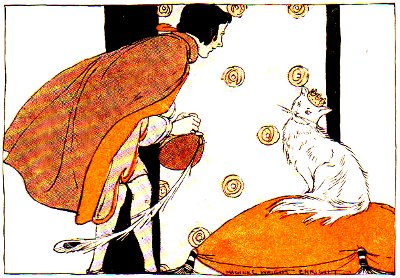
ONE DAY AT the school for anthropomorphic animals, the teacher (a motherly old hen) decided to ask the children what they wanted to be when they grew up.
First she came to a retriever puppy, who was always at the top of the class in every accomplishment. “What do you want to be when you grow up?” the teacher asked her.
“I want to be an astronaut,” the retriever puppy answered. “I want to discover new planets and boldly go where no retriever has gone before.”
“Well, if that’s your dream,” the teacher said, “then you stick to it. Because ours is a country where anything is possible, and if you really work hard, you can grow up to be anything you want to be.”
Next the teacher came to a little raccoon. “And what do you want to be when you grow up?” the teacher asked the raccoon.
“I want to be an architect,” the raccoon answered. “I want to design beautiful museums and recreation centers for the delight and edification of the working classes.”
“Well, if that’s your dream,” the teacher said, “then you stick to it. Because ours is a country where anything is possible, and if you really work hard, you can grow up to be anything you want to be.”
Next the teacher came to a little red fox. “And what do you want to be when you grow up?” the teacher asked the fox.
“I want to be an accountant,” the fox answered. “I want to be the best accountant there ever was. I want to account things no one has ever accounted before.”
“Well, if that’s your dream,” the teacher said, “then you stick to it. Because ours is a country where anything is possible, and if you really work hard, you can grow up to be anything you want to be.”
Then the teacher came to a little white kitten. “And what do you want to be when you grow up?” she asked the kitten.
“I want to be an empress,” the kitten answered.
“An empress?”
“Yes,” the kitten said. “I want to have absolute power and tell everybody what to do and no one can challenge me or I’ll chop all their heads off.”
“I’m not sure that’s a practical ambition, dear,” the teacher said gently.
“Why not?” the kitten demanded. “You said ours was a country where anything was possible. You said that if we really worked hard, we could grow up to be anything we wanted to be.”
“Technically, I did say those things,” the teacher admitted.
“Well, I want to be an empress,” the kitten declared.
“But, you see,” the teacher explained patiently, “we have a democracy, or more properly a republican form of government, which is guaranteed in our constitution. That means that no one can have absolute power, because all power ultimately derives from the people.”
“Phooey,” the kitten said. “It’s not really a democracy if you can’t grow up to be anything you want to be. And what I want to be is an empress.”
“I’m sorry, dear,” the teacher said. And turning to face the rest of the class, she explained, “I should have said that ours was a country where almost anything is possible, and that if you work hard you can grow up to be almost anything you want, absolute sovereign with arbitrary power excepted.”
But the kitten did become an empress after all. When she grew up, she went into politics, and her good looks and aggressive personality made her an instant success. First she was elected as a member of parliament, and then she became Minister of Defense, and then she was chosen Prime Minister, and then she abrogated the constitution and ruled by decree, and everyone did exactly what she told them to do all day long. And when anyone disagreed with her, she chopped off his head. But she really had to chop off very few heads, because public opinion was solidly behind her, and most of the people agreed that a strong leader was exactly what we needed in the current crisis, whatever the current crisis was.
So the kitten proved that hers really is the sort of country where anything is possible, and where, if you really work hard, you can grow up to be anything you want to be. Or at least it used to be that way, although it’s not so much anymore.
–
MORAL: If you want to grow up to be anything you want to be, you’d probably better grow up right now.
CERTAIN LESS FAMILIAR RHYMES OF MOTHER GOOSE.
The Remarkable Mary and Her Bank.
Mary had a little bank;
She fleeced it white as snow.
And everywhere that Mary went,
The feds were sure to go.
She hid the money overseas
(Which was against the rule),
Because she might have been a crook,
But Mary was no fool.
–
The Young Man Who Was Not a Gentleman.
Georgy Porgy, pudding and pie,
Kissed the girls and made them cry.
Now he sits in the county jail,
Till he can come up with the bail.
–
The Two Arboreal Women.
Dear, dear, what can the matter be?
Two old women got up in an apple-tree.
One came down and the other couldn’t think of a proper rhyme for “apple-tree,” so for all I know she’s still up there.
–
A Nautical Vision.
I saw a ship a-sailing,
A-sailing on the sea,
And oh! It was all laden
With pretty things for me!
With pretty things for me, dear,
And not a one for you:
Because I’m a monopolist,
And that is what we do.
–
A Numerical Composition.
One, two,
A steel-toed shoe;
Three, four,
Kick down the door;
Five, six,
Beat them with sticks;
Seven, eight,
This ain’t Apartment 38?
Nine, ten,
Oh, well, try again.
CAPTAIN PLEONASM FACES THE FUTURE.

[In honor of the second anniversary of his Celebrated Magazine on the World-Wide Web, Dr. Boli is reprinting a number of his own favorite articles from the past two years.]
–
Although no recordings of the old Captain Pleonasm radio serial have survived, a number of the original scripts were recently unearthed in the archives of the Northern Broadcasting Company.
ANNOUNCER. Malt-O-Cod, the delicious and nutritious malt food drink flavored with real cod-liver oil, presents…
(Music: Theme, up and under for…)
ANNOUNCER. The Thrilling and Exciting Adventures of Captain Pleonasm and His Faithful and Trustworthy Sidekick and Assistant, Interjection Boy! Now featuring the Malt-O-Cod Orchestra and Chorus, directed by Paul Hindemith.
(Music: In full.)
CHORUS. Don’t throw a fit or have a spasm:
It’s time for Captain Pleonasm!
He battles evil, and, forsooth,
He fights for justice and for truth!
He hates the bad and loves the good,
As self-respecting heroes should.
He conquers villains strange and odd,
And saves the world for Malt-O-Cod!
(Music: Fade.)
ANNOUNCER. As you recall, in last week’s episode, Captain Pleonasm and Interjection Boy found themselves facing a strange new villain.
INTERJECTON BOY. Oscillatin’ ocelots, Captain Pleonasm! It’s just a crumbly old man in a funny costume!
(Music: stinger.)
LIEUT. COL. PLEONASM (aged voice). Is that so, Interjection Boy? Is that what you think of me now? Well, Captain Pleonasm, perhaps you will disregard and ignore Interjection Boy’s intemperate and ill-considered remarks. Perhaps you will pay no attention to him at all when you discover the truth of who I am. Perhaps you will set aside the boy’s incontinent logorrhea and—
INTERJECTION BOY. Marry come up, Captain Pleonasm! He talks just like you!
CAPT. PLEONASM. Indeed he does, Interjection Boy! He speaks with the same carefully constructed and balanced rhetorical exactitude which I have always cultivated. His periods move with the same impeccable rhythm that it has always been my studious endeavor to maintain. Could it be, sir—could it be that you are my long-lost father?
LIEUT. COL. PLEONASM. No, you idiot! Mercy, I forgot how dim I used to be. Can it be that I was ever such a moron? You know perfectly well your father is alive and well in Tarpon Springs. The only reason you’ve “lost” him is because Interjection Boy set fire to your address book when he was playing with your Inferno Ray.
INTERJECTION BOY. Red-hot yams, Captain Pleonasm! How does he know about that? You promised not to tell anybody!
CAPT. PLEONASM. Then who, sir, are you? What is your name, and whence do you come?
LIEUT. COL. PLEONASM. I’m you, you lackwit fool!
(Music: stinger.)
LIEUT. COL. PLEONASM. My name is Lieutenant Colonel Pleonasm, and I am you from the future. I have come back here thanks to the recent commercial availability of inexpensive and reliable time machines.
INTERJECTION BOY. Holy persimmons!
CAPT. PLEONASM. Then you are I, and I am yourself! We are identical, though different in age. Separated in time, we are yet united in identity.
LIEUT. COL. PLEONASM. I knew you were going to say that.
CAPT. PLEONASM. Then can it be that you have come back to aid me in my darkest hour? Is there some diabolical plot afoot, so fearful in its complexity, so awesome in its power, that only the two of us working together, with your superior future technology, can defeat it? Have you come to offer me the benefit of my own future cooperation?
LIEUT. COL. PLEONASM. No, you ignorant booby! I’ve come back to destroy you. I’ve returned to wipe you clean from the pages of history.
INTERJECTION BOY. But, jodhpurs, Lieutenant Colonel Pleonasm! Why?
LIEUT. COL. PLEONASM. Because I’ve turned evil in my old age! Forsaking the good, I have found far more profit and satisfaction in villainy! Yet the world would be a much more secure place for villainy had my former self not dedicated his life to making the world safe for good.
INTERJECTION BOY. But, gallopin’ gnus, Lieutenant Colonel Pleonasm! Does this mean I turned evil in the future, too?
LIEUT. COL. PLEONASM. No, you opened a Peugeot dealership on Baum Boulevard. I have no quarrel with you. My quarrel is only with myself. If I destroy my former good self now, all his works for good will never have happened!
(Music: Stinger.)
ANNOUNCER. Is this the end for Captain Pleonasm? Will his future destroy his present? Will his present destroy his future? Will his future, by destroying his present, destroy his future as well? Will Interjection Boy be able to make a living selling unreliable French cars to American drivers? Don’t miss next week’s enthralling and riveting episode of the Thrilling and Exciting Adventures of Captain Pleonasm and His Faithful and Trustworthy Sidekick and Assistant, Interjection Boy!
(Music: Theme, in full and under for…)
ANNOUNCER. When Captain Pleonasm wakes up in the morning, what’s the first thing he asks for? It’s Malt-O-Cod, the only malt beverage flavored with 100% real cod-liver oil. Kids, ask your moms for Malt-O-Cod, now with an official Captain Pleonasm demitasse spoon in every package. It’s the malt food drink that’s brain food—Malt-O-Cod.
(Music: In full, then out.)
THE BOY’S BOOK OF CRAFTS AND HANDY-WORKS.
No. 317.—A Brigantine.
[In honor of the second anniversary of his Celebrated Magazine on the World-Wide Web, Dr. Boli is reprinting a number of his own favorite articles from the past two years.]
NOT SO LONG ago by radiocarbon dating, my friend Ned and I spent a summer by Lake Erie. The constantly shifting aspects of water and shore stimulated our imaginations, and the knowledge that the very scenes before us had formed the setting against which the magnificent deeds of Commodore Perry were enacted, filled our youthful fancies with a desire to emulate his great feats of naval prowess. Indeed, so filled were we with youthful bravado that we imagined ourselves surpassing the great commander, and carving out a great northern empire around the great northern waters. For this purpose we required a brig similar to Commodore Perry’s Niagara.
It was clear to us that, unlike our simple dog-cart (No. 18) and our simple time-machine (No. 241), this was a project that would require a great deal of preparation and dedicated work. But that did not dampen our enthusiasm, for we reflected that we had the whole summer to accomplish our task, and we had never yet encountered an obstacle which we could not overcome by hard work and imagination.
First we needed a great quantity of wood. My uncle, with whom we were staying, had no such materials handy; but luckily his neighbors were away for the summer, and thus would not be needing their house.
For three weeks, Ned and I were up at sunrise every morning with our hammers and saws. We used the roof trusses to form the skeleton of our ship. Having no design or plans other than our memories of the Niagara and other ships we had seen, we naturally made many mistakes and had to do some of the work twice; but by the middle of July we had finished the construction. We had decided to rig our ship as a brigantine rather than a brig, mostly because we found the polysyllabic name more impressive. All that was left, then, was to add sails, for which we made use of our neighbors’ best linens, and to seal the hull against the intrusion of water. We recalled that Noah had sealed the Ark with bitumen, but the local hardware store had run out of bitumen, and was not expecting any more until October. We had come too far, however, to be inconvenienced by a minor setback; and it was Ned who hit on the idea of substituting chewing gum for bitumen. How our jaws ached when we had finished! But our efforts were not in vain: our ship was water-tight and ready to launch. In honor of our hero, we christened our brigantine the Commodore Perry.
Now all we needed was a crew. For this we decided to resort to the old English custom of impressment, which seemed to us the most effective method of assembling a large crew in a short time. We visited a number of disreputable saloons in the east end of town, and, bribing a few of the rowdiest characters there with strong liquor, soon assembled an efficient press gang which did the rest of our work for us. By the next morning we had a large though somewhat baffled crew, and were ready to set sail.
We armed our ship with cannons made from pickle barrels we had found in my uncle’s storeroom and set out on our first adventure, which we had determined should be the conquest of Canada. This we accomplished in short order, as it transpired that the Canadian Great Lakes fleet was disorganized and ill-prepared for an attack from the south. We set up a puppet government in Welland, which was close enough that we could sail home for dinner at my uncle’s house every night, and for a few weeks ruled as absolute dictators. All too soon, however, the autumn was upon us, and we had to go back to our homes and school, filled with the memories of a summer brimming with adventure.
THE GOOD OLD DAYS.
[In honor of the second anniversary of his Celebrated Magazine on the World-Wide Web, Dr. Boli is reprinting a number of his own favorite articles from the past two years.]

“TELL ME AGAIN about the old days, grandmother,” said the sweet little girl sitting by the fire.
“Well,” her grandmother began, her eyes misting over with nostalgia, “we didn’t have trees or any of these modern conveniences. When we wanted wood, we had to make it ourselves. I remember the day old Mitch from down at the mill told your great-grandpappy that there was a new kind of plant that grew wood in its stem, and all you had to do was take it if you wanted it. Pappy laughed himself sick. That was how he died, in fact.
“We had to walk fifteen miles in the snow just to get to school, and then when we got there we had to turn around and walk right back, because schools hadn’t been invented yet.
“The sun didn’t start automatically every morning the way it does now. Pappy had to turn a crank, and some mornings it took forever to get it started. Those were cold mornings, but all we could do was shiver until Pappy got the sun started, because of course no one had thought of blankets in those days.
“The moon was a bit smaller then, and more rectangular. There weren’t nearly as many stars, but then we lived in a poor neighborhood. We didn’t know we were poor, though, because poverty wasn’t discovered till I was eighteen years old. I remember that day, and how cheated we all felt when we finally found out we were poor.
“We didn’t have opposable thumbs back then, either. When we wanted to pick something up, we had to use our toes, so of course we fell down a lot. We couldn’t hold cups, so we had to drink everything through a straw, even hot water, which we couldn’t make into tea or coffee because no one had thought of those things.
“People didn’t live very long in those days, either. The average lifespan was about twenty-one. I myself died when I was nineteen, but I didn’t like it and gave it up after a while. Most people died of starvation, because food hadn’t been invented yet, and the only time we ate anything was when something accidentally fell into our mouths.”
“Goodness, grandmother,” said the little girl, “aren’t you glad you lived to see our modern world, with all its wonderful inventions?”
“Well, I’m not so sure I am,” the kindly old lady replied. “We had to work hard in the old days, but that made us tough. We didn’t have time for dilly-dallying with fripperies like shoes and elbows. I forgot to mention that elbows hadn’t been invented yet, either, so we had to hold our arms straight out like this. But we didn’t complain, because complaining hadn’t been invented yet, either. No, those were the good old days.”
ASK DR. BOLI.
Dear Dr. Boli: I am desperately eager to be the host of a celebration in my town of Dr. Boli’s 2nd Anniversary on the World Wide Web, but I am sadly lacking in additional cravats and spats and fear my intended guests will be unable to meet my dress requirements. Is there any help for me?
very best regards,
yours truly,
Dictated But Not Read.
P.S. I have a surplus of straw boaters, as they are not in fashion here, at this time.
Dear Sir or Madam: A very serviceable pair of spats may be made from an old whitewall tire, which you may easily obtain from one of your neighbors’ automobiles, especially if the neighbors are not very observant. It is possible to cut a cravat out of a straw boater, but Dr. Boli does not recommend straw cravats, as they tend to be a bit itchy. Instead, he suggests curtains. Curtains come in many fabrics of many weights, so you are likely to find something suitable; and then all you need is a pair of scissors. Once again, your neighbors can be a useful resource.
–
Dear Dr. Boli: I was hoping you, as an expert on “oft-neglected sports,” could recommend some titles regarding what I have always considered a close cousin to Musical Chairs: Duck-Duck-Goose. My son’s school will be holding tryouts for their team come next fall and I hope to have him thoroughly prepared.
With many profuse thanks,
Eustace C. Dither
Dear Sir: The best resource for the aspiring Duck-Duck-Goose player remains, as it has been for generations, Sir Humphrey Merganser’s Taxonomy of the Family Anatidae, which is recommended by the best coaches as an essential intellectual preparation for the sport. But it may be a little more technical than a schoolboy is ready to handle. An alternative more suitable for young people is One with the Goose: The Zen of Playground Games, by Miss Juniper Etoile Ocean-Breeze.
THE BOY’S BOOK OF CRAFTS AND HANDY-WORKS.
No. 359.—A Cigar-Box Mandolin.
I WAS ALWAYS musically inclined, and my friend Ned scarcely less so. We spent many a jolly afternoon down by the wharf, learning the robust and merry songs the bargemen sang to ease their labors, and we loved to sing them at home over and over until the day Ned’s father grasped us firmly by the collars and washed our mouths out with soap. This unpleasant experience suggested to us that it was time to redirect our latent talent toward instrumental music. Ned and I were no longer allowed within six feet of my mother’s parlor organ (see No. 294, A Simple Blast Furnace); so, after some debate, we decided on building a cigar-box mandolin, a traditional folk instrument much beloved in those days.
It was difficult finding a merchant who would sell two young boys a box of cigars. Fortunately there was on Wood Street a tobacconist who was a bit nearsighted, and mistook Ned for a well-known operatic soprano who frequently patronized his shop. We purchased a box of Las Mercancías cigars, which we were assured by the tobacconist were among the finest cigars Slovenia had ever produced. More to the point, the box was good and sturdy, and the top was adorned with a colorful lithograph of a llama devouring a charango. This musical iconography, we thought, boded well for our intended use of the wood.
The next order of business was to empty out the box. We nearly ended the experiment at this stage, both of us becoming dreadfully ill until Ned, who has a clever streak in him, pointed out that it was not strictly necessary for us to smoke all the cigars in order to get rid of them. We sold the remaining cigars singly to our chums in the schoolyard, making a tidy profit that more than paid for the other materials involved in the construction of our instrument.
Now that we had emptied the box, the next thing to do was to borrow Ned’s father’s woodworking tools and get to work on shaping it into the body of a mandolin. Here I was perhaps a bit too much of a perfectionist. I scraped and carved and sanded that box until it bore no resemblance at all to the thing we had started with; but I was disappointed to see that it bore little more resemblance to a mandolin. The mandolins with which I was familiar were lute-shaped affairs, more or less oval, with a deep bowl back and a round or elliptical sound hole on top; what I had when I was done planing and scraping was an irregularly shaped thing, with a narrow waist in the middle and bulging on both ends, and with two sound holes that more or less resembled an italic letter F. But it would have to do, as we had no other cigar box.
For the neck I used the leg of an end table that was just sitting idle in the parlor. The ornate scroll at the end of it, we agreed, would give a pleasing artistic touch to our instrument. We decided to forgo frets, since measuring the correct distances would be difficult, and a fretless neck would make it possible to achieve various entertaining musical effects not possible with a fretted instrument.
For strings we found some old electrical wire lying about the house, which was not strictly needed, since it would still be light outside for several hours, and by evening we should certainly be able to scrounge some candles somewhere. A bit of glue here and there, a few tuning pegs hurriedly whittled out of the remains of the end table, a few pins for the ends of the strings, and we had a completely functional mandolin, although not in the traditional rectangular shape affected by most cigar-box mandolins.
It was Ned who, delighted by our success, insisted on taking the thing back to the tobacconist’s shop to show him what we had done with his cigar box. We took turns playing him some improvised fantasias, although as he was also a little deaf I fear he failed to appreciate our artistry properly.
We were just about to pack up and leave when the famous operatic soprano, whom I mentioned earlier as a patron of that establishment, appeared in the doorway.
“Mon Dieu!” she exclaimed in her broad Southside accent. “It is incredible, is it not? A genuine Stradivarius! Here of all places! Where, dear boys, did you obtain this magnificent instrument?”
I was about to speak, but the woman continued without a pause. “I must have it! My husband, you must know, is a famous violinist, and the possession of this instrument will make him the foremost master of the concert stage. I must have it at any price! You may name your figure! It is worth millions—millions, dear boys!”
In the end, we negotiated for an even $2,500,000, which at that time was a world’s record price for a Stradivarius violin. I felt somewhat ambivalent about my part in this affair, but I reasoned that the customer walked away from the sale entirely satisfied, as indeed did Ned and I. Since then we have heard our mandolin, played with a bow, in many broadcast concerts, and Ned and I often toyed with the idea of buying ourselves another box of cigars. But, what with one thing and another, so far we have not had the time.