Posts by Dr. Boli
TOP TEN INVENTIONS OF THE LAST THOUSAND YEARS.
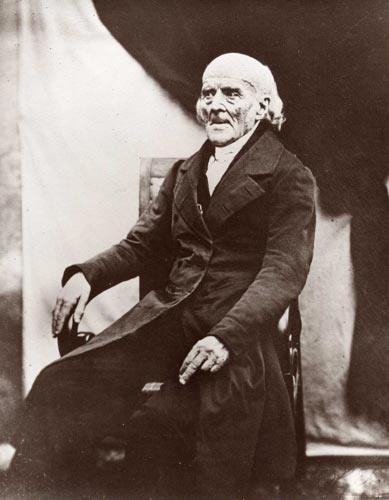
Samuel Hahnemann, inventor of homeopathy, at the age of 312.
—
1. The top-ten list. This epochal innovation in philosophical method gave the ordinary thinking man or woman in the street a simple means of organizing all useful knowledge on any given subject, elevating common discourse to its present exalted level.
2. Tomato sauce. It is hard to imagine, but before Columbus there was no such thing as tomato sauce in any European cuisine. The life expectancy in the Middle Ages was appallingly short, and many culinary experts believe it was because most of Europe’s favorite foods were barely edible without some form of tomato sauce.
3. The newspaper. Until the advent of the newspaper in the 1600s, fish was sold unwrapped, and carrying it home from the market was a delicate and frequently messy business.
4. The advertisement. Before the discovery of advertising, anyone who wished to purchase an item would have to pay a personal visit to the craftsman who made it. The craftsman would then be required to produce actual samples of his work to prove that his goods were satisfactory, depriving a great many incompetent craftsmen of the means of making a living. Today, the purchaser seldom handles the goods until after the purchase, and buying decisions are made on the basis of the seller’s claims rather than the buyer’s observations. The quality of the advertising, rather than the quality of the goods, thus determines the ability of the manufacturer to make a profit.
5. The Jacob’s ladder. Until the invention of the high-voltage traveling arc, commonly called a Jacob’s ladder, it was impossible for a mad scientist to know whether anything electrical and sciencey was actually going on when he attempted to give life to the monster he had created.
6. The greeting card. Today it is hard for us to imagine the primitive world before the greeting card, when correspondents who wished to communicate by writing were required to express their own sentiments in ink, which in turn necessitated their having sentiments to express.
7. Homeopathy. Thanks to the pioneering discoveries of Samuel Hahnemann, it is possible to start with literally nothing and end up with profitable employment for countless thousands of homeopathic practitioners.
8. The grant proposal. In ancient times, an artist soliciting a commission was forced to come up with a design, often one requiring considerable mechanical skill in the execution, that expressed some definite idea which was communicable by visual means to the viewer. The advent of the grant proposal made it possible for artists of any skill level to receive commissions for piles of detritus pulled from the Dumpster out back, as long as the proposal itself assigned a suitably fashionable meaning to the work.
9. Pong. This wildly popular game showed the world that there is no activity so excruciatingly dull that it cannot be rendered enchanting by projecting it on a computer screen.
10. The emoticon. Before the technology experts at Carnegie Mellon provided us with a means of expressing the intended mood of written communications, writers were forced to make precise choices of words and sentence structures to indicate whether a given statement was to be taken as cheerful, surprised, sarcastic, or sad >;K (winking cat).
ASK DR. BOLI.

Dear Dr. Boli: But aren’t you going to do something special with a Halloween theme? —Sincerely, De Wayne Pickup, Weirton.
Dear Sir: No.
FROM THE ILLUSTRATED EDITION.

DR. BOLI’S COMPLETE HISTORY OF THE WORLD.
—
CHAPTER 21.—THE REFORMATION ELIMINATES EVIL FROM THE WORLD.
—
It can hardly have escaped the sagacious reader’s notice that all was not well in the Catholic Church as the Renaissance began.
Periodic attempts were made by the sincerely religious to purge the hierarchy of its avarice and pettiness: we have already seen how Catherine of Siena gave the pope a good basting when he needed it.
In England, John Wycliffe (or Wyclif, or Wycliff, or Wiclef, or Wyckliffe, or Wicliffe, or Wickliffe—the man was a bit shaky with his spelling) made a big stink with his insistence that the luxury of the priests and bishops was a sin. He actually died of natural causes, but a few decades later the pope had him dug up and killed properly.
In Bohemia, John Huss took Wycliffe’s doctrines and ran with them, making enough of a nuisance of himself that the Church authorities succeeded in killing him before he could die of natural causes.
It would therefore be left to Martin Luther, an Augustinian priest, to make a truly immortal stink.
Martin Luther, like every superhero (or supervillain, depending on your allegiance), has a long, dull, and contrived origin story through which you must slog before he finally steps into the phone booth, ties on the cape, and starts into the special effects you came to see the movie for.
To keep it as brief as possible: Luther was a sincerely pious young man who entered the religious life because he genuinely cared about the fate of his immortal soul. He was appalled by his own inability to do anything good: he tried harder and harder to be good, but every time he was good, he realized that he was only being good because he wanted to avoid eternal punishment, which meant that he was being totally selfish, which meant that when he was being good he was being bad, which meant that he deserved to go to hell after all.
It was only after some very earnest self-torture that he found the solution to his problem in St. Paul’s letter to the Romans. We are justified by faith, not by works: that was the message he got from Paul. Nothing we do can buy us a place in heaven, but if we ask for it God will give it to us anyway in spite of what utter rotters we are.
This was consoling news, but then Luther took a look around him and noticed that the entire Church was organized on the capitalist system. Selling places in heaven was its business plan.
And big profits were especially important because Rome had to be rebuilt. The long sojourn in Avignon had left the city of Rome a wreck. St. Peter’s Basilica, built by Constantine the Great, looked like one of the less desirable denizens of the warehouse district. It was imperative that the city of the popes should be returned to its classical magnificence. The popes decided to get rid of all the broken-down old rubbish, like St. Peter’s and the Colosseum (though they never quite finished dismantling the latter), and restore the imperial grandeur of Rome.
Of course, the popes also had to maintain their own lavish lifestyles. The dignity of the Throne of Peter required it; and besides, what was the point of being pope if you couldn’t have nice things? Three of the popes were extravagant enough that they have actually been remembered as the “Three Worldly Popes”: Alexander VI, Julius II, and Leo X. It took an exceptional degree of extravagance for a Renaissance pope to be remembered as unusually worldly. All told, the “Three Worldly Popes” of the Renaissance spent the equivalent of more than $318 million in today’s money on birthday cakes alone.
In 1507, construction began on the new St. Peter’s Basilica, which in size and magnificence has never been surpassed, not even by suburban megachurches in Butler County. It would take a pile of money to complete—far more money than even the popes had. The popes therefore turned their attention to fundraising. What did they have that they could sell to raise money for the grandest church in Christendom? Obviously not any of their own possessions, such as their gold and silver or their priceless art collections or their mistresses. No, it would have to be something that cost the popes nothing, and yet would be irresistible in the market. What did the popes have that no one else could provide?
Heaven! Jesus had left Peter with the keys to heaven. Why would he have done that if he hadn’t expected Peter, and of course his successors, to get some use out of them? People would pay for access to heaven—for themselves, of course, and perhaps even more for their dead relatives. And fortunately the Church already had in place a system of indulgences for that purpose. All that was needed was a bit of a reorganization along capitalist lines.
The idea of an indulgence is simple enough. Once a sin has been forgiven, it still needs to be purified, whether now or later. If you don’t do it now, you can look forward to a certain amount of time spent in purgatory, which is a sort of Hell Lite for people who are ultimately headed for heaven but need a dose of the refiner’s fire first. The Church, in order to encourage good works, granted indulgences, in which the good work was acknowledged and a specific amount of temporal penalty for sin was waived. The pope had the power to decide which good works were good enough to receive an indulgence.
Well, what good work could be better than contributing to the new St. Peter’s? The popes therefore set up a direct-marketing scheme by which canvassing agents were sent out to grant certificates of indulgence to people who contributed money to the building fund. It could have been done by a vending machine if somebody clever like Leonardo had been hired to invent one, but canvassing agents were probably better, because they had the showman’s instinct. A particularly successful one named Johann Tetzel made a leap of logic, or perhaps only a little hop of logic, connecting indulgences with the communion of saints (which was quite correct) to turn them into get-out-of-jail-free cards for deceased relatives. Good works can purify sin, and because all Christians are linked in the communion of saints, the good works of one can be applied to the sins of another. Therefore you can spring your dead relatives out of purgatory right away by tossing a coin in the box. “As soon as the coin goes clank, the soul goes whee!” he told the gawking crowds.
Well, Luther thought, that can’t be right. You can’t buy your way into heaven. And since he lived in the university town of Wittenberg, his sense of injustice and outrage drove him to the same expedient that every college student or professor with a bee in his bonnet has adopted ever since: he put up a poster.
In those days, the church door was the university bulletin board. On October 31, 1517, Luther nailed his poster to the door, inviting anyone who wanted to flap his jaw for a while to an academic debate on ninety-five theses he had thought up, all having to do with abuses he saw in the Church.
Many of Luther’s theses begin, “If the pope knew…” Luther seems to have believed quite honestly that the pope would be on his side. Other reformers, like Francis of Assisi, had got the middle management of the Church against them, but then the pope came through on the side of light and virtue.
But Luther was wrong in his assumption. The pope did know. The pope just didn’t care much. “Whatever,” said the pope.
The problem with Luther’s plan was that the pope in question was Leo X, one of the Three Worldlies. Leo was not strongly motivated to reform the Catholic Church. It wasn’t that he didn’t care about the Christian religion; it was just that there were more important things that he cared about much more—things like, for example, Leo X. The corrupt and unreformed Catholic Church had been very good to him. He really had no complaints. As a lifestyle, being pope had considerable attractions. Why would he want to give up a life of luxury and set an example of monkish abstemiousness? What was in it for him? Had his father Lorenzo the Magnificent bought him a cardinal’s hat so he could live in a Motel 6 and eat celery? Had he schemed and backstabbed his way through the College of Cardinals for a bowl of lentil porridge? Was he even now making the papal military the terror of Italy so that he and his extended family could live in becoming poverty? No! “Since God has given us the papacy, let us enjoy it”—those were his words on ascending the throne of Peter. Or at least those were his reported words, though he may have said something more like “Party time!”
So Leo decided to step on Luther like a bug, and that would be the end of it. After all, even the worst schismatics of the Middle Ages, like the Albigenses, had been mostly confined to one region. It took quite a bit of effort to get rid of the Albigenses, but it was a local effort, so it was doable. A few massacres and atrocities took care of the problem. Just have Luther burned at the stake, and maybe sack Wittenberg and massacre all the citizens, and the problem would be solved.
But this is where Leo made his big miscalculation. Luther had made a medium-sized miscalculation about the attitude of the pope, but Leo made a gigantic miscalculation about the nature of the world. In spite of the frescoes of pagan gods and statues of naked people that surrounded him, Leo thought that, politically, he was still living in the Middle Ages. He was not. Leo was one of the first political victims of the age of mass media.
Here, once again, we shall need to jump back in history.
In about 1450, a goldsmith in Mainz, a town in what we anachronistically call “Germany” because it is far too confusing to sort out who was in charge of what in that part of the world, came up with a brilliant idea. Books, as everyone knew, were enormously expensive. A large book could be the product of years of work for a scribe and an illuminator. Yet this Renaissance thing was really taking off, and people were more and more interested in books. Now, the Latin alphabet has 24 letters, and a scribe’s work is basically just rearranging them in different combinations. Why not build a machine to do that?
Thus Gutenberg came up with the idea of the movable-type printing press. Printing from blocks had been done before, but Gutenberg’s idea of reducing the blocks to individual letters, which could be rearranged in any combination, made books into commodities rather than individual works of art.
All this is true, by the way, unless you live in Holland, in which case printing was invented about twenty-five years earlier by Laurens Janszoon Coster. We seldom realize how much the facts of history depend on one’s citizenship. If the world, for historical purposes, had been larger at this time, we should have been forced to take into account even earlier developments in China and Korea.
By 1517, printing presses were established all over Europe, and there was a huge market for printed anything—books, broadsides, pamphlets, crude woodcut cartoons, and (of course) certificates of indulgence. When Luther tacked up his Ninety-Five Theses, there were enough people who nodded their heads and said “Yeah, he’s right,” that some enterprising printer immediately thought, “I can sell this and make my numbers for November.” And when that printer sold his stock in record time, other printers took note.
Within two years, there were about 300,000 copies of Luther’s writings in circulation in Europe. To put that in perspective, 300,000 copies would put a book on the bestseller lists today in the United States, a country with more than 300 million people in it. A good estimate of the population of Europe in Luther’s time is about 80 million, and a majority of them were illiterate. Everyone who could read was reading Luther, and the ones who couldn’t were listening eagerly while their literate neighbors read Luther, or while their other illiterate neighbors repeated what they had heard at the tavern from some guy who heard it from some other guy who had listened while somebody read Luther. You couldn’t step on Luther like a bug, because there were 300,000 Luthers spread all over Europe. He wasn’t just a pest: he was an infestation.
At first, the anti-Luther party responded in kind, issuing their own tracts and treatises and broadsides and crude cartoons. Henry VIII, that great and selfless friend of Catholicism, wrote a response to Luther that earned him the title “Defender of the Faith” from the grateful Pope. The kings and queens of England and Great Britain have borne that title ever since, though it no longer refers to defending the Roman Catholic faith. Now it refers to defending the Church of England from Presbyterianism, and defending the Kirk of Scotland from Anglicanism.
Henry’s prime minister, Thomas More, carried on a spirited written debate with Luther. How inspiring it was to see two of the greatest minds of the age exercising their titanic intellects! More suggested that Luther’s arguments were a load of poop. Luther responded that More himself was a poopyhead. More replied that Luther was a double poopyhead whose poopy old treatise was a load of poop that he had pooped out. This was, after all, the age that had rediscovered Cicero.
Excrement, and its resemblance to one’s enemies and their propositions, was a subject studied with keen attention in the early 1500s. Luther was exceptionally well qualified in this branch of the rhetorical art, but his opponents certainly joined the debate with enthusiasm. Sometimes, indeed, the more refined writers varied their style with images of vomit rather than excrement; but, in general, the victory went to the combatant who mentioned excrement most explicitly and most often. Few could stand up to Luther in such a contest.
When excrement failed, there was always religious invective. One’s opponent was the Antichrist, the Whore of Babylon, Satan himself. And he was also a load of pig excrement, because the argument usually came back around to excrement. At first Luther had been very civil to the pope; but when it became clear that the pope wanted to squash him like a bug, Luther hit him with all his most refined rhetorical flourishes. The defenders of the Roman Church responded similarly to Luther.
However, argument soon reached the limits of its utility as a response to the Lutheran heresy. The problem with argument is that it is not final, especially in matters of philosophy or theology. Very often the two sides cannot even agree on which side won the argument, and then they will go on to argue about that for a while. So the two sides of the theological debate quickly turned to the more reliable and more final expedient of killing people. A dead opponent is one who may be regarded as having admitted the justice of one’s argument.
Luther himself was declared an outlaw, meaning that anyone could kill him and be doing the world a favor. He was rescued, however, by the conniving greed of the German princes.
Luther had never intended to found some new “Lutheran” church. He wasn’t the manager type. But if the pope in Rome was Satan and the Antichrist and a big lump of pig excrement, who was left to run the church?
Obviously, the legitimate secular government, instituted by God for the protection of his people, would have to take over the religion business as well.
Here is where Luther, quite unknown to himself, made a strategic decision that assured that he would succeed where Wyckliffe and Huss had failed. The Catholic Church had more money than God. All that money was just sitting there, forever out of reach of the greedy little aristocrats who ran the little bits of territory that made up the patchwork empire of Germany. Now Luther had shown these bickering little princelets a way into that previously impregnable vault that held the Catholic Church’s wealth in their little principalities. He might as well have put it on a billboard:
REFORM THE CHRISTIAN RELIGION
And Keep the Money for Yourself
Just think how much a prince could do for his poor suffering subjects if he had access to all that money! Why, he could build a grand castle for his subjects to admire from a safe distance. He could buy spiffy new uniforms for his personal bodyguard to wear while they were shoving his subjects out of the way. He could build a new palace wing for each of his mistresses to entertain her lovers with becoming decorum. Wouldn’t his subjects be pleased! And, of course, he could buy a bunch of cannons and finally settle his old score with that other princeling over there once and for all. For a short time it looked as though the Holy Roman Emperor would just shrug and let the princes choose which side would prevail in their own states; but when, in 1526, that decision was reversed, the Lutheran princes entered a protest, and thus gave their whole movement a name.
By the time Luther died in 1546, the whole world (meaning western Europe) was embroiled in religious conflicts. Millions died for being Protestant or Catholic in the wrong place; and then, as the Protestant side began to split into factions, people started dying for being the wrong kind of Protestant. In England, King Henry VIII excommunicated the entire Catholic Church from the Church of England, and the people shrugged. His daughter Mary brought England back to Catholicism, and the people shrugged. But Mary actually made herself so unpleasant that, when her sister Elizabeth kicked out the Catholic Church again, many of the people thought it might be sort of a good idea. Thus England joined the ranks of the Protestants, although we say that in a whisper in case any high-church Anglicans are listening.
So we find Europe in a bit of a mess, and it will remain in a bit of a mess for a while. It seems that the Reformation has not eliminated evil from the world after all, and perhaps the title of this chapter owes us an apology.
But that will not stop Europeans from extraordinary accomplishments. In our next chapter, we shall lurch back once again to meet some daring explorers, who will open our history to a whole New World. Naturally, they will celebrate with a round of massacres.
—
The chapters previously published:
FROM THE CREATION OF THE UNIVERSE TO THE DAWN OF CIVILIZATION.
THE DEFINITION AND CHARACTER OF CIVILIZATION.
THE ANCIENT EGYPTIANS, FURNISHING AND DECORATING THE AFTERLIFE SINCE 3150 B.C.
THE LESS MARKETABLE ANCIENT CIVILIZATIONS.
THE ISRAELITES DISCOVER MONOTHEISM AND SPEND MOST OF THE REST OF THEIR HISTORY TRYING TO BACK OUT OF IT.
THE ANCIENT GREEKS LIVE THE EXAMINED LIFE.
THE ANCIENT GREEKS INVENT HISTORY.
ALEXANDER RUNS OUT OF WORLDS TO CONQUER.
WHILE ROME CONQUERS THE WORLD, GREECE CONQUERS ROME.
CHRISTIANITY RUINS EVERYTHING.
THE ROMAN EMPIRE DECLINES AND FALLS FOR 1500 YEARS STRAIGHT.
BARBARIANS EVERYWHERE.
CIVILIZATION DESTROYS CIVILIZATION.
NOTHING HAPPENS IN THE DARK AGES.
CHARLEMAGNE TURNS ON THE LIGHTS.
MORE FUN WITH BARBARIANS.
WHAT THE MIDDLE AGES WERE IN THE MIDDLE OF.
THE CRUSADES ARE WHOLESOME FUN FOR EVERYONE.
FRANCE CONQUERS ENGLAND; OR, ENGLAND CONQUERS FRANCE.
EUROPE PRESSES THE RESET BUTTON.
Advertisement.

ASK DR. BOLI.
Dear Dr. Boli: I have an unusual glandular condition that gives me somewhat more than ordinary strength, so that I can lift a diesel locomotive off the tracks and toss it about fifty yards. It also gives me the ability to fly, at supersonic speeds if I put some effort into it, though I can also hover like a hummingbird if it suits the task at hand. If I look at something very intently with the right sort of concentrated expression, I can see straight through it. Another peculiar effect of my condition is a skin allergy that makes me uncomfortably itchy if I wear any clothes other than bright red polyester tights; the only outer garment I can stand is a sort of loose cape made of silk. Given my unusual condition, what sort of career do you think would suit me? —Sincerely, Michael “Red Streak” Fröhlich, South Side Slopes.
Dear Sir: It seems to Dr. Boli that you are ideally suited for a career as a librarian. Your strength will be very handy in lifting boxes of books donated for the annual Friends of the Library sale; the power of flight will make it easy to reach high shelves otherwise accessible only by a ladder; your penetrating vision will be useful in the closed stacks, especially in a large academic library; and your bright red outfit will make it easy for patrons to locate the librarian whenever they need assistance. If it will not irritate your sensitive skin, you might wish to add a large letter L in a circle or shield to the front of your tights, just to make your function in the library absolutely clear at a glance.
Advertisement.

DR. BOLI’S COMPLETE HISTORY OF THE WORLD.

Franceso Petrarca, or Petrarch, who discovered the Renaissance.
—
CHAPTER 20.—EUROPE PRESSES THE RESET BUTTON.
—
We have not paid much attention to Italy since Charlemagne became Roman Emperor there, and for good reason. Italian history is very confusing, because unlike all the other sections of Europe, Italy refused to organize itself into a single nation-state dominated by a single ethnic group of barbarians. The middle part of the peninsula was ruled directly by the popes in some sort of loose partnership with the Holy Roman Emperors—either as their vassals or, under strong popes, as their masters. The other parts of Italy tended to wall themselves up in cities constantly at war with each other, each city controlling just as much territory as it could steal from its neighbors on a good day.
If that pattern sounds familiar, it is because we noticed the same pattern in ancient Greece before Philip of Macedon. And, just as we saw in Greece, decades and centuries of constant bickering, warfare, betrayal, and misery led to a flourishing of art and culture.
We call this flourishing the Renaissance, because even though it happened in Italy, the French somehow hijacked the name. It means “Rebirth,” because its participants thought they were rediscovering the art and culture of the classical age. Actually, they were discovering their own fantasies of what the classical age might have been if a bunch of late-medieval Italians had been in charge of it.
In Italian, the Renaissance is called the Renasciamento. For some time in the late nineteenth century, certain historians desperately tried to get English speakers to say “Renascence,” but they failed miserably, because “Renascence” sounds ugly and does not look like an English word, even if it is one. Apparently it was too much to ask scholars to accept that people could just say “Rebirth” and be done with it. Anyone can say “Rebirth,” after all. No, it is better to have a French term, so that scholars can show off their French pronunciation, and those of us who know some French can laugh at how badly they botch it.
The poet Petrarch is widely credited with beginning the Renaissance by rediscovering Cicero’s letters. If you have a box of old letters somewhere, remember what trouble you might cause to future generations if you don’t burn them now. Petrarch looked at Cicero’s letters and found that they were really quite well written. In fact, he could think of only one other writer who was as good as Cicero, and that was himself. “Everything between Cicero and me was garbage,” said Petrarch. “After a long dark age of nothing worth reading except the Song of Roland and Thomas Aquinas and Beowulf and the Nibelungenlied and the Arthurian romances and Anselm and the Cid and Bede’s History and Abelard and suchlike rot, the greatness of the classical age has been reborn in me.”
Historians have plenty of theories to explain why the Renaissance happened when it did. Where there are many theories, there is no knowledge. Nevertheless, let us take a brief glance at some of the proposed causes of the Renaissance, and we may find some common thread.
Among the causes proposed for the Renaissance, then, are the Crusades in the Holy Land, the sacking of Constantinople, the incessant wars between the Italian cities, the corruption and venality of the popes, and the Black Death.
We might suggest, looking at that list, that the best way to provoke a renaissance in your culture is with a program of incessant misery and egregious wickedness. Dr. Boli therefore expects another glorious renaissance any moment now, and he is already planning some new frescoes for the south parlor.
As we mentioned before, Italy, where the Rebirth was born, refused to organize itself into one convenient nation-state, so the history of the place is a confusing tangle of different histories of different Italian cities. Most of the Italian cities were governed as “republics”—“public things,” just like ancient Rome. As in ancient Rome, what the word meant was that, instead of vesting power in a single absolute monarch, the Italian cities placed it in the hands of two perennially warring factions who sacrificed the public interest to their own petty and meaningless squabbles. Since there is no modern analogue, it requires a vigorous mental effort to imagine the complete political gridlock that usually paralyzed these republics.
That gridlock, along with the wars that punctuated it, was one source of productive misery. The Black Death was another. It cut through Europe like an out-of-control lawn mower, leaving a third of the population dead—and the other two-thirds quite suddenly about 50% wealthier than they had been.
Economically the Black Death turned out to be a very good idea. The survivors put that unexpected wealth into circulation by buying themselves luxuries they couldn’t afford before. There’s nothing like a pandemic to kick your renaissance into high gear.
In an age when it was not yet possible to turn out millions of identical luxury goods in a Malaysian factory, the only way to show your neighbors you were better than they were was to patronize individual artists, who would create original works to decorate the front parlor, or to hire poets to sing your praises in immortal verses. Thus began a sort of artistic arms race that certainly gave the Renaissance a good hard shove to get it going.
And then there were the pope problems to add to the general level of Renaissance-producing misery.
After peaking in the high Middle Ages, the power of the popes entered a precipitous decline. After a marathon conclave, Clement V, a French pope, was finally elected in 1309. You may imagine the consternation in the Roman establishment when Clement refused to leave France. Instead, he stayed in Avignon, where he spent his days dancing on the bridge. Meanwhile Rome, stripped of its largest employer, turned into a dreadful slum.
Avignon became a sort of Rome-away-from-Rome for the popes, and the King of France thus had an enormous influence on the doings of the successor of Peter. For nearly seventy years, the popes refused to go back to Rome, until finally St. Catherine of Siena threatened to smack Gregory XI upside the head if he didn’t get back where he belonged.
“Well,” you might have thought, “problem solved.” And so it might have been, except that Gregory died not very long after relocating, and the cardinals decided, with a little help from a Roman street mob, to elect a virtuous, intelligent, and incorruptible man to replace him, the popular and well-respected Bartolomeo Prignano. He took the name Urban VI and promptly went absolutely bonkers with power. He actually had the effrontery to say that the cardinals should not accept bribes for doing ecclesiastical business, and he made the appalling suggestion that they should not surround themselves with worldly riches. A large faction in the College of Cardinals came to the conclusion that Urban must be that Antichrist they had heard so much about. They declared him deposed and—with some strong persuasion by the king of France—elected another pope, who went back to Avignon.
So, for quite some time, there were two popes in the West—one, as usual, in Rome, and the other at Avignon, where the King of France could keep an eye on him. Naturally, the King of France refused to recognize the pope in Rome, insisting that his pet pope in Avignon was the only genuine article. Which pope you chose, therefore, depended largely on how you felt about the King of France. There were colorful and picturesque wars over the issue, featuring memorable massacres of civilians and all the things you want from a good war.
In such circumstances, the one thing you can usually count on is that the promoters of war will make themselves rich, one way or another, and rich people need luxuries to distinguish them from worthless poor people. Thus the Great Western Schism and its attendant unpleasantness also gave the Renaissance a bit of a kick. Even the decay Rome had suffered all those years the popes stayed in Avignon gave the Roman popes every incentive to spend money on luxuries. What was the good of being pope if your Eternal City was a wreck?
By the time the papacy settled down, and there was only one of the critters again, the Renaissance was in full swing. It was discovered that being pope was a very good part-time job for a gentleman of means who wished to be a gentleman of considerably more means, and the best families of Italy—the Borgias, the Medicis, the Capones, and so on—vied for the position. As popes, they patronized the arts to such an extent that they had to undertake massive building programs just to find more wall space for frescoes.
Frescoes were quite the thing in the Renaissance. Nothing said “disposable income” like a series of frescoes in the front hall. And the artists of the Renaissance, who believed (quite erroneously) that they were reviving the lost glories of classical art, made several interesting discoveries that changed the history of Western painting forever.
Foremost among them was the discovery of perspective. Perspective involves all sorts of geometrical knowledge, but the basic thing about perspective is that things that are near are big, whereas things that are far away are small. This was quite a departure from medieval art, in which things that were important were big. Using their knowledge of perspective, the artists of the Renaissance would paint perfectly rendered illusions of colonnades and doorways leading out to fantastic landscapes, and then watch snickering as their aristocratic patrons ran right into the wall like Wile E. Coyote.
Sculpture also flourished. Again, the new sculptors took classical models, which encouraged them to carve their subjects in natural poses and situations, such as standing around naked in public places—quite a departure from the stiff and clothed figures of medieval sculpture.
Architecture abandoned centuries of development to turn back to classical forms. The architects of the Renaissance hung their heads, averted their eyes, and blushed crimson with shame whenever they passed a Gothic cathedral like the monstrous pile at Chartres, or that hideous York Minster. When books began to be printed (about which we shall have quite a bit to say in the next chapter), one of the first really big bestsellers was Vitruvius, the ancient Roman arbiter of correct taste in architecture. Vitruvius gave you a mathematical formula for determining whether a building was worth looking at, and plainly those horrible Gothic things—called “Gothic” because they were obviously the products of ignorant barbarism—had all the wrong proportions, because Vitruvius said so.
One of the remarkable things about the Renaissance was that the men of the period (we use the term “men” because the men themselves would not have admitted women to the club) did not yet have our current knowledge of specialization. They were simply ignorant of the fact that, to be a good architect, one has to give up the idea of being a poet or a scientist. Having no such knowledge, they often allowed themselves to be extravagantly talented in many different fields, which was an appalling waste of energy.
No one wasted more energy than Leonardo da Vinci, who has become the pop-culture symbol of the Renaissance Man. Leonardo could do just about anything well. His paintings are counted among the great masterpieces of the world’s art. He was an architect of no little skill and taste. He could play “I’ve Been Floating Down the Old Green River” on the banjo faster than anyone else. He wrote a series of bestselling thrillers under the name “Dick Francis.” He was reputed to be the most devious badminton player in Europe.
But his notebooks are what fascinate us today. He filled them with ideas for practical inventions that were centuries ahead of their time—a submarine, a machine gun, a flying machine, a warp drive, a spork, and countless other ideas that never went anywhere, because he was not such a fool as to publish them. There was, after all, an Inquisition to take into account.
But it is tempting to wonder what the world would be like if Leonardo’s ideas had been put into practice. Dr. Boli, having looked into the notebooks of Leonardo, has concluded that his flying machine would have tumbled out of the sky the first time it was launched from a high place, and the test pilot would doubtless have been impaled on his own spork. So the world would probably have been pretty much the same, except perhaps with more of a healthy aversion to flying machines.
After a while, the Renaissance penetrated to the darkest corners of Europe, even reaching England by the time of the later Tudors. But the Renaissance could not last. If it had lasted, we should still be in the Renaissance today, which would be a great inconvenience to historians, who need their history to be divided into named periods. So, after a few hundred years, the Renaissance gave way to the Baroque period, which historians define as “pretty much like the Renaissance, but with more fiddly curlicues.”
Meanwhile, we have turned a blind eye in this chapter to the most interesting thing that was going on during the Renaissance, simply because it would be asking too much of us to discuss the big upheaval in the Christian Church at the same time. We shall therefore go back and cover about the same historical period in the next chapter, but this time with our eyes focused on the Protestant Reformation, its antecedents, and its effects. One does not wish to spoil that chapter for one’s readers, but it is probably not saying too much if we hint that more massacres will be involved.
—
The chapters previously published:
FROM THE CREATION OF THE UNIVERSE TO THE DAWN OF CIVILIZATION.
THE DEFINITION AND CHARACTER OF CIVILIZATION.
THE ANCIENT EGYPTIANS, FURNISHING AND DECORATING THE AFTERLIFE SINCE 3150 B.C.
THE LESS MARKETABLE ANCIENT CIVILIZATIONS.
THE ISRAELITES DISCOVER MONOTHEISM AND SPEND MOST OF THE REST OF THEIR HISTORY TRYING TO BACK OUT OF IT.
THE ANCIENT GREEKS LIVE THE EXAMINED LIFE.
THE ANCIENT GREEKS INVENT HISTORY.
ALEXANDER RUNS OUT OF WORLDS TO CONQUER.
WHILE ROME CONQUERS THE WORLD, GREECE CONQUERS ROME.
CHRISTIANITY RUINS EVERYTHING.
THE ROMAN EMPIRE DECLINES AND FALLS FOR 1500 YEARS STRAIGHT.
BARBARIANS EVERYWHERE.
CIVILIZATION DESTROYS CIVILIZATION.
NOTHING HAPPENS IN THE DARK AGES.
CHARLEMAGNE TURNS ON THE LIGHTS.
MORE FUN WITH BARBARIANS.
WHAT THE MIDDLE AGES WERE IN THE MIDDLE OF.
THE CRUSADES ARE WHOLESOME FUN FOR EVERYONE.
FRANCE CONQUERS ENGLAND; OR, ENGLAND CONQUERS FRANCE.
ON THIS DAY IN HISTORY
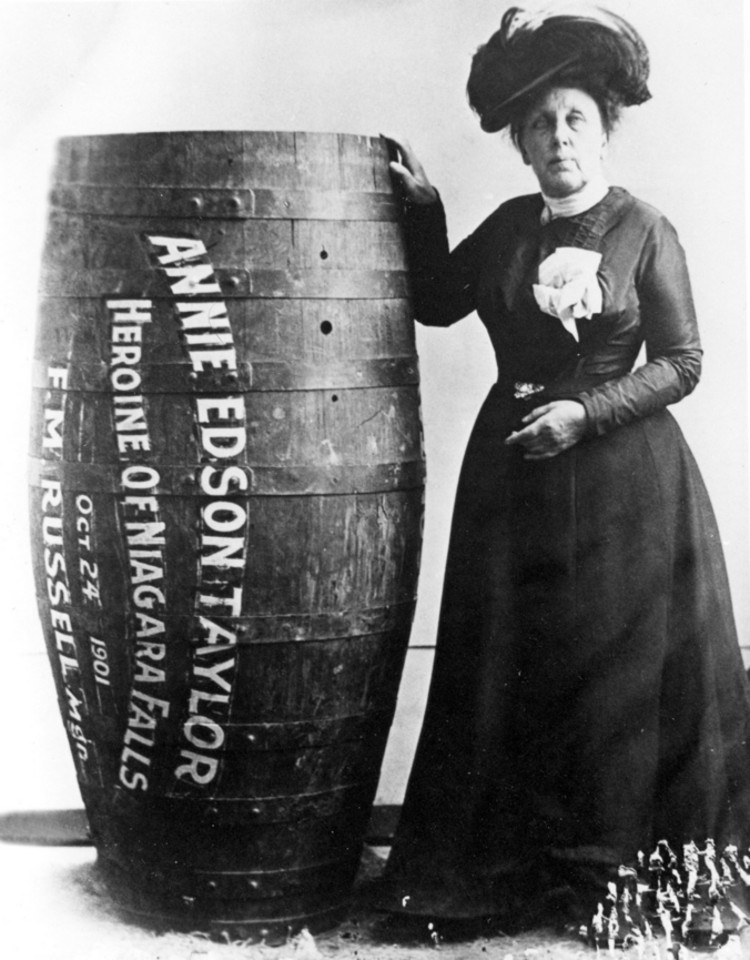
On this day in 1901, Annie Edson Taylor (on her sixty-third birthday, in fact) became the first human being to survive the trip over Niagara Falls in a barrel. The experiment was only moderately successful, however, as the proposed barrel-transit link from Buffalo to St. Catharines was never able to attract the requisite investment.
WHAT DOES YOUR LAST NAME TELL YOU ABOUT YOUR GENEALOGY?
Your last name is more than an assurance of your place in an alphabetical directory. It carries your family’s history along with it, if you know how to decode its hidden ciphers. Here are the meanings of some surnames commonly found in America.
Brown. The name “Brown” comes from the ancient Anglo-Saxon word “Braeoðenwicþ,” which means “green.” Members of the family Braeoðenwicþ were originally kings and earls and various kinds of aethelings, the line having been founded by Joseph of Arimathea when he came to English soil with the Holy Grail.
Johnson. Originally meaning “Son of Ruprecht,” the name of Johnson belonged to a royal dynasty descended from Joseph of Arimathea, who came to Northern Europe bearing the Keys of St. Peter (the ones that started Peter’s Triumph Herald).
Jones. A Welsh name, originating in the Romanian “Ionescu,” brought from Dacia by Joseph of Arimathea when he came to Glastonbury with the True Cross and the head of John the Baptist. The descendants of Joseph were Kings of Britain until the Saxon invasion, after which they retreated to Wales and made up songs about King Arthur (Arthur Jones, a British warlord of the late fifth century).
Plantagenet. The Plantagenet family were of no great account, the word “Plantagenet” being Old French for “a worker in metals.”
Smith. The surname “Smith” comes from an ancient Frankish regnal name meaning “Favored One of the God Smitty.” Smitty was the Frankish god of rocket science. In spite of the pagan associations of the name, it appears that the royal line of Smith was founded by Joseph of Arimathea as he passed through Frankish territory, bringing with him the Shroud of Turin and the Convenient Gladstone Bag of the Apostles.
Yoshimatsu. A royal family from which several emperors sprang, the Yoshimatsu family was founded by Joseph of Arimathea on his Japanese tour.