Posts by Dr. Boli
10 ÷ 3 = 0.
What kind of arithmetic is this? It is marketing math, a separate discipline from the mathematics you were supposed to have learned in grade school while you were reading comic books under your desk.

Ten calories per container. About three servings per container. Zero calories per serving. 10 ÷ 3 = 0.
How can this be? It can be because government labeling standards assign a very specific technical meaning to “zero.” In the field of food labeling, “zero” is defined as “not zero.”
This sort of mathematics is very useful. It would not have got us to the moon—we must admit that. If NASA had used calculations like these, the Apollo 11 astronauts would still be on their way to the moon today, confidently expecting to land any day now. But it is useful in fooling the consumer into thinking that something is what it is not, or vice versa, and that is the essence of marketing. Government labeling standards mandate the use of marketing math because the purpose of regulatory agencies is to protect manufacturers from consumers, who might otherwise demand food that is what it is and is not what it is not. We pay our taxes to relieve large manufacturing concerns of that embarrassment.
ON THIS DAY IN HISTORY.

ASK DR. BOLI.
Dear Dr. Boli: Could you explain to me where the jars fit in the Masonic conspiracy? —Sincerely, A Pope Who Prefers to Remain Anonymous.
Dear Sir: Dr. Boli is not a Mason. It is against his taste, if not his principles, to belong to any organization whose rituals are so embarrassingly ridiculous that they cannot be divulged to the general public. In this case, however, there is no secret. The Ancient and Accepted Order of Canners is an appendant body of Freemasonry whose members wear a tall squarish glass hat with a metal screw top and the word “Mason” prominently molded in the glass. That these hats can also be used for preserving food is incidental to their main purpose.
JOKES FOR KIDS!
Q. What did the cow cop say to the juvenile delinquents?
A. Mooooooooooooooooooooove along there, boys!
Q. How did the dog pirate sail the seven seas?
A. On a barque!
Q. How did the snake photographer judge his exposures?
A. With a hissssssssssssstogram!
Q. How did the alpaca calculate the square root of 137?
A. With a calculator, same as everybody else!
Q. How did Mrs. Owl do her daily cleaning?
A. With a Hoooooooooooooooooooover!
Q. How did the horse vote in borough council?
A. Neigh!
Q. What did the coral say to the sea anemone?
A. Not a whole lot!
MEMORANDUM.
TO: All Employees
FROM: The President
RE: Time of Transition
All of us here at the Schenectady Small Arms & Biscuit Co., Inc., have experienced change during our lives. Change is the only constant in life: that was said by a famous philosopher or singer-songwriter or some other sort of intellectual type. How true it is! Though I do not want to be misunderstood as suggesting that philosophers are anything but parasites. Nevertheless, change happens all the time. When I was young, I was small, but now the pants I wore when I was six no longer fit me. Change happened! The milk I put in the refrigerator last month is cottage cheese this month. Change happened! My wife used to be sixty-two years old and brunette, and now she’s twenty-eight years old and blonde. Change happened!
The point is that change happens all the time, and we should embrace change. If you fear change, then when change comes, you will be afraid. I think that goes without saying. In fact, I’m wondering why I said it.
The immediate intent of this memo, therefore, is to inform all employees that your management team will be wearing polo shirts instead of button-down shirts going forward. This transition may be difficult for some of us, and certainly for no one more than for me, since my wife has had to buy polo shirts, and she’s not very bright about sizes. But change happens, and change is necessary, and change is good, and we should not be afraid of it. To aid us in this time of transition, therefore, any employee caught mocking a member of the management team with a polo shirt that is too small for him will be subject to summary dismissal. This will reduce the fear of change in the minds of those whom it is most likely to affect.
With warmest regards,
J. Rutherford Pinckney,
President
Advertisement.

FROM THE ILLUSTRATED EDITION.
ON THIS DAY IN HISTORY.


A TEMPLE OF OBJECTS.
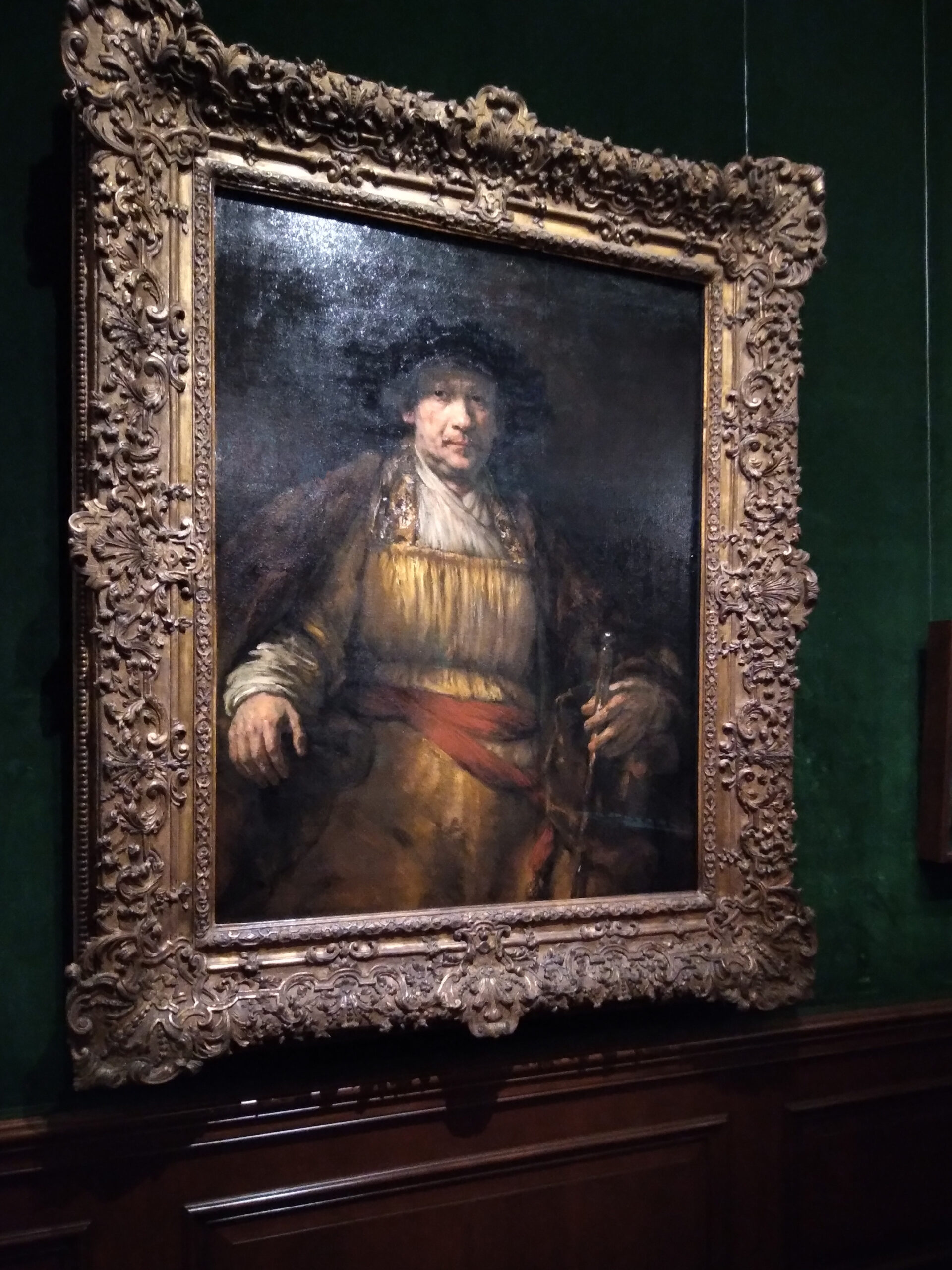
An object.
As you leave the exhibit, you come to this sign, in which the museum apologizes for making you suffer through all that art. We duplicate it here for the purpose of comment and criticism.
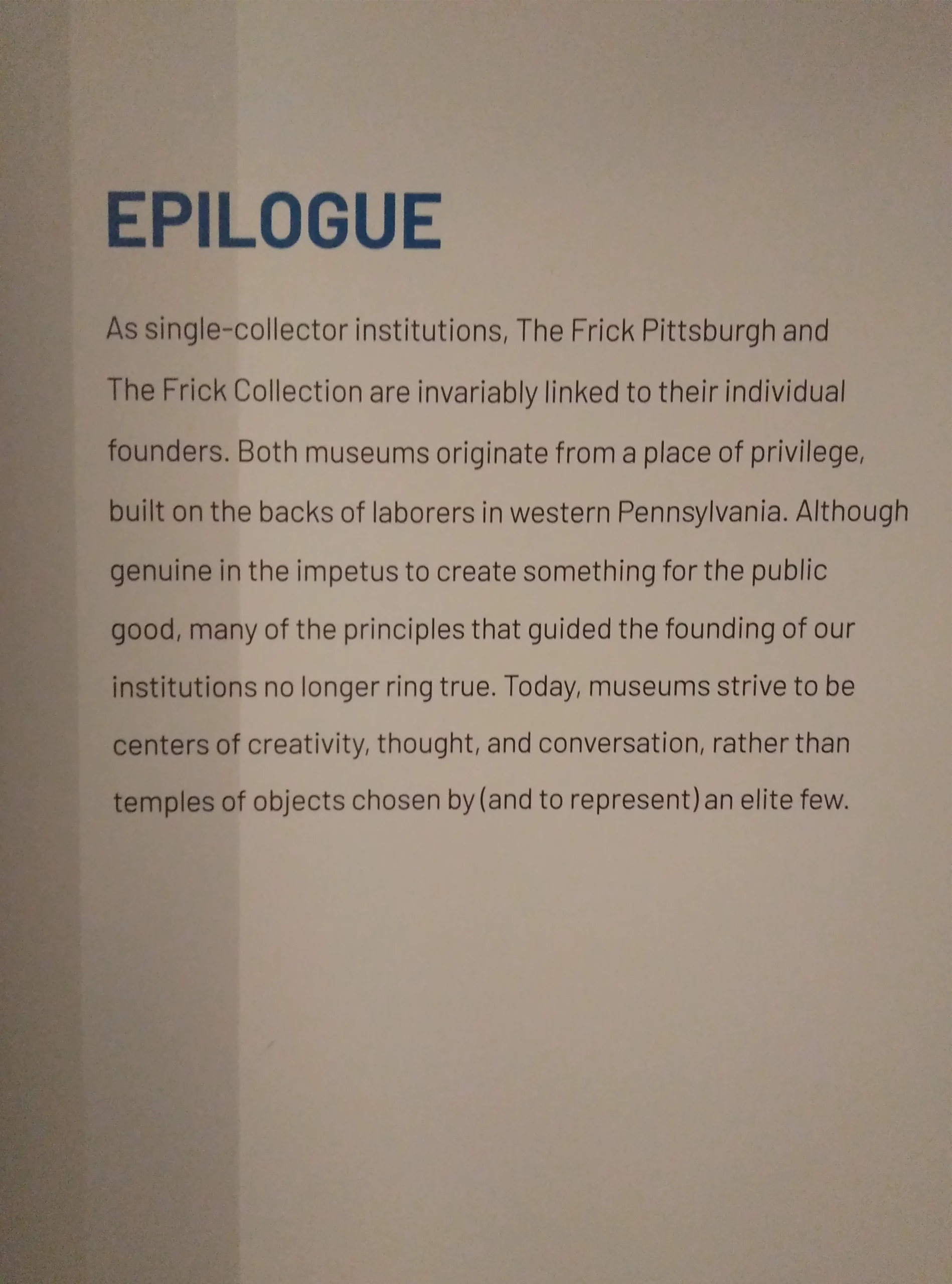
Epilogue. As single-collector institutions, The Frick Pittsburgh and The Frick Collection are invariably linked to their individual founders. Both museums originate from a place of privilege, built on the backs of laborers in western Pennsylvania. Although genuine in the impetus to create something for the public good, many of the principles that guided the founding of our institutions no longer ring true. Today, museums strive to be centers of creativity, thought, and conversation, rather than temples of objects chosen by (and to represent) an elite few.
Here are a few essay questions on our assigned reading.
1. If museums are not to be temples of objects, then where should the objects be?
2. If the objects in museums are not to be chosen by an elite few—for example, by the vanishingly small number of intellectuals who have studied the history of art—then by what sort of democratic referendum are they to be chosen?
3. What will happen to the objects once we succeed in transforming our museums into centers of creativity, thought, and conversation? Will the objects go back into the hands of private collectors who will exclude the general public from viewing them?
4. If a museum is to be a center of creativity, thought, and conversation, how is it different from a coffeehouse? Is it just that the coffee is worse?
Dr. Boli will be very straightforward here. In his opinion, this is simple old-fashioned Yankee anti-intellectualism dressed up as fashionably enlightened righteousness. It is as silly to say that the “elite few” should not choose art as it is to say that a trained auto mechanic should not rebuild your transmission, or that a trained surgeon should not remove your appendix. What, you think I’m not good enough to perform an appendectomy? Just because I’m a cashier at the Circle K? I thought we were done with that kind of snobbery. It’s so nineteenth century.
It is also particularly antidemocratic anti-intellectualism, because of course the logical consequence of abandoning the idea of the museum as “a temple of objects” is that the δῆμος shall no longer have access to the objects. In the Frick Pittsburgh’s permanent collection you can see a colossal landscape by Boucher, and a portrait by Reynolds, and another by Gainsborough, and a whole room of early Italian Renaissance devotional art, and it’s free, because Helen Frick endowed the museum so that the public could always have free access to her art collection. The cleansing of the temple would mean that the art student who had taste but no money would no longer have that privilege.
What would our hypothetical impoverished art student see instead? Beside the “Epilogue” was a station with a table where visitors could think, exercise their creativity, and join the conversation by writing their thoughts on sticky notes and sticking them on the wall. This is what you should see in a museum, instead of stuffy old Rembrandt, who looks sad for some reason.
One of the questions you could choose to answer on sticky notes was “What would you like to see in a museum?” After thinking for a while, Dr. Boli picked up a pencil and wrote, “A temple of objects, chosen by an elite few.”

Portrait of a Man in a Red Hat, by Titian.
FROM THE ILLUSTRATED EDITION.
