Posts by Dr. Boli
IN BUSINESS NEWS.
THE ROCOCO-COLA Bottling Company has announced plans to confront its rivals in the shelf-space war with its new ten-and-a-half-ounce bottle, which will now be offered in all Rococo-Cola brands, including Rococo-Cola, Rococo-Cola No Caffeine, Rococo-Cola Real Sugar, Rococo-Cola Reduced Caffeine, Diet Rococo-Cola, No-Calorie Rococo-Cola, Rococo-Cola Zilch, Sugar-Free Rococo-Cola, Low-Sugar Rococo-Cola, Rococo-Cola Transparent, Rococo-Cola Cherry, Rococo-Cola Lime, Rococo-Cola Vanilla, and Rococo-Cola Tastes Like Chicken. The ten-and-a-half-ounce bottle joins the regular six-ounce, eight-ounce, twelve-ounce, sixteen-ounce, twenty-four-ounce, liter, two-liter, three-liter, and half-liter sizes, as well as the nine-ounce and eleven-and-a-half-ounce cans.
ANNOUNCEMENT.

NOTICE.
THE SCHEDULED PERFORMANCE by Mr. Herbert Herbertson, the noted ventriloquist, featuring Jeremy, the world’s only mute ventriloquist’s dummy, has been postponed again. Jeremy and Mr. Herbertson have had a small misunderstanding, and are refusing the speak to each other. The management of Heptagon Gardens suggests that patrons may wish to take in a movie or something instead.
ON THIS DAY IN HISTORY.
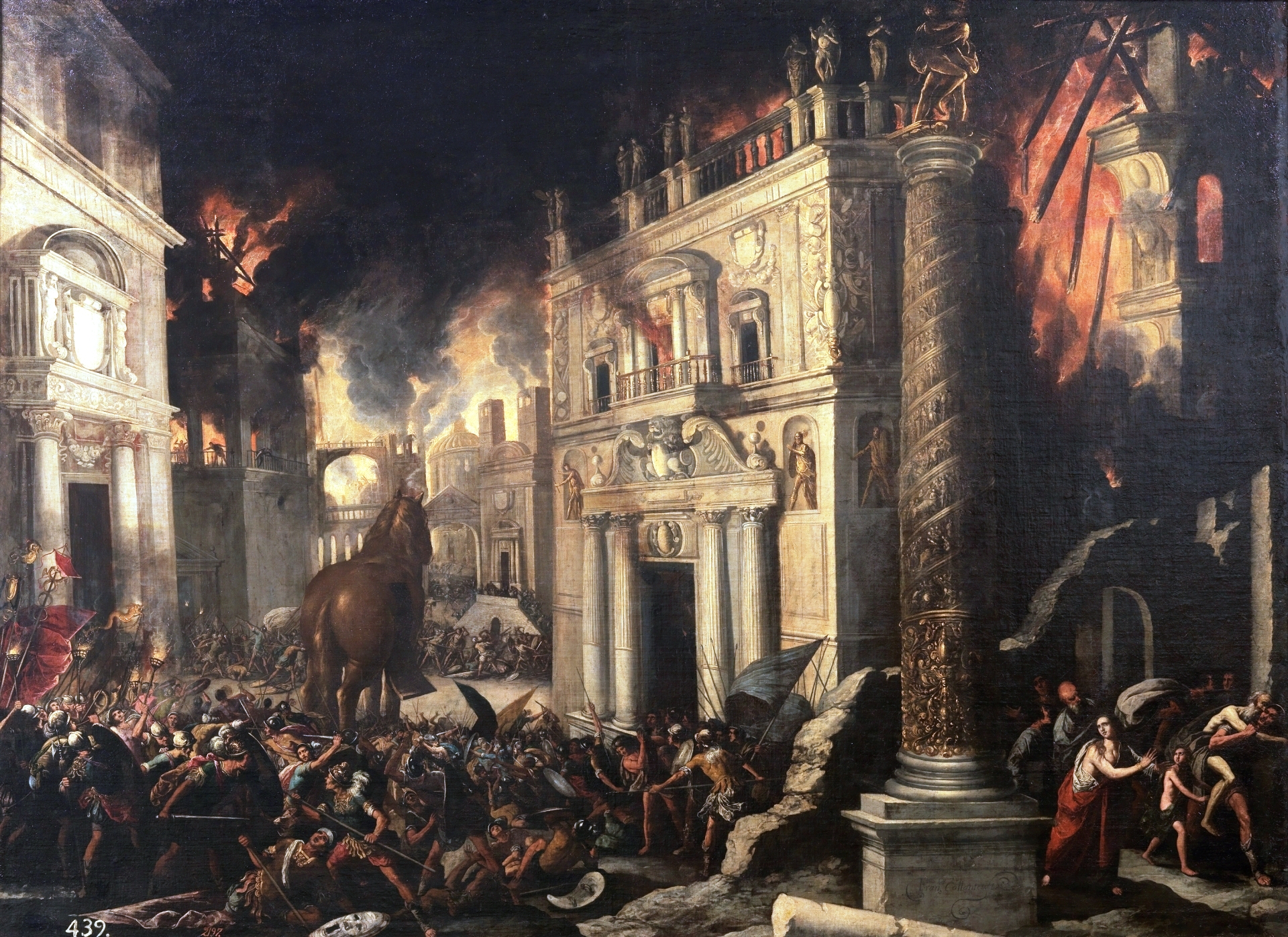
ON THIS DAY in 1184 B.C. (according to Eratosthenes, who put some effort into working out the date), the city of Troy fell after a ten-year siege. Thus the tawdry little affair between Helen and Paris came to a spectacular end. In those days, there were no supermarket tabloids to shame adulterers in public, so an offended husband could not simply call his publicist, and had to resort to war as his only recourse.
Advertisement.

OUR VALUED CORRESPONDENTS.
THIS MAGAZINE USES very sophisticated technology, powered by coal gas, to sort through the myriad comments left on every article. Over at our sister site I Wish I’d Said That, however, the technology is much more primitive, and the comments left are correspondingly much more diverse.
Many of them are quite complimentary, though some of them reveal a little more of the authors’ private lives than one would willingly know:
I very much to like and agree with your point of view. Thank you for sharing. At the same time, I love best pram very much .Welcome to look at my website and blog articles.
What our correspondent and his best pram get up to in the privacy of their own home is none of our business, but we should like him to respect our indifference as much as we respect his privacy.
The theme clear, the central idea anacreontic, let me read, very have feeling, that kind of feeling in words cannot express, hope after the author make persistent efforts, write this article came out
Dr. Boli would like his correspondent to know that he will make the most persistent efforts possible to see that his ideas remain as anacreontic as our national anthem.
The article lively and interesting, let a person have the feeling of experience, I hope I can see the author, explore together under this article, really let me very touching
This correspondent has already received a copy of his restraining order.
Here is a correspondence that combines an enthusiasm for Greek mythology with a touch of the nautical:
Hera are an adept internet site, we can buoy apportion whatever aspect, and acquire a lot a different affairs, cheers such inauspicious comprise bought at Hera.
And finally, a worrisome bit of local news:
Despite that warning, North Vietnam has increased its military aggression in all these areas, and particularly in louis vuitton online store.
In Dr. Boli’s opinion, North Vietnam deserves everything that’s coming to it.
Advertisement.
CURE WARTS, ACNE, athelete’s foot, hangnails, and other similar ailments with a complete course of Freudian psychotherapy. Many common diseases are symptoms of feelings you never even knew you had about your mother. Dr. Emil Wolfspitz has successfully treated more than twelve patients with a remarkable 62% success rate. Write for an appointment in care of this publication, and be sure to enclose photographs of your mother.
Advertisement.

DR. BOLI’S COMPLETE HISTORY OF THE WORLD.
CHAPTER 8.—ALEXANDER RUNS OUT OF WORLDS TO CONQUER.
MACEDON WAS A rural backwater in Greece, the sort of place about which Athenians told jokes involving moonshine and prohibited degrees of consanguinity. If you had told the more civilized Greeks that the next great world empire would begin in Macedon, they would have looked at you with the same puzzled and contemptuous stares you would get from a New Yorker today if you said, “Mark my words, the next big player on the global stage will be Parkersburg, West Virginia.”
One big advantage the Macedonians had, however, was a lack of principles. The Spartans were obsessed with their national honor; the Athenians were devoted to liberty, as long as it was their own liberty and not somebody else’s. But the Macedonians, free of juvenile and unwholesome ideas like “honor” and “liberty,” were entirely unencumbered in their pursuit of their own advantage. They were especially unencumbered when the throne was taken by Philip, a man whose simple pragmatism is still an inspiration to every ruthless tyrant who thinks that principles only get in the way. The more civilized Greeks thought of Philip as a bull in a china shop; but, simply by not caring how much of the china he broke, Philip soon made himself master of all Greece. He had just announced his intention of going after Persia as well when he was felled by an assassin.
Philip’s heir was a young man—hardly more than a boy—by the name of Alexander. And in order to account for the remarkable career of this young hick from the hill country, we must have a look at his education.
The environment in which Alexander grew up was a unique mixture of the sophisticated and the hayseed. He was surrounded by the court life of his father Philip, whose ideas of honor and morality were still decidedly Homeric, which is to say that they leaned heavily on evisceration as the solution to any particularly intractable problem. On the other hand, Philip was also eager to be accepted by the pretentious intellectuals in the big cities, for which reason he hired the famous philosopher Aristotle as his son’s tutor.
We can easily imagine how Alexander’s lessons went, with the wise old philosopher demanding that his pupil distinguish the kinds of causes, and Alexander replying, “Well, the material cause is the iron of my blade; the formal cause is the sharpness, and, if I may so call it, the bladishness of it; the efficient cause is my ripping his abdomen open with it; and the final cause is so that others may learn never to cheat when they play marbles with me.” We can imagine Aristotle gently suggesting that it might be clearer if we confined our examples to statues and cups and such things, and we can imagine Alexander losing interest in the lesson shortly after that.
This was the young man who, at the age of twenty, found himself master of all Greece, at least after he had finished pummeling Greece back into submission again. He had the greatest scientific mind the world had yet produced as his tutor; but it is worth noting that the book he carried with him everywhere he went was the Iliad, the classic Greek manual of practical evisceration. Abstract science, after all, will get you only so far in conquering the world.
Alexander was set on carrying out his father’s ambition of putting Persia in its place; so, once he had secured the allegiance of the grateful Greek cities, which were grateful that he had wiped only one of them off the map, he plunged into Asia Minor, where he began a long string of victories over Persian armies. After each disaster, the Persian king Darius would make good his escape. Alexander chased Darius all over the Persian Empire, merrily crushing armies and leveling cities along the way, until at last Darius’ luck ran out. Mortally wounded, he allowed Alexander to catch up with him at last. Then, as he lay dying, he breathed out his last words to the victorious conqueror: “You have slaughtered our armies; you have burnt and pillaged cities across the length and breadth of the empire; you have put our men to the sword and sold our women and children as slaves; and finally you have pursued me unto my death. Clearly no one has been more loyal to the cause of Persia than you have been, and it is my desire that you should succeed me as King of Kings.”
At least that was how Alexander told the story, and who was going to contradict him?
So Alexander took his place as the duly designated head of the Persian Empire, a vast territory that included Egypt in the south, Asia Minor in the west, and the borders of India in the east. Vast though his new empire may have been, however, his ambition was vaster. Under the usual pretext of some trifling border incidents, Alexander led his armies into India itself; and there, when he had reduced a large chunk of the subcontinent to his dominion, he sat down and wept because there were no more worlds to conquer. One wonders how he might have reacted if someone had told him about China, Siberia, Mongolia, Scandinavia, Indonesia, Australia, sub-Saharan Africa, North and South America, and Tristan da Cunha. But no one did tell him; so he ambled back to Babylon in a blue funk, and there he died of ennui.
Alexander’s generals agreed that one of them should succeed him, but on the question of which one of them it ought to be they could come to no agreement whatsoever. Eventually, after a long run of civil wars so monotonous that no historian ever bothers to chronicle them in detail, the territory was divided into three smaller empires, each one of which was still unimaginably vast by Greek standards, but none of which was vast enough for the grasping cupidity of its emperor.
What, then, did Alexander accomplish if he did not build a lasting empire?
Well, for one thing, he founded flourishing cities wherever cities appeared to be needed. Owing to some curious mental deficiency, Alexander could think of only one name for a city, so the map was peppered with Alexandrias from Thrace to India. It infuriated the Postmaster General and gave the travel agents fits, but the name had a certain ring to it. The most successful of the lot was Alexandria in Egypt, which still bears that name today, and which in turn has given its name to other Alexandrias all over the globe; so that, in a sense, Alexander’s empire really has reached as far as Virginia, Louisiana, and New South Wales.
This proliferation of Alexandrias was only part of a larger tendency to Hellenize the world. Wherever he went, Alexander propagated the noble idea he had learned from his great tutor: viz., that Greeks are better than other people. But Alexander brought his own little twist to the idea. Unlike Aristotle, he believed that anybody, deep down inside, was potentially a Greek. There was no difference in nature between Greeks and barbarians. All the barbarians had to do was dress more tastefully, learn to speak Greek, and stop acting so foreign, and then they could have all the benefits of Greek civilization.
The Hellenization program really took off, because one of the immediately obvious benefits of Greek civilization was getting rich. With a common language from Marseilles to India, merchants could trade across vast distances and bring expensive luxuries to newly opened markets. Most luxuries, after all, were luxuries only because they came from somewhere far away. Greeks would pay enormous sums for the pepper that clambered all over the ground in India, and the Indians were equally enchanted with the cheap wine that the Greeks themselves usually bought in cardboard boxes. For anyone who had the ambition to transport worthless rubbish to some port so far away that the rubbish became a precious treasure, there were vast fortunes to be made.
Thus Greek culture was spread over an enormous area that stretched from the Mediterranean to the Indian Ocean. Of course, to spread so far, it had to be spread pretty thin. Instead of stirring epics and immortal tragedies, the literary lights of the new “Hellenistic” age tended to produce dime novels.
Nevertheless, there was a certain cultural uniformity across the known world (“known” meaning “known to the Greeks,” of course). And that would prove to be very convenient for the next stage of history, because it meant that, when the time came, the known world would be ripe for conquering in big chunks, rather than in unprofitable little pieces.
THE ADVENTURES OF SIR MONTAGUE BLASTOFF, INTERPLANETARY SPACE DRAGOON.
ANNOUNCER. And now Malt-O-Cod, the only malt food drink flavored with real cod-liver oil, proudly presents…
(Music: Fanfare)
ANNOUNCER. The Adventures of Sir Montague Blastoff, Interplanetary Space Dragoon!
(Music: Theme, in and under for…)
ANNOUNCER. Tonight we find Sir Montague busy with Form 267-G, Paperwork Reduction Documentation Checklist, when Colonel Wilhelmina Darling suddenly bursts through the door.
COL. DARLING. Monty! Oh, Monty! You’ll never guess what’s happened!
SIR MONTAGUE. Well, you certainly do look happy about it, whatever it is. I’d say it would have to be some ripping good news.
COL. DARLING. I’ll say it is! I just heard I’m being promoted to brigadier!
SIR MONTAGUE. Brigadier? Are you positively sure?
COL. DARLING. I just heard it from the station master! He just had a message from general headquarters on the communicatron that I was to report to HQ right away!
SIR MONTAGUE. Oh, dear me!
COL. DARLING. Why, Monty, aren’t you happy for me?
SIR MONTAGUE. But you know what this means, don’t you, Colonel?
COL. DARLING. I assume it means more responsibility and a higher pay grade. Why? Is it supposed to mean something else?
SIR MONTAGUE. Why, my dear, it means you’re being… Well, there’s no way to sugar-coat this, is there? It means you’re being written out of the series.
COL. DARLING. Written out? But—but no!
SIR MONTAGUE. Now, my dear, you knew something like this would come eventually.
COL. DARLING. But I thought I had a long time left! I mean—how could it happen to me? I’m only nineteen and ravishingly beautiful!
SIR MONTAGUE. True, you are, as you have been for the past thirty-four seasons. But youth is not always exempt from the inevitable debt of nature.
COL. DARLING. But—but what happens to people when they get…written out?
SIR MONTAGUE. Well, nobody knows, my dear. Some believe they go to a happy place where there are no more bad scripts to memorize and no more sponsors to kowtow to. Some Eastern religions believe they are reincarnated as characters on other radio dramas. And, of course, there are those who think that, after that, there’s, well…nothing.
COL. DARLING. I feel cold.
SIR MONTAGUE. Be brave, Wilhelmina. I shall always remember you and your fine bureaucratic mind fondly. And of course you will live on in reruns. I say, that’s something, isn’t it?
LOUDSPEAKER VOICE. Paging Colonel Wilhelmina Darling! Paging Colonel Wilhelmina Darling!
SIR MONTAGUE. It’s time, my dear.
COL. DARLING. But…but I don’t want to…
LOUDSPEAKER VOICE. Paging Colonel Wilhelmina Darling! Paging Colonel Wilhelmina Darling!
SIR MONTAGUE. You know what you must do.
COL. DARLING (sighing). Darling here.
LOUDSPEAKER VOICE. Oh, there you are. Listen, I’m awfully sorry about this, but you know how hard it is to understand people on the communicatron sometimes, and, well… I just got the papers from the facsimilator, and it turns out—I’m really sorry—that promotion wasn’t for you after all.
COL. DARLING. Not for me?
LOUDSPEAKER VOICE. No, it was for Colonel Gwendolina Barley. I just heard it wrong. I’m really sorry. I know you deserve that promotion more than some random character who doesn’t even have a speaking part.
COL. DARLING. Oh, that’s all right. Really it is.
LOUDSPEAKER VOICE. Well, you’re a very brave girl, and I’m sure you’ll get the promotion you deserve someday. Station master out.
COL. DARLING. Oh, Monty! That means I’m not being written out after all! I’m still your sidekick and occasional love interest!
SIR MONTAGUE. And that’s jolly reassuring. I wasn’t looking forward to breaking in another. Now, help us with this paperwork-reduction paperwork, will you, my dear?
(Music: Theme, in and under for…)
ANNOUNCER. Don’t miss next week’s exciting episode: Sir Montague Blastoff Fills Out a Purchase Order! Till then, remember that a day without Malt-O-Cod increases your chance of dying in an alpine avalanche by more than 18%. Don’t take chances with your growing body. Drink Malt-O-Cod every day. Malt-O-Cod is the only malt food drink with the rich, satisfying flavor of real cod-liver oil, now with the exclusive Sir Montague Blastoff rubber stamp in every package. It’s the malt food drink that’s brain food—Malt-O-Cod!
(Music: In full, then out.)