Posts by Dr. Boli
WEATHER MAP.

Current conditions: Breezy.
A REMARKABLE EXAMPLE OF CRANK LINGUISTICS.
Henry Matthews believed he had cracked the linguistic nut. In a little prospectus published in 1821, or possibly 1815, or perhaps some other year (but from the type clearly early nineteenth century), he proposed to create a dictionary that would make it possible for everyone to communicate with everyone else. The title of the prospectus displays his ambition and his optimism clearly enough: “A Plan for Translating Languages, Without Study, or Any Previous Acquaintance Therewith.”
We must give Mr. Matthews credit for articulating the difficulty that keeps an artificial “universal” language from ever succeeding.
An opinion has been entertained by some learned men, in different ages, that the knowledge of overcoming the difficulties of languages would be one day accomplished; and others have thought it possible to contrive, or create, a general or universal language. Several ingenious plans have been suggested for the support of foreign correspondence, by means of a general or universal character; but, in all these, there is much to be acquired and remembered, as well as a thorough acquaintance with the principles of grammar. Except a plan can be devised to be comprehensible by the person who can merely read, as well as the scholar, the sale of such a work would not be sufficiently extensive to justify the expence.
Here he seems to hit the nail on the head. The average intelligent reader will never summon sufficient motivation to learn a constructed language. A few fanatics will do it; but the most successful of all these supposed universal languages is Esperanto, and you may measure its success by going to any large city in the world and attempting, without making prior arrangements with the local Esperanto boosters, to accomplish anything at all in that language.
What, then, is to be done?
A system fully suitable has been conceived, which, by a simple arrangement, will obviate every difficulty.
The dictionary now proposed will enable persons to correspond with foreigners, of whose language they have no knowledge; and to translate freely, every species of their literature.…
By this dictionary, it will be only pastime for children to translate English works into the languages of India and China, and their works into our own. In fact, it will unlock the knowledge of the world, and communicate it to all, the most uninformed as well as the profoundly learned.
You want a copy of this dictionary already! How can you obtain it? Well, it has not been compiled quite yet. This is, after all, a prospectus, designed to raise enough interest to persuade a publisher that it will be worth paying Mr. Matthews to compile the work. But he lays out the system clearly enough. His plan is to create a dictionary of meanings rather than words (anticipating by some decades the work of Peter Mark Roget). The meanings of words must be carefully distinguished, and each listed separately if a word has more than one meaning.
For instance, in the common dictionary the words and significations would sometimes stand thus:
Tiller, s. a ploughman; handle of a rudder.
But, in this dictionary, it must be repeated thus:
- Tiller, s. a ploughman.
- Tiller, s. a handle of a rudder.
Having made that arrangement of all the meanings in English, he will assign a number to each meaning. This number is the key to everything. Now we may compile a French dictionary, or a Nahuatl dictionary, or an Igbo dictionary, with the same meanings assigned to the same numbers.
Our author recognizes one difficulty that comes up right away: since the English language is the key, only in English will the numerical order and the alphabetical order of words be anything like the same. “The English interpreting dictionary will be both alphabetical and numerical, in one and the same book. This advantage can only fall to the language that first adopts the plan.” In every other language, the dictionary (like Roget’s Thesaurus) must have two sections: one in numerical order, and one in alphabetical order.
Now see how wonderfully this eliminates the work of translation. If you are writing to someone in China who has the Chinese equivalent of this dictionary, then you have only to write your letter as usual, and then find the number for the meaning of each word and write those numbers down. Your Chinese correspondent receives your numerical letter, looks up the numbers in his own dictionary, and transcribes the matching words, and your letter sits before him in pure Chinese! If, however, you suspect that your Chinese correspondents are not supplied with dictionaries on the Matthews system, then you can obtain a Matthews-system Chinese dictionary yourself, and you can write your letters in Chinese just as if you had been born in Peiping.
At this point you may be thinking to yourself that Mr. Matthews is a little bit naive about the extent of the differences between languages. You are correct. He seems to know a little French, though perhaps not much: he gives a translation of the first Psalm from the French version as an example of how well his system works. Even here it is necessary to make some allowances for the differences in grammar between the languages, but he thinks that anyone of ordinary intelligence can make those allowances. “The very few superfluous words, such as the double negative in the French, &c. can, at first sight, be discovered by a common capacity, and struck out, or supplied, as may be required.”
It seems to us, however, that the system utterly wrecks against the rock of Latin, or German, or (heaven forfend) Russian, or any other declined language, where the form of the word itself conveys much of the meaning. Let us apply the system to Virgil, for example:
Arma virumque—
But here we have already run up against a nearly insuperable difficulty. That little parasitic particle -que, meaning “and,” attaches itself to the end of the second word of a pair, forming a single written word, but with two meanings. We do not need to be experts in Latin, but it will be necessary to have at least so much “previous acquaintance therewith” as will allow us to recognize that “virumque” resolves into the two completely unrelated meanings “man” and “and,” and that it will be necessary to place “and” before “man” to translate the word into English. We might overcome the difficulty by listing the combined form of every Latin word that can possibly take que on the end, effectively doubling the size of our Latin dictionary. But wait: we must then effectively double the size of every dictionary in every language, because each of those Latin meanings must be assigned a number.
And we have not begun to address the problem of inflection, which we can practically ignore in English and French, but which entirely determines who does what to whom in Latin. Let us suppose that we have managed to discover, somehow, that the enclitic -que has a separate meaning, and that we have managed to deduce the dictionary entries from the inflected forms of the words, and go on to translate the first few lines of the Aeneid on the Matthews system, remembering that inflection is not accounted for:
Arm man and sing Troy which first from coast
Italy fate fugitive Lavinia and come
shore much that and land thrown and high
force above fierce memory Juno because anger
many also war step while found city
carry god Latium tribe whence Latin
Alban and father and altar wall Rome.
It would take all the imagination of Barry Fell to make a “smooth translation” from this jumble, and then it would bear little resemblance to what Virgil actually meant.
Now, this is an Indo-European language. In the great scheme of world languages, Latin and English are practically dialects of the same tongue. We cannot imagine that a translation from Cherokee would go as smoothly.
So it seems that Mr. Matthews never produced even his English dictionary, let alone the matching dictionaries for other languages that would break down the walls of incomprehension and open up any language to any intelligent reader “without study, or any previous acquaintance therewith.” But for a moment let us admire the ingenuity and optimism of a man who was ready to undo the eleventh chapter of Genesis. He was wrong, but he was gloriously wrong.
Advertisement.

ON THIS DAY IN HISTORY.

Both men immediately fell into miserable obscurity.
IN THE NEWS.

ASK DR. BOLI.
Dear Dr. Boli: I bought a bottle of conditioner the other day, and on the label it says that one of the main ingredients is coconut oil, which it describes as a “traditional West African ingredient.” And below that in big letters it says “
Dear Madam: It means, “Capitalist god descends from the heavens and grants his faithful worshipers just so much local autonomy as is profitable for his large industrial conglomerate.” The word for this used to be “colonialism,” but American marketers have made the useful discovery that the synonymous term “empowerment” sells more hair-care products. If local communities were actually empowered, of course, they would not require the intervention of an American corporation to “empower” them. They would be dictating terms to the Americans. Fortunately we have put a great deal of effort into making sure that local communities are not actually empowered.
EVERY SINGLE DAY IN 2021.
We began in January with some inspirational yard signs, in tautological and surrealist models.
In February we solved the Dot-Matrix Mystery. It turns out that dot-matrix printers do not print 1500 pages a minute, but it was fun to imagine for a while. We also spent some time thinking about the things you can do with a typewriter that are much harder to do with a computer.
In March we asked “What will happen to cursive?”—and gave the answer, of course, in cursive. March was also the month when we were the first publication to report that the family of Marcel Marceau had apologized for decades-old whiteface photos of the famous mime. As far as we know, we were also the last publication to report that story.
In April we helped the world overcome its chronic misunderstanding of nineteenth-century photography. No need to thank us.
May gave us one of the Landmarks of Spirit Photography. Whoever denies the reality of the world beyond is simply immune to evidence.
In June we considered the problem of interpreting historiated initials, and we liked doing it so well that we considered it again a few days later.
In July we were attacked by nefarious agents of a foreign power, and yet Dr. Boli did not excuse himself from preparing articles for the days his Magazine spent off line. Instead, as readers were doubtless delighted to discover, when the site was working again, there was a new article for every day the site had been inaccessible. Dr. Boli values his readers even when they are not there. July was also the month we introduced Binary Sudoku to the world, because it has always been Dr. Boli’s ambition to leave the world more puzzled than it was before he came into it.
August brought us a new Malt-O-Cod hero, Silent Jim, whose adventures are perfectly suited to the medium of radio drama.
In September, we heard the story of “The Godproof Room,” in which T. A. Wright outwits God and profits from the accomplishment.
In October, the Yohogania Electric Light Company brought us a world-premiere dramatic radio event: the first episode of The Postapocalypticon.
In November we learned to navigate the menu system at the Call Center Frustration Hotline.
In December we talked quite a bit about the Voynich Manuscript, first in response to a comment on yet another article we had published earlier on that wonderful book, and then again after a kind commenter announced that he had found the key to the cipher. Dr. Boli remains to be convinced, but he is ready to host a grand Decipherment Ball as soon as a successful translation is confirmed.
Now, what do you think Dr. Boli has in store for his readers in 2022? It might be something very exciting. It might push the boundaries of literary probability. It might knock your socks off, so that you will have to wear sandals. But if you were thinking, “Oh, more of the same, I’m guessing,” you are probably not wide of the mark.
Advertisement.

Advertisement.

THE VARIOUS HISTORY OF AELIAN.
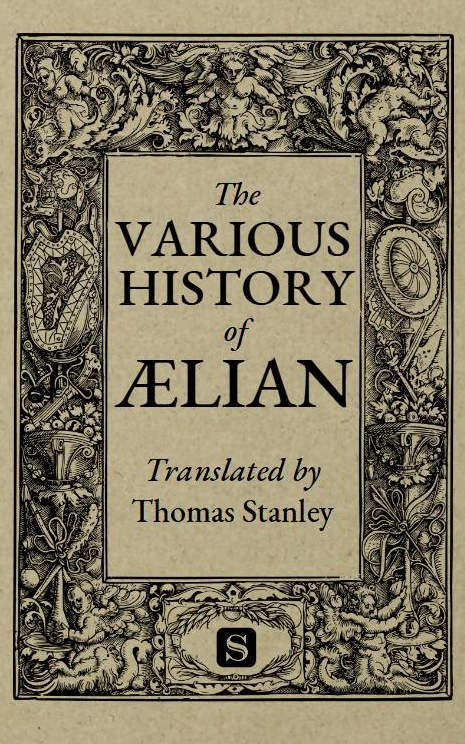
Once again Serif Press brings us a new edition of a delightful old book, and once again an introduction, which we reproduce here, is provided by H. Albertus Boli.
It seems that there were two well-known classical authors by the name of Ælian, and literary historians are generally agreed that this one was not that one but the other one. Our Ælian, Claudius Ælianus, lived about the year 200. He was a Roman, but a Hellenophile; he wrote in Greek, and was praised in his time for his pure Attic style. His love of Greek history and Greek thought comes through in every story. He was a miscellanist: his other famous work, On the Nature of Animals, is a collection of odd facts and observations (collected from books, not by observing the animals), again flung together without much system.
Modern readers find themselves more in sympathy with Ælian than with many other classical writers. He is human in a way that some of the best writers of his time are not. He has prejudices we can sympathize with. He thinks infanticide ought to be illegal, though Thebes is the only place he can think of that has such a law. He thinks forgiveness is a splendid virtue. He prefers mercy to justice, but is especially pleased when a wise ruler finds a way to have both of them at once. He thinks animals can be remarkably clever. He likes a story of remarkable wonders, but he is quick to point out that it probably isn’t true. Ælian, in short, is just the sort of guest you would like to have at a party of intellectual friends today.
As for his stories, some of them may preserve facts of history otherwise unknown to us. Many of them are probably not true, in the limited and uninteresting sense of not corresponding to the actual events that happened in the real world. They are true, however, in the much more important sense that they bring to life what the Greeks and Romans believed about themselves. They may not tell us what happened in ancient times, but they make the ancient world present to us in the same way it was present to people in the Roman Empire of the year 200 or so.
And now a word about our translator. Thomas Stanley’s translation is doubtless imperfect, as any translation must be; he leaves out some of the parts that were more embarrassing to a gentleman of 1665 (we have supplied those parts in footnotes from the earlier Fleming translation); occasionally he may misunderstand his author, though very seldom, and probably no more than most of the best translators. With its few flaws, however, this is a very good translation, and a good model of what translations of classical literature ought to be. This was in fact the last English translation of Ælian’s Various History published for more than 300 years; not until the 1990s was the book translated again.
It is worth noting, therefore, that the author of the standard English translation of the Various History was no more than fourteen years old when he wrote it. The younger Thomas Stanley was born in 1650; his Ælian was printed in 1665. According to the dedication, his father, the elder and much more famous Thomas Stanley, had set him the task. Now you see why the commendatory verses make so much of the author’s youth:
If from a Glorious Morn we justly may
Take a Prognostick of th’ ensuing Day;
What do these early glories promise, when
You shall arrive at your Meridian?
To which we may only say, Prognostick schmognostick. This translation is the only thing for which the younger Stanley is known. History is even ignorant of when he died; since we have no other works by him, he may have died young. As a memorial to him, we have reproduced two of the three commendatory verses in this edition. One of them is by Edward Sherburne, a distinguished poet of the second rank who was capable of a memorable turn of phrase:
Not to know what was done ere we were born,
Is to live Children still…
The third poem is written in Greek and printed with every arcane ligature in the compositor’s arsenal; we have omitted that one.
The Stanley translation has the virtue of making Ælian live in English, more so than the earlier Fleming translation. It keeps up a conversational style that is perfectly appropriate to the author. We have kept the original 1665 spelling and capitalization; the only thing we have changed is the use of italics, which (as was common for the time) are used in the original edition for all proper names, a convention modern readers might find distracting. Stanley adds a few judicious notes, which we reproduce here. We have added very few of our own. There may be references a modern reader will not recognize; but most of the stories stand as they are, and to weigh down the pages with footnotes would have produced an effect completely opposite to the cheerful entertainment of the original.
You probably have an Amazon gift card burning a hole in your pocket right now. Everyone has: it is nothing to be ashamed of. Whittle down that outstanding balance with Aelian’s Various History. Or consider one of the other Serif Classics, handsome editions of old books worth rediscovering. Or, if your tastes run to the modern in literature, you may wish to stock up on the works of H. Albertus Boli.